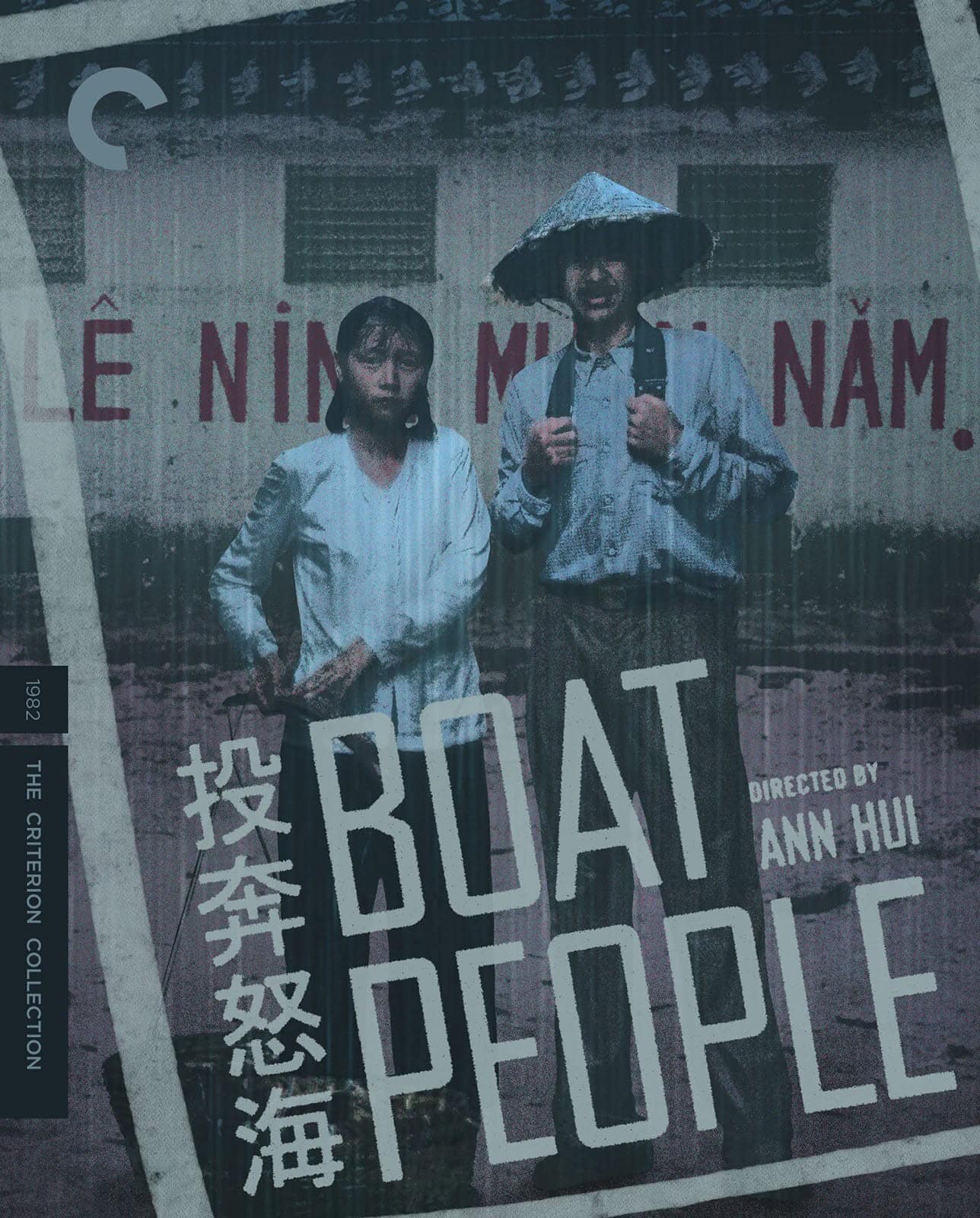
 Ann Hui’s Boat People was a controversial watershed for the Hong Kong New Wave. Shot in mainland China not long after the Sino-Vietnamese War, the 1982 film was accused of being everything from pro-China to anti-communist. The French even removed it from competition at Cannes as a gesture of goodwill toward Vietnam, with whom the former colonial power was working to build diplomatic relations.
To be sure, the film’s account of the reunification of Vietnam is grisly, and it’s hard not to see in it a certain anxiety from a Hong Kong filmmaker about her homeland’s eventual handover to communist China. Yet while Hui didn’t set out to make an apolitical feature, Boat People constantly orients its horrors around a larger tapestry of history, refusing to condemn any one power structure as the cause of this suffering when Vietnam has endured so much over the preceding century.
The film’s protagonist isn’t a native Vietnamese person but a Japanese photojournalist, Akutagawa Shiomi (George Lam), who documented the war and has returned to Vietnam to cover the nation’s developments after the full integration of north and south under communist rule. Shiomi has a naturalist’s eye, and one ostensibly in sync with the tenets of socialist realism. Yet from the moment Shiomi is taken to a New Economic Zone that houses displaced South Vietnamese, it’s obvious that he’s being not so subtly directed as to what he can and cannot shoot by his guides, and that behind every photo op of clean, freshly painted official buildings and rows of beaming war orphans lies a country still in throng to a century of endless conflict and near-starvation levels of deprivation that breed desperation.
Situating Boat People in Shiomi’s perspective, Hui establishes a calm tonality with static compositions and the occasional gentle movement that makes the ruptures of violence that much more rattling. The sudden, explosive movement of children hungrily diving for food or cops viciously beating people in the street for the smallest crimes forces the photographer to re-evaluate his assumptions about the country. And as Shiomi becomes more disillusioned, he falls in with Vietnamese who see the foreigner as a possible means of escape.
Such people include Cam (Season Ma), a teenage girl who provides for herself and her family by looting corpses, and To Minh (Andy Lau), a common criminal who goes in and out of re-education camps. Around these characters, the sheer, unmitigated hellishness of life only intensifies, exposing Shiomi to such terrible sights that the once-beaming outsider is reduced to a drained, scarred figure akin to the child protagonist of Elmen Klimov’s Come and See.
Boat People also uses peripheral details to contextualize its bluntly depicted horrors. Though the film never calls attention to it, there are far more women, children, and elderly visible than men between the ages of 18 and 60, a silent testament to the generational devastation wrought by decades of war. And while Shiomi later sees the true living conditions of the children who happily greet him at the start of his supervised visit, he does note that when he was last in Vietnam, most such children roamed the streets as abandoned orphans.
Above all, Hui is empathetic to how Vietnam’s fragmented identity has resulted in irreconcilable differences across society and within individuals. As one of Shiomi’s handlers, a Sorbonne-educated officer named Nguyen (Shi Mengqi), tells him early in Boat People, “My mind still lives in the colonial past. Vietnam has won her revolution, but I’ve lost mine.” Embedded within such sentiments is the suggestion that at least some of Vietnam’s lingering violence is an expression of confusion as much as retribution, that unification has only brought to light just how little anyone understands themselves, much less their countrymen.
Image/Sound
Criterion’s transfer, sourced from a 4K restoration, offers a detailed image with handsomely saturated colors, from the verdant shades of jungle foliage to the reds of plastered communist propaganda messages. Interior and nighttime scenes lose no detail in the darker lighting. The mono track crisply renders the bustle of street noise and the frenzy of crackdowns amid many quieter scenes in which the only consistent source of sound is dialogue.
Extras
Criterion’s release of Boat People is loaded with extras, none more essential than Ann Hui’s 1997 hour-long documentary self-portrait As Time Goes By, which mingles the director’s memories of her life and career amid ruminations on Hong Kong’s handover that same year. Keep Rolling, a feature-length documentary on Hui by her frequent production designer and art director, Man Lim-chung, is also included. A new conversation between Hui and filmmaker Stanley Kwan (Center Stage), who once served as her assistant director, touches on their work together and their thoughts on how the Hong Kong film industry has changed.
Of particular note is footage from a press conference that Hui and George Lam gave at Cannes in 1983 following Boat People’s removal from competition. The conference is cordial but finds both director and actor passionately defending their work from the opprobrium of those who mostly had not even laid eyes on it. Finally, a booklet contains essays by critic Justin Chang and scholar Vinh Nguyen that respectively examine the film’s formal and historical importance. Nguyen is especially adamant in defending Hui’s depictions of post-war horrors and championing Boat People for treating the Vietnamese with empathy and humanism after so many years of being a boogeyman in even the most anti-war of Western films.
Overall
Ann Hui’s harrowing and profoundly human Boat People receives a gorgeous and loaded home video release from the Criterion Collection.
Since 2001, we've brought you uncompromising, candid takes on the world of film, music, television, video games, theater, and more. Independently owned and operated publications like Slant have been hit hard in recent years, but we’re committed to keeping our content free and accessible—meaning no paywalls or fees.
If you like what we do, please consider subscribing to our Patreon or making a donation.