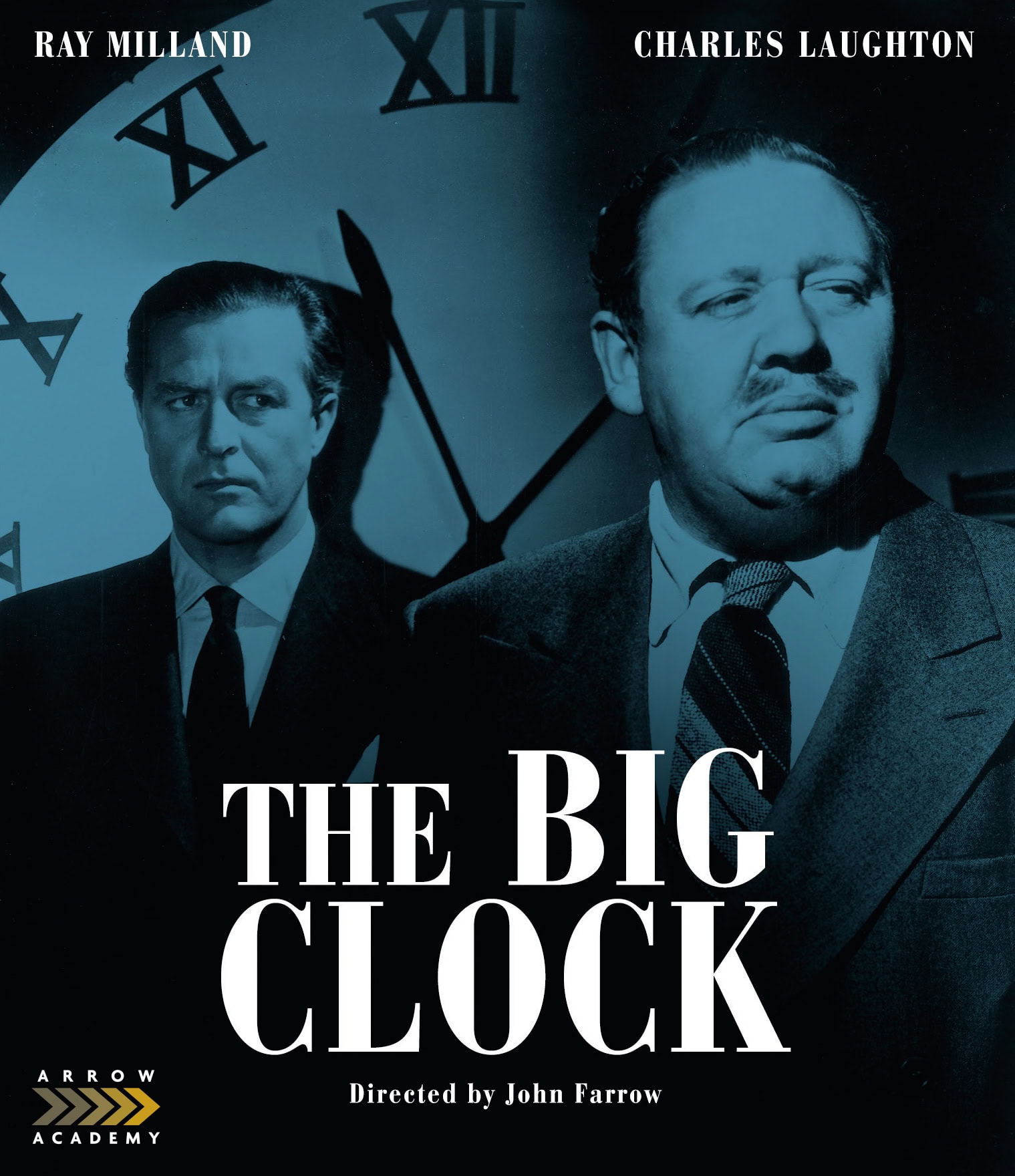
 John Farrow’s The Big Clock is a marvel of production design that also features rich, weirdly amusing performances from both Ray Milland and Charles Laughton, but it’s too slight in its contemplation of power dynamics to rank high in the pantheon of film noirs. Though the film opens grimly near the story’s end, with George (Milland) evading capture inside a publishing office where he works for a murder he didn’t commit, the actual series of events that leads up to that point is closer in tenor to Hawksian comedy, with Milland’s working man juggling the demands of family and work in almost screwball fashion.
As editor-in-chief of Crimeways, George answers to Janoth (Laughton), who owns and oversees multiple magazines and their offices inside a New York City skyscraper, which contains the eponymous object that displays time zones from around the world. The clock isn’t only a striking visual touchstone around which much of the film’s action revolves, it also provides a symbolic basis for Janoth’s controlling of his employees’ lives. Due to Janoth’s uncompromising demands, George and his wife, Georgette (Maureen O’Sullivan), didn’t get to have a honeymoon five years ago, and his workaholic tendencies have begun to alienate her since then. Thus, an upcoming vacation to West Virginia is George’s last-ditch effort to prove his commitment to Georgette and their young son (B.G. Norman). But when Janoth insists that George delay the trip again, it sends George into a defiant and drunken tailspin, placing him in a position to be framed for murder.
While this sequence of events has the potential to emphasize how the postwar American workforce is reoriented by inhuman demands for around-the-clock labor, the filmmakers are hesitant to grapple with these ideas to their fullest extent. Instead, George’s workplace predicament is treated as a prelude to an absurdist punchline. When Janoth, who’s trying to cover his murderous tracks, assigns George to hunt down an alleged killer for a story, he’s ironically tasked with pursuing himself, as George is the man with whom Janoth’s victim spent the previous evening. The convoluted nature of how George even becomes a murder suspect indicates how the expansive set design is ultimately used less as a thematic trait of modernist architecture’s intersection with corporate ambition than as a maze for George’s deferral of his positive identification by a host of eyewitnesses roaming in and around the large building.
The plot’s devolution into a basic game of cat and mouse sidesteps any concern for business practices and competition that’s suggested early on as Janoth, speaking to a group of his employees, implores them to “anticipate trends before they are trends.” Early on, one might expect The Big Clock to do the same—namely, to utilize its unique setting and intriguing set of circumstances to arrive at something weightier, more morally indignant. Or, if the film is opposed to Janoth’s promotion of constant innovation, reveal how the cold logic of corporate pursuits jeopardizes the American family’s livelihood. Instead, as Janoth’s comprehensive threat is rather easily dispatched once it’s realized by George, The Big Clock proves content to prevent its bubbling critique of capitalism from ever reaching a boiling point.
Image/Sound
While The Big Clok hasn’t been given the 4K treatment that many films from the 1940s have received from various home-video publishers in recent years, this high-definition presentation is a considerable upgrade over Universal’s 2004 DVD release. Wide shots of the publication offices benefit most from the restoration work, as the finest of details, from elevator buttons to the patterns on walls, are readily visible. The close-ups are also quite impressive in their level of clarity. There are sporadic instances of light scratches or debris visible within the frame, but they’re by no means egregious. The monaural track is consistent, with the dialogue and Victor Young’s score registering quite strongly and clearly up in the front of the mix.
Extras
An audio commentary by film scholar Adrian Martin is full of insights about the film’s production history and John Farrow’s use of sequence shots. Martin gamely makes a case for Farrow as an unheralded artist of the period with a unique flair for detail, notably singling out an impressive early scene that necessitated set changes prior to the elevator doors of the high-rise office opening on various floors. Martin also points out where the film differs from the novel upon which it’s based, noting that certain tweaks were made to soften the premise of adultery in order to satisfy the production code. A featurette with critic Adrian Wootton fills in more details about the film’s pre-production history, including why Paramount was so keen to adapt the novel in the first place. Actor and writer Simon Callow chimes in with an appreciation of actor Charles Laughton, articulating what makes his performance in The Big Clock stand out. In addition to these excellent supplements, there’s an hour-long radio dramatization of the film performed in 1948 by the Lux Radio Theatre, the original theatrical trailer, and a gallery of original stills and promotional materials.
Overall
A minor film noir featuring top-shelf production design, The Big Clock receives a commendable high-def transfer and a handful of worthwhile extras from the Arrow Academy.
Since 2001, we've brought you uncompromising, candid takes on the world of film, music, television, video games, theater, and more. Independently owned and operated publications like Slant have been hit hard in recent years, but we’re committed to keeping our content free and accessible—meaning no paywalls or fees.
If you like what we do, please consider subscribing to our Patreon or making a donation.