
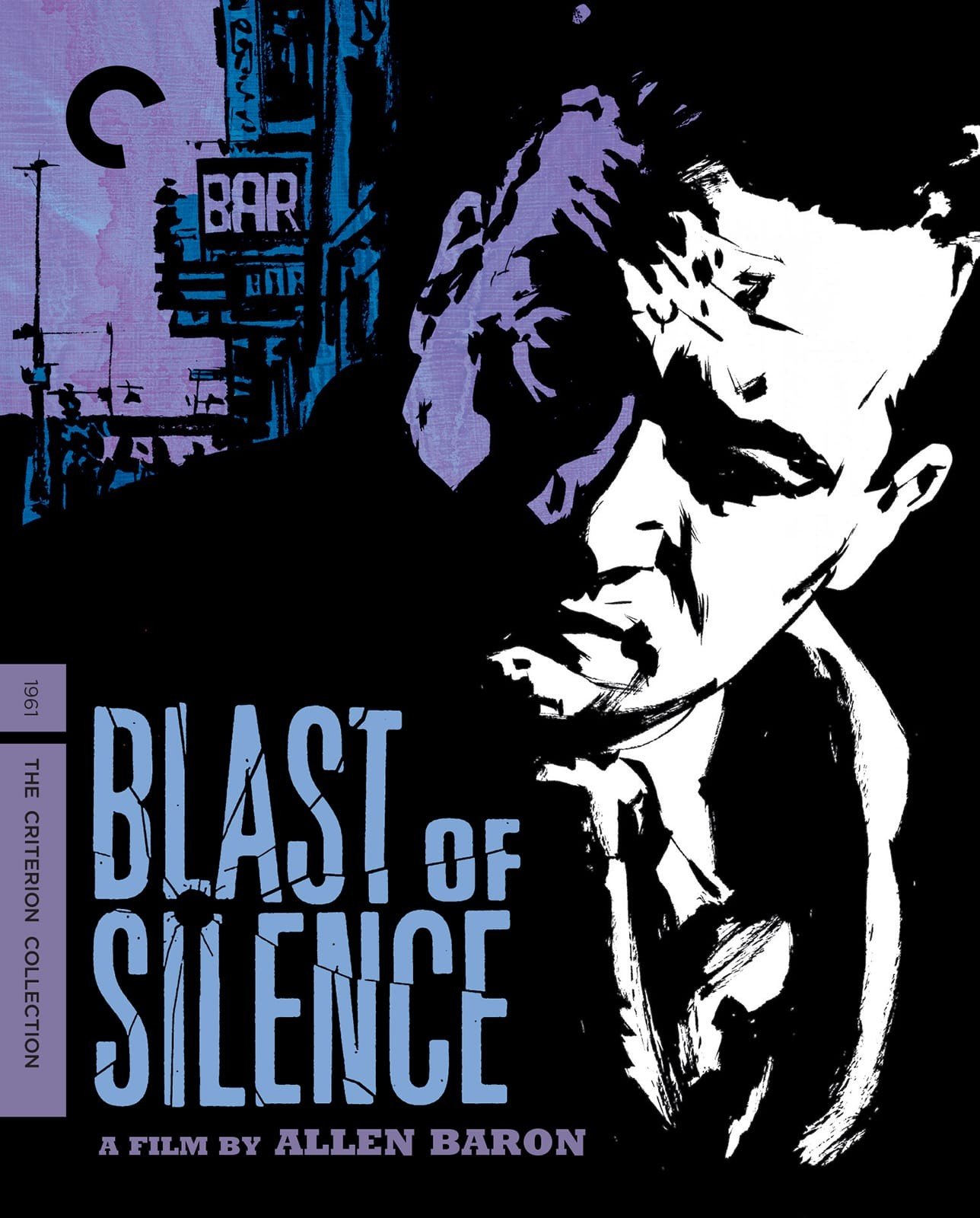
 With one foot planted firmly in the Kiss Me Deadly era of film noir and the other closer to The Killing of a Chinese Bookie, writer-director Allen Baron’s Blast of Silence begins with a brutal, uncompromising invocation of birth and ends with an almost mystically sensitive death. The story of socially isolated hit man Frankie (Baron) who comes to terms with his deferred need for human connection just in time for, one, Christmas and, two, a job that will require him to be especially cold-hearted, Blast of Silence is less a manifestation of the labyrinthine plot trajectories of great noir than an early harbinger of the DIY moxie of the American independent movement.
Baron’s blunt, almost perfunctory story doesn’t reveal much about the inner workings of its central character, instead taking advantage of the downright dull aspects of New York City, a city that films (especially noir films) often depict with mythic reverence as a succession of places you’d want to visit but aren’t even sure you could live therein. As far as the movies are generally concerned, New York is as artificially engineered an environment as Disneyland or Stepford, Connecticut (or Hollywood). What Blast of Silence, which was shot on a shoestring budget, gets and gets right is the sense that New York, for all its “top of the world” potential, is also a working metropolis with accompanying concessions, mediocrities, and isolations.
Much like Mark Robson’s The Seventh Victim, the tension of Blast of Silence doesn’t so much revolve around the antihero’s job, redemption, or ultimate fate, but rather the disconnect between a mundane milieu and the grandiose flourishes they’re meant to convey. Frankie spends the film looking schlubbish and constipated, far from the suave operator that the narrator coolly informs us is in the top five percentile earnings-wise. The film’s narration, incidentally, is often cited for its use of the rare second-person address, but my take on it is that it’s actually dissociative first-person from within the protagonist’s overstressed psyche—that the instructions Frankie takes his cues from are actually coming from inside the house, so to speak.
For all the narrator’s insistence on stressing the dangers around every corner, Blast of Silence’s bland images suggest that the world truly couldn’t care less about Frankie’s dogged pursuit of a gun with a silencer. At one point, a headline screams one of his crimes, but he’s the only character shown even bothering to read the article. Haunting, remote, and workmanlike, Blast of Silence may be the only film depicting a trip on the Station Island Ferry in which it would have made sense if a tumbleweed flitted across the deck.
Image/Sound
Criterion put some legwork into improving the presentation from its prior DVD release. That release was thankfully not among the full-frame transfers that it opted to release windowboxed (a regrettable practice that marked that brief period when households were gradually weaning off tube sets in favor of LED and plasma). Still, there was much room for improvement, and Criterion went the extra mile here, significantly dialing up the resolution of the image and the dynamic range of the gray hues. Furthermore, they offer the film in two distinct aspect ratios: the 1.33:1 Academy ratio previously released on DVD, and a 1.85:1 widescreen version that, to my tastes, looks far more “correct” and consciously framed. The film still looks like it may have been shot, in part, using short ends, with the quality of the film stock varying radically from shot to shot. But now you can see more of the method that went into the movie’s jazzy improvisational feel. Compared to the image bump, temper expectations when it comes to the new disc’s sound presentation, though admittedly, brashness still works in the film’s favor.
Extras
In contrast to the A/V upgrade, Criterion’s bonus features remain as they were last time around. Just as Allen Baron is pretty much the whole show in the feature film, he’s given the Criterion disc’s meatiest bonus feature: a one-hour retrospective in which the renaissance man is filmed returning to Blast of Silence’s locations to reminisce (though one gets the sense that he’s spent many of his days there, even though a title indicates he’s relocated to Beverly Hills). Baron is good-spirited and offers plenty of insight, and at times seems almost bemused that his film even has any reputation to speak of. He also looks, sounds, and acts like a second cousin of Martin Scorsese, and you half expect Fran Lebowitz to pop her head around a corner to bust him up with a wry quip about New York’s lost grit. A collection of photos juxtaposing Baron in the film and, over 45 years later, revisiting the same locations seems a tad beside the point, but offers some text background information. A collection of old Polaroids from the shoot has the gratuitously mottled look that’s absent from the actual film. There’s also a trailer along with a tony booklet essay by critic Terrence Rafferty, as well as a cute little mini-comic adaptation of Blast of Silence (emphasis on “mini,” as it’s all of four pages long).
Overall
The neglected standing of Blast of Silence is the film’s own best proof of its uniquely wallflowerish take on film noir tropes, but even more intriguing is its standing as one of the greatest and most unsung of American Christmas movies.
Since 2001, we've brought you uncompromising, candid takes on the world of film, music, television, video games, theater, and more. Independently owned and operated publications like Slant have been hit hard in recent years, but we’re committed to keeping our content free and accessible—meaning no paywalls or fees.
If you like what we do, please consider subscribing to our Patreon or making a donation.



This new Blu-ray of the film is superb!! For any fans of this movie, and film noir, it’s a must!!