After several years of working as an assistant director for Suzuki Seijun, Hasebe Yasuharu finally got the chance to direct his own film with 1966’s Black Tight Killers. While Suzuki’s irreverent whatsit Tokyo Drifter went on to international fame that same year, Hasebe’s debut lurked in relative obscurity outside of Japan. It’s an understandable fate since Suzuki’s relentless abstraction of both narrative and action accounts for much of what still makes it feel vital and fresh nearly six decades later, and Black Tight Killers sticks more tightly to the type of mukokuseki akushon (“borderless action”) film that Nikkatsu Studios had been churning out since the late ’50s.
Still, Black Tight Killers is an immensely stylish film in its own right. And it functions as a fascinating time capsule of a post-war Japan at a time when its youth culture was embracing the spirit of the Swinging ’60s. Despite a brief opening scene in which Japanese war photographer Daisuke Hondo (Kobayashi Akira) is snapping photos in Vietnam during the war, any hint of, or interest in, political subtext is quickly dismissed when the man takes Yoriko (Matsubara Chieko), a stewardess he meets on his flight home, on a date and soon learns that she’s been kidnapped by a trio of leather-clad, go-go-dancing female assassins.
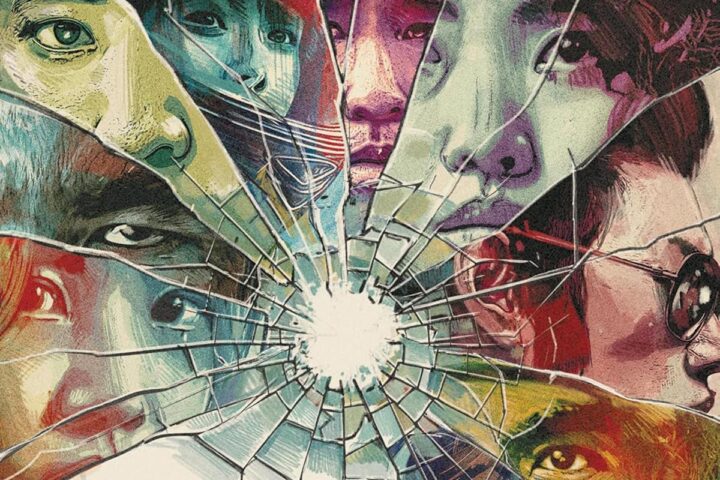
Between the crew’s weaponry (razorblade measuring tape, “ninja chewing gum” bullets, bras lined with explosives, and sharpened 45 records that they use in lieu of throwing stars) and Hondo spending much of the rest of Black Tight Killers in a dapper white tux and acting the part of the action hero du jour, the film’s allegiance to the James Bond series is undeniable. But Hasebe is considerably less interested in spycraft and steamy displays of machismo. He keeps Black Tight Killers anchored in a fragmented, pop-art-infused dream space, drenched in neons and bold primary colors and cranking up the artifice to 11 in the film’s best scenes.
One sequence finds Hondo wandering down a street at night with the only visible background consisting of cut-out silhouettes of buildings and neon club signs hanging in negative space. Another remarkable sequence, Hondo’s feverish dream after Yoriko goes missing, sees the young girl being chased by the assassins through vibrant monochrome sets, stumbling as she smashes through a series of paper walls, each time revealing a wildly different color behind it.
It’s in these stretches that Black Tight Killers best captures the joyously anarchic, reality-defying energy that it’s trying to serve up. Several of the film’s lengthy action sequences, though, do end up veering into complete silliness, featuring some risibly inept fight choreography and lacking in the snappiness that keeps Hasebe’s mentor’s best works consistently moving at a brisk clip. But despite its inconsistencies, Black Tight Killers remains a handsomely mounted, entertaining example of the kind of stylistic boundary-pushing going on during the Japanese New Wave, in which young filmmakers, for better and worse, turned their back on the early masters and pulled the nation’s cinema into the globalized era of the ’60s.
Image/Sound
Radiance’s HD transfer appears a tad milky during the film’s more action-oriented sequences, but otherwise the various neons and bold primary colors are vibrant and the image is sharp and fairly detailed. The black levels could use a little boost, but this is such a colorful film that aside from the titular black tights, it’s never more than a minor setback. On the audio front, the uncompressed mono soundtrack features a well-balanced mix that has nice separation between the dialogue, music, and countless foley sounds used in the fight sequences.
Extras
On his newly recorded commentary track, Jasper Sharp, critic and author of The Historical Dictionary of Japanese Cinema, serves as our guide through the film and Japanese cinema of the ’60s. He packs a lot of info into less than 90 minutes, touching on everything from Japan’s globalization after WWII to the various stars and directors who worked at Nikkatsu Studios throughout the decade. The disc also comes with an archival interview from 2000 with Hasebe Yasuharu, who discusses his years of working as an assistant director and his desire to make a new kind of action film. The package is rounded out with a 20-page full-color booklet that includes an essay by Japanese cinema expert Chris D., who pays tribute to the film’s aesthetic qualities as well as to some highlights of Hasebe’s career post-Black Tight Killers.
Overall
Radiance’s release of Black Tight Killers is a perfect opportunity to discover a little-seen, pop-art-infused side of the Japanese New Wave.
Since 2001, we've brought you uncompromising, candid takes on the world of film, music, television, video games, theater, and more. Independently owned and operated publications like Slant have been hit hard in recent years, but we’re committed to keeping our content free and accessible—meaning no paywalls or fees.
If you like what we do, please consider subscribing to our Patreon or making a donation.