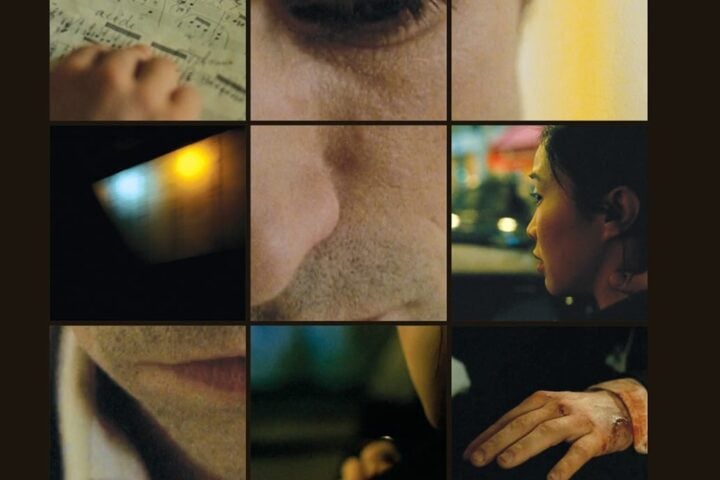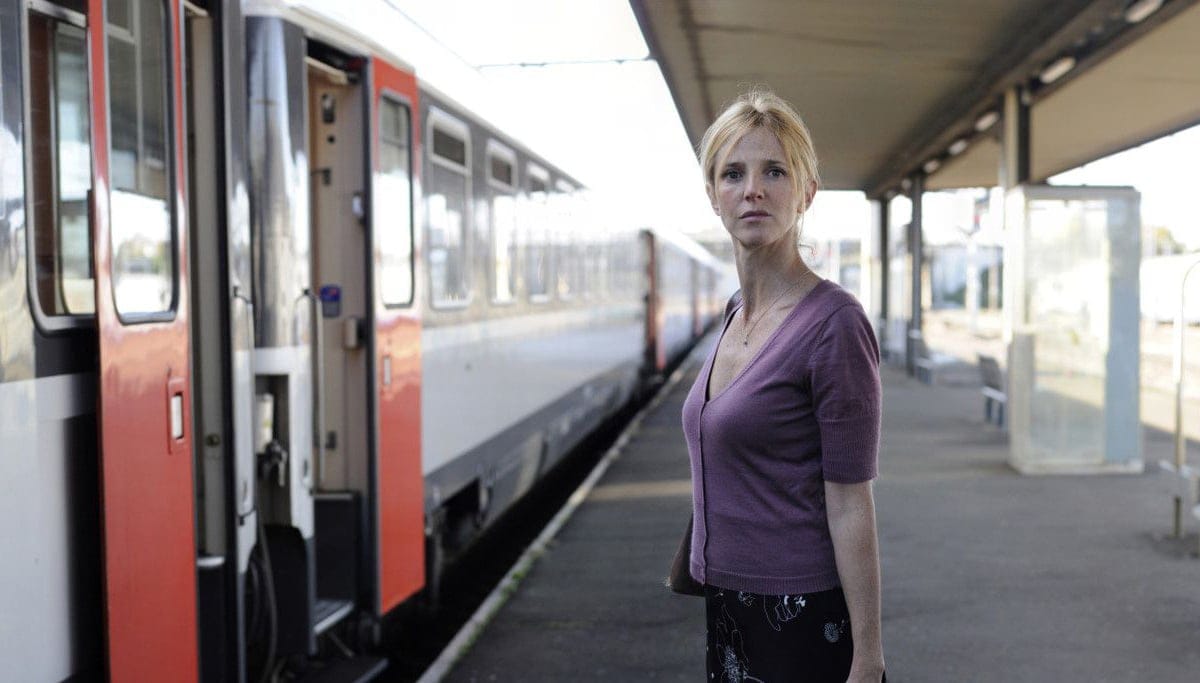
Sandrine Kiberlain as Véronique Chambon in Stéphane Brizé's Mademoiselle Chambon. [Photo: Lorber Films] Mademoiselle Chambon

Mademoiselle Chambon **½

by Joseph Jon Lanthier on May 26, 2010   Jump to Comments (4) or Add Your Own


Unlike the similarly bucolic and gesture-driven milieu of French films such as Claude Berri's Jean de Florette or Olivier Assayas's Summer Hours, Stéphane Brizé's Mademoiselle Chambon is more fascinated by how an individual can become entrapped by his or her singular essence. At its most gently successful, the movie is a character study with intensely baroque observations; at its more noticeable nadir, however, it's a trite and partially incomprehensible ersatz-tragedy.

The film's protagonist, Jean (Vincent Lindon), is a middle-class mason who falls for his grade school-aged son's teacher, the mademoiselle of the title (Sandrine Kiberlain), after she inspires within him a passion his more pragmatic wife (Aure Atika) fails to incite within the deadened restrictions of child-centric domesticity. What's crucially inventive about director Stéphane Brizé's exploration of this franc-a-dozen premise is that Jean's life before Mlle. Chambon never seems stifling or even particularly unfulfilling. We see Jean happily fumbling over his son's language homework and tenderly caring for his sickly father; these scenes establish a false sense of propriety that the movie desperately needs for its central love story to feel star-crossed, but they also provocatively suggest a man who interprets masculine nobility, at least in part, as genetic stewardship. And Lindon renders the manual intelligence of his wood-working, house-building everyman with peculiar sensuality: His large hands never seem leathery or worn, but kinetic and mystical, expressing even while stationary all the muddied feelings that never quite reach his brain.

The space where Jean and Mlle. Chambon meaningfully communicate is thus a visceral, nonverbal zone. While he fixes her windows she plays the violin for him—we note, too, the digital dexterity required to manipulate string instruments—and he realizes that there's a life beyond the dutiful and the tactile. Photographed in cinemascope, presumably to allow Brizé to impose visual metaphors for the vast stretches of emptiness that transmissions from character to character are forced to traverse, the scenes that build the film's romance brick by brick are handsomely delicate; Chambon's apartment reeks of the cinematographically elysian, but the staging of mannered awkwardness never feels gratuitous, and we're taken aback whenever Jean's face fills up with quiet, otherworldly pain.

The moments that follow the couple's mutual, empathic discovery, however, are laced with contrivance and sentimental confusion; from there on, the film focuses on how Jean grapples with his forbidden fruit rather than exploring how his encounters with the mademoiselle have mutated his glacial perceptions. And gradually, Brizé begins to succumb to cliché: the unbroken shot where Jean and Chambon first make bodily contact feels dusty and anticlimactic rather than softly triumphant; Mlle. Chambon's elongated neck and honeyed, Aryan features are ham-fistedly yin-yanged with the brunette orderliness of Jean's wife; and Jean's frustrated fingers even begin to take on an oddly masturbatory aura, a hackneyed motif that daintily exposes itself with the assistance of a limp baguette. The predictability of the ostensibly heartbreaking resolution aside, we're never quite convinced that these individuals deserve to be anything more than platonic but intimate friends; as Jean's newfound femininity blossoms, Brizé neglects to address the filial ripples, for example, this personality metamorphosis may provoke.

If the information compiled in the French Wikipedia page on Mademoiselle Chambon is accurate, then the version reaching U.S. shores has been pruned by an entire third, which makes one hesitant to pass definitive judgment; poetry often resides in the fleeting details. But in the case of Mademoiselle Chambon, the incisiveness of those details prove as deliquescent as the film's attempted love story. I'd offer the same advice to both Brizé and his main character Jean: Rather than mining despondency from what cannot be had, why not nurse what positive change that unattainable desire has catalyzed?


  • Director(s): Stéphane Brizé
  • Screenplay: Stéphane Brizé, Florence Vignon
  • Cast: Vincent Lindon, Sandrine Kiberlain, Aure Atika, Jean-Marc Thibault, Arthur Le Houérou
  • Distributor: Lorber Films
  • Runtime: 101 min.
  • Rating: NR
  • Year: 2009


Comments

Sam Juliano on May 31, 2010, 10:26 PM

Well, Jon, I am not sure about that "pruning" you speak of near the end of your SLANT review, but taken on its own terms this is a wrenching, beautifully executed drama that for me earned only the second five-star rating of 2010 with Audiard's UN PROPHETE. (Two other films, Bellochio's VINCERE and an animated film, HOW TO TRAIN YOUR DRAGON push close though at 4 1/2) You speak here of the film's nadir being it's trite epicenter, but in fact this is what made it comparable to Rohmer and Denis—the simple premise executed to perfection, where long side glances and facial reactions speak far more than any dialogue can. There was certainly potential at the train station for narrative disaster (and how many of us were thinking BRIEF ENCOUNTER or even FAR FROM HEAVEN?) but Ms. Brize ended it with taste and dignity, resulting in a moment of true heartbreak. You rightly speak of the violin playing as part of the film's vocational fabric, and I'd add the construction scenes as part of the oddly fascinating look at ordinary life that in this case is accomplished with shame and anguish. The film is perfectly acted by the two leads, and there is a resonance long after you leave the theater. (I saw it Sunday afternoon at 1:10 P.M. at the Cinema Village at 12th Street in Manhattan).

As always, this is a beautifully written review

Steve Haas on June 20, 2010, 01:45 PM

Dear dear J.J. Lanthier I sense you are completely bored with "franc-a-dozen" French cinema. The technique of space and gesture filled cinemascope is very welcoming.

"Mademoiselle Chambon" was one of the most tender movies recently made. The true art of the film was its topic of "affections". The movie itself just underscores the main thread, which is the basic French film in contrast to American films-normally we want everything upfront.

One of the film's dimension is why do men cheat when their life is in very good order. Perhaps the answer is in the opening pinic scene when Jean and his wife going over his son's grammar homework. He seems so settled with his simple life.

So when his son's teacher ask him to do a parent classroom discussion about his work Mr. Brize executes the technical use of CinemaScope on 3rd graders. The French capture the unrehearsed momemnt like a jazz saxophonist. Innocuously the classroom discussion with children turns into a home repair sidejob on a dafty window.

Affection is an emotion which conflicts within our sense of propriety. Jean is a very good man. He dotes upon his son and cares for his 80 year old father, bathes him and even helps him pick his casket. His wife is pregnant,too. Jeans loves the quiet life and doing construction. So what happens when he meets his son's teacher, who is cultivated, and a shy vilonist? What did the music do to him because Mademoiselle Chambon had no intention to stir him.

Jean's wife knows something happened and he seems afraid and uncertain. In the end, Mademoiselle Chambon decides what she alway conveniently does and Jean is not quitre ready for scandal, or is he?

bambolina on September 17, 2010, 03:27 AM

"Mademoiselle Chambon" has just opened in the San Francisco Bay Area (mid-September 2010), and I went to see it yesterday. This movie is one of the most exquisite I've seen in a long time, but I have the impression that Joseph Jon Lanthier, despite his French surname, didn't "get" this film. Dommage, vraiment. The attraction that Jean feels for Mlle. Chambon has to do with the contrast between his life—working-class and devoted to family—and that of Chambon, who seems to live a life of the intellect which is embellished by music. I doubt that the attraction has to do with Chambon's "Aryan" features which I don't agree that she has; this observation is also quite comical, given that all four of actress Sandrine Kiberlain's grandparents are Jewish. Another indication of sloppy (or no) research for this review is Lanthier's reference to male director Stephane Brize as "she" ("her main character"). Mr. Lanthier, in French the name "Stephane" is a man's name; "Stephanie" is a woman's name. While I would accord "Mademoiselle Chambon" a grade of 98 (out of 100), Joseph Jon Lanthier only deserves 45 for his review. In future, a little more background preparation is definitely in order.

Joseph Jon Lanthier on September 19, 2010, 05:11 PM

Thanks for your comment, bambolina. I admit that my French is a tad rusty, and stand corrected on the misaligned pronoun. Since my reading of the film had little to do with the director's gender, however, the "lack of preparation" here, as you put it, is of little consequence.

Your point about the attraction that Jean shares with Mlle. Chambon is well-made, but is not in any way antithetical to my analysis—I would argue that I deepen that train of thought by observing how both lives are oriented around distinct interpretations of manual craftsmanship. And Brizé (a he) clearly establishes a binary between Chambon and Jean's wife that encompasses even complexion.

The term "Aryan," as you might be aware, is colloquially used refer to physical features now divorced from racial context; to suggest that an individual of Jewish descent cannot bear blonde hair and blue eyes is, quite frankly, to take profiling cues from der Führer himself. In other words, no one would dare utilize the terminology to imply "non-Jewish" attributes anymore, whatever the heck that would mean, but I do agree that it perhaps has a muddy and distracting connotation. Jewish or not, in this film Kiberlain has an undeniably Nordic quality about her that is undeniably intentional...and perhaps partially superficial?

Finally, if everyone would simply disregard the star rating and the couple of infinitesimal near-errors here they might realize that I actually *liked* this film quite a bit. Since when does 2 1/2 stars denote antipathy? I found it nuanced, intuitively acted, and well-paced—it just erred a bit too much on the side of quietness, and had a (let's face it) tiredly hackneyed ending.

Add Your Own

Login to post comment

or Create an Account


Giveaway

3
Newsletter