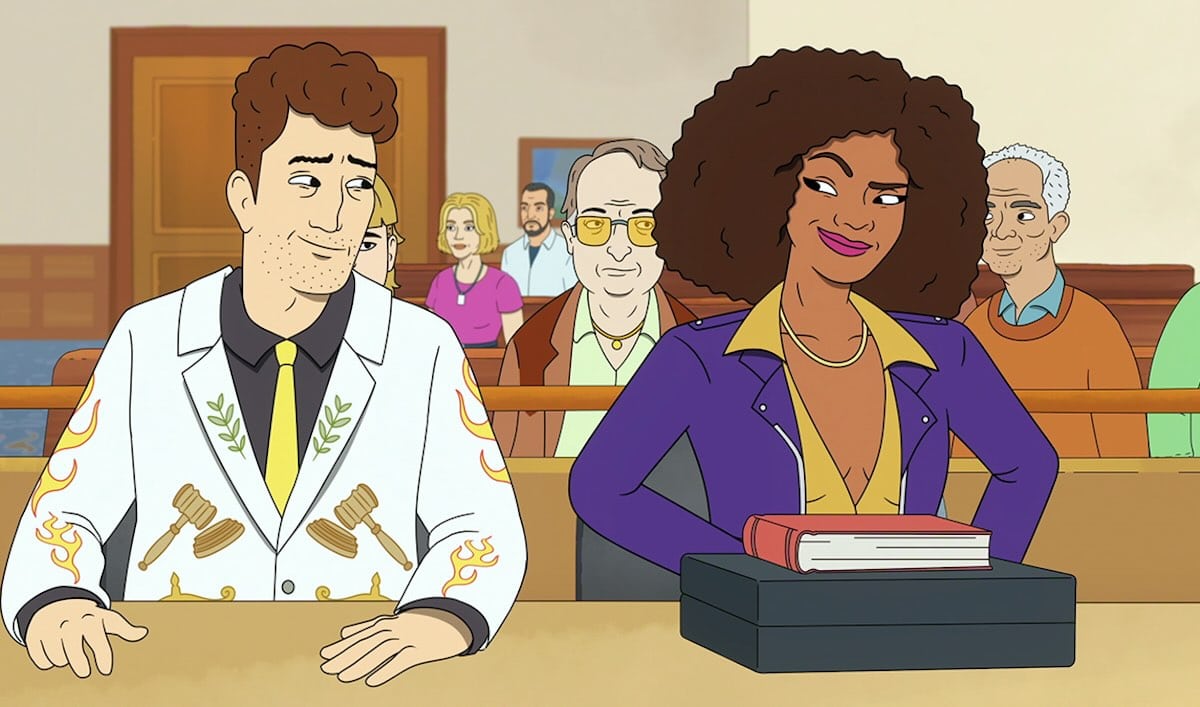
Netflix’s Strip Law arrives ready to slot seamlessly into a carousel of “adult animation” alongside six or seven other shows that look just like it and are roughly as funny. Each colorfully chaotic episode of Cullen Crawford’s series is packed with sex jokes, swears, pop-cultural allusions, and zany hijinks. It’s all reasonably amusing, but there’s nothing to distinguish it from the raft of other animated sitcoms that have emerged in recent years.
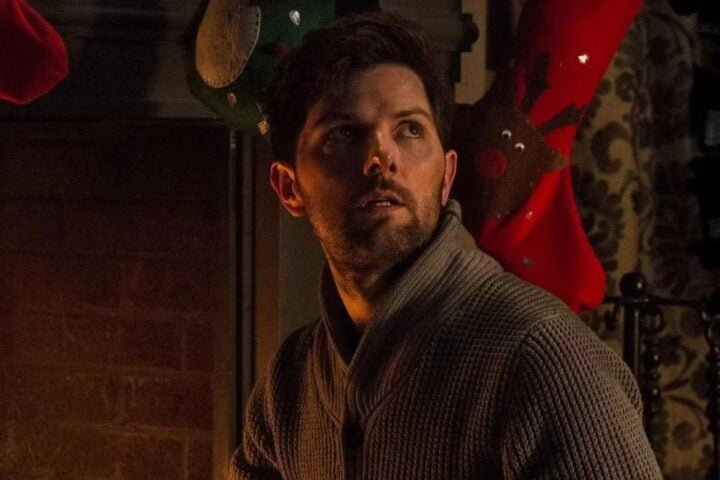
Strip Law follows dorky Las Vegas lawyer Lincoln Gumb (Adam Scott) as he tries to turn his career around by teaming up with flamboyant street magician Sheila Flambé (Janelle James). Along with Lincoln’s teenage niece, Irene (Shannon Gisela), and his longtime partner, Glem (Stephen Root), they get to work on one ridiculous case after another—from representing a man who wants to sue his own penis to trying to disprove the existence of Santa Claus…and God.
The latter two cases take up two separate episodes, despite Lincoln’s protests that the storylines are far too similar. Strip Law comes from the ultra-postmodern school of animated sitcoms where self-aware moments like this are plentiful. Later on, during a VR training exercise led by a digital amalgamation of various Rat Pack personalities, Irene wonders aloud, “Why is everything we do always so high-concept and wacky?” In Strip Law, things like character arcs and emotional epiphanies exist only so that the series can point them out and laugh.
Lincoln and his friends operate in a world where everyone is as ridiculous as they are. Record-hungry judges force attorneys to speed-run cases while rival law firms all come with their own absurd gimmicks. From the moment the cacophonous sound of Bob Destiny’s “Wang Dang” sends the opening credits roaring to life, each episode of Strip Law is powered by a carefree, manic energy. Nothing is to be taken seriously as the series bounces from one dumb joke to another, perhaps with a quick aside about how dumb that last joke was slipped in between.
It’s an approach to comedy that batters us with gleeful violence, absurd non sequiturs, and lots of yelling. That sort of antic humor was also a key component of Archer—another unconventional workplace sitcom with a similar “case-of-the-week” setup—and provided many of its most meme-able moments. But while that series always had a base layer of wordplay, wit, and coherent joke-writing, Strip Law often seems to be trying to sell its gags on volume alone.
Sometimes it succeeds. One episode, about the God case, features a riff on New Atheist celebrities, complete with a parody of Ricky Gervais’s famous crucifixion photoshoot. It’s a fairly clever sequence, though it’s also indicative of how dated most of Strip Law’s pop-cultural references are. Hearing characters say things like “Zendaya is Meechee” and “Black Girl Magic” is enough to make you wonder if you haven’t accidentally booted up a series from a decade ago.
The thing Strip Law loves to reference more than anything else is The Simpsons. Hardly an episode goes by without a nod to monorails, the Gracie Films logo, or Ralph Wiggum, which only invites comparisons between the two shows. In fact, Strip Law ends up kind of making the case against itself when it offers a much clumsier version of The Simpsons’s classic “Lee Carvallo’s Putting Challenge” gag. Because, while Mr. Carvallo’s ponderous golf game still crops up in meme form from time to time, it’s hard to imagine any of Strip Law’s jokes sticking around for three weeks, let alone three decades.
Since 2001, we've brought you uncompromising, candid takes on the world of film, music, television, video games, theater, and more. Independently owned and operated publications like Slant have been hit hard in recent years, but we’re committed to keeping our content free and accessible—meaning no paywalls or fees.
If you like what we do, please consider subscribing to our Patreon or making a donation.