In the fourth episode of Amazon mystery series Outer Range, mourners and murderers gather in the Wyoming countryside for a funeral as Billy Tillerson (Noah Reid), the brother of the deceased, sings Peter Gabriel and Kate Bush’s “Don’t Give Up.” He hits the high notes in a vulnerable falsetto, communing with his brother the only way that he can now—by singing both parts of the duet. Despite the bewilderment that some onlookers clearly feel in the moment, the performance is all the more gripping for its oddness.
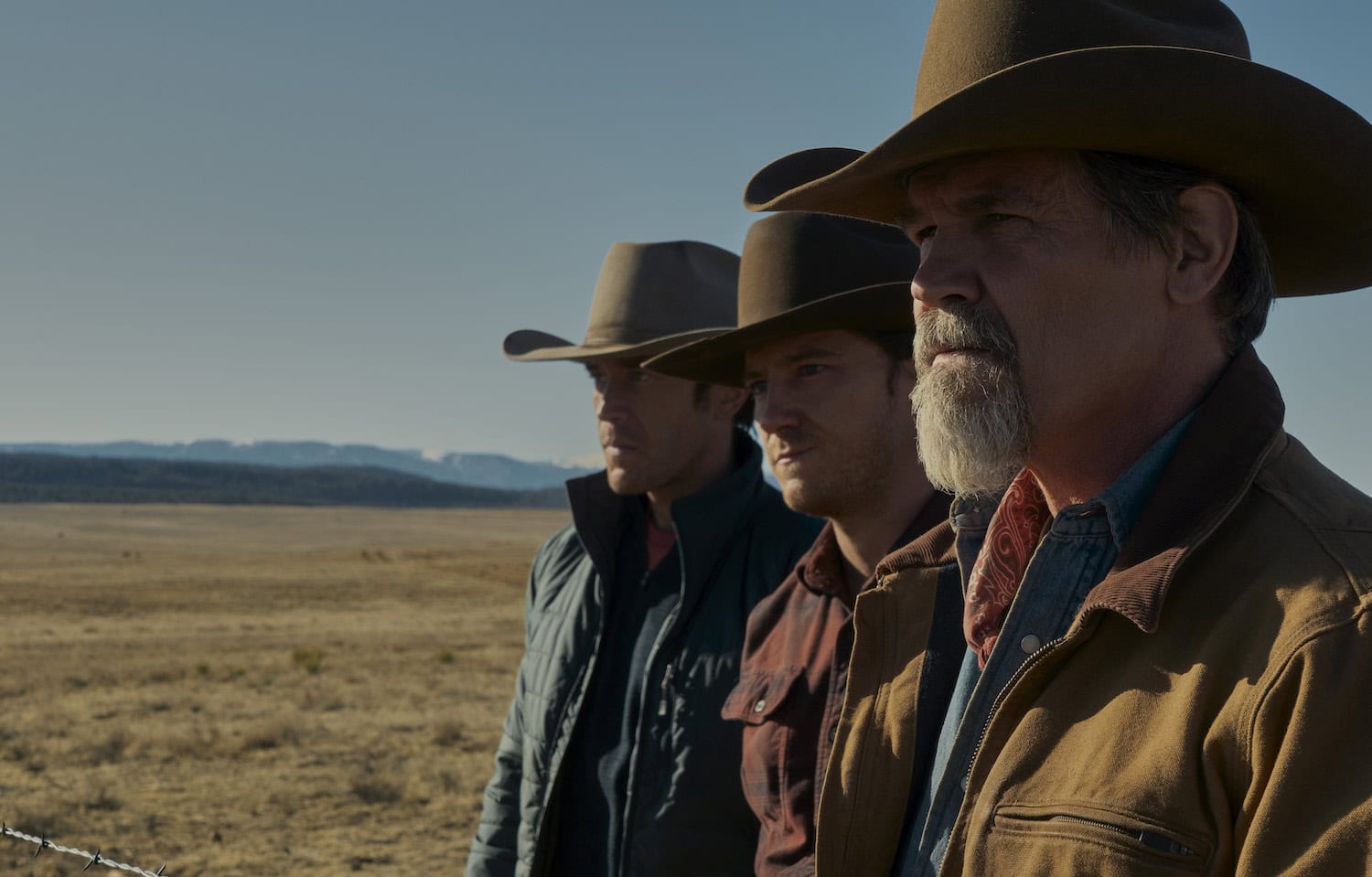
Created by Brian Watkins, Outer Range is at its core a family drama. It centers on the Abbotts, cattle ranchers whose humble operation carries more sentimental than commercial value. One day, patriarch Royal Abbott (Josh Brolin) finds a deep, strangely symmetrical hole filled with a swirling planetary mist on the family’s sprawling land. Things that are thrown into this void, we soon learn, reappear elsewhere after jaunts through space and time.
Royal’s discovery coincides with a number of other shocks to his life: an aggressive play for land by the madcap Wayne Tillerson (Will Patton), Royal’s neighbor; the death of Wayne’s son, Trevor (Matt Lauria), to which Royal’s sons Perry (Tom Pelphrey) and Rhett (Lewis Pullman) are inextricably tied; the arrival of Autumn (Imogen Poots), a stranger who begins camping out on the Abbott property in search of something; not to mention the disappearance of Royal’s daughter-in-law nine months earlier. The stoic Royal mostly takes these developments in stride. He’s a grunting emblem of the American West, where the mouths of men are closed portals to buried emotions, much to the frustration of his wife, Cecilia (Lili Taylor).
Outer Range evokes myth not just in its depiction of the West and its denizens, but in Royal’s reckoning with the hole on his property. The Greek titan Cronos, Royal explains in the voiceover that opens the series, forever ago severed the heavens from the Earth. By reflecting on and interrogating the nature of the void, the characters begin to grapple with what comes after we go—and to live, in the meantime, with the all-consuming grief, regret, and doubt that haunt men like Royal and families like the Abbotts.
Though the void proves a rather enticing visual symbol, Outer Range is slow to carve out the particulars of the world and people around it. In its early goings, the series grasps at the beguiling eccentricity of David Lynch’s Twin Peaks, the totemic model of fantastical small-town mysteries. Throughout, genres brush against each other but don’t quite intertwine; the western and supernatural elements come close to doing so, concerned as both are with the unknown things beyond frontiers, but the latter initially feels sprinkled in for color rather than substance. From the regal buffalo that intermittently appears in the wild, two arrows stuck in its side, to Royal himself, who, goateed and grizzled, looks not unlike a buffalo, the show’s intriguing images hint at a cosmic logic but remain incoherent.
Outer Range undergoes a tectonic shift, though, in its fourth episode, “The Loss,” which was directed by Jennifer Getzinger. Trevor’s funeral and other scenes, including a tense, high-stakes hand of poker between Royal and Autumn, more penetratingly delve into the minds of the characters, and the creeping influence of the void begins to reveal itself in Royal, who trades his gruff quiet for understated but menacing philosophizing. “Maybe it’s like you’ve been saying,” he tells Autumn, staring her down over a poker table. “Something happening around here. Something more than we can know.” Royal’s rumination feels biblical, the “know” profound, grimly conveying the expansiveness of all that eludes him and his ilk.
Wayne, in contrast to Royal, is verbose from the jump. Patton toes the line between madness and melodrama as Wayne lets off unhinged monologues about desire and the invisible forces that he feels creeping on. There’s a sense, per the tenets of frontier masculinity, that Wayne is less of a man than Royal—for the looseness of his lips, the nakedness of his greed, and his relative lack of concern for his three sons. He seems to have been touched by the void in some distant past, and is wholly consumed by a fixation on claiming the ground that contains it. Wayne’s obsession almost absolves him of his broader indifference—because what meaning does anything hold next to the nothing of oblivion? The question courses through Outer Range, an alluring exploration of lives and lands that have been all but annihilated.
Since 2001, we've brought you uncompromising, candid takes on the world of film, music, television, video games, theater, and more. Independently owned and operated publications like Slant have been hit hard in recent years, but we’re committed to keeping our content free and accessible—meaning no paywalls or fees.
If you like what we do, please consider subscribing to our Patreon or making a donation.