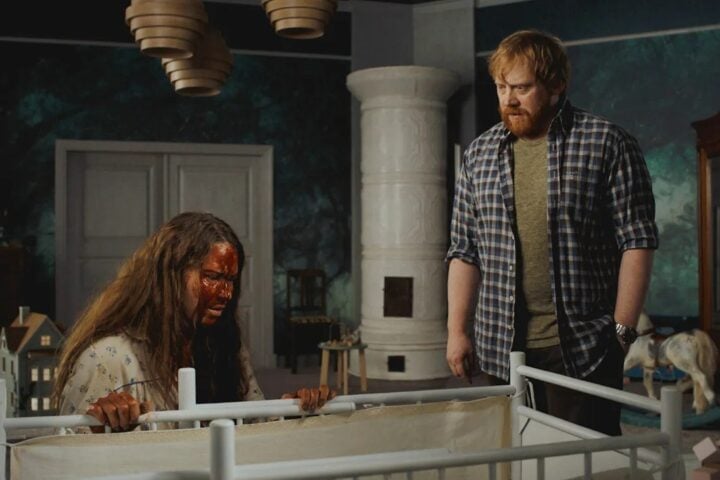
“The Autopsy,” the David Prior-directed third episode of Guillermo del Toro’s Cabinet of Curiosities, begins with a stunningly textured series of images. First, a spider traverses its web, then stars rotate in the night sky, followed by a rock wall carved deep in a mine. This sequence subtly establishes the interconnected worlds that the Netflix show explores: the natural, the cosmic, and the man-made, each home to monsters of its own.
Cabinet of Curiosities feels like a haunted funhouse, as its eight shorts, each one helmed by a different director, reflect an eclectic range of tones and sensibilities. Every episode also comes with an introduction from Guillermo del Toro himself, who steps out of the darkness to deliver a monologue to the camera, wildly charming in his grave seriousness.
Though Keith Thomas’s “Pickman’s Model” and Catherine Hardwicke’s “Dreams in the Witch House,” both adaptations of H.P. Lovecraft stories, are overly familiar in their depictions of demons and ghosts, most of the episodes are compellingly idiosyncratic, including “The Autopsy,” in which a coroner (F. Murray Abraham) and a sheriff (Glynn Turman) uncover a small-scale alien invasion; Vincenzo Natali’s “Graveyard Rats,” which portrays the plight of an indebted graverobber (David Hewlett) with almost slapsticky humor; and Guillermo Navarro’s “Lot 36,” which, while somewhat ham-fisted, infuses the desolate compound of storage units scavenged by a racist war veteran (Tim Blake Nelson) with an effectively ominous atmosphere.
Three directors who have made outsized—if, in some cases, underappreciated—contributions to 21st-century horror are responsible for the series’s standout episodes, which distinguish themselves with striking senses of place and thoughtful social commentaries. “The Outside,” directed by Ana Lily Amirpour and based on a short story by Emily Carroll, is set in a colorful, totemic suburb that suggests a fever-dream refraction of middle-class American life. An unsatisfied bank teller named Stacey (Katie Micucci) undertakes an expensive, disturbing skincare regimen—and begins to commune, through her TV, with the sleazy pitchman (Dan Stevens) who peddles the product in infomercials. Stacey’s increasing disconnection from reality makes her resemble, more and more, her co-workers, who place vanity and pleasure above all else. It’s a bizarre, funny, and unsettling examination of consumerism.
Jennifer Kent’s “The Murmuring,” based on a short story by del Toro, generates similar intrigue, albeit with greater solemnity. The story chronicles a bird-watching trip undertaken by ornithologists Nancy and Edgar (Essie Davis and Andrew Lincoln), who are reeling from—and refusing to talk about—a recent tragedy. The couple camps out in an isolated, abandoned house, and gorgeous but understated wide shots show them recording the sounds of countless birds soaring over water. As the duo’s frustrations with each other and their grief are brought to the surface, these images come to serve as complex symbols of the tension between the freedom of flight and the irresistibility of the bonds that hold flocks, and families, together.
In contrast, the characters of Panos Cosmatos’s “The Viewing” are united not by blood or instinct, but by the whims of one man: Lionel Lassiter (Peter Weller), an absurdly wealthy recluse who invites a selection of strangers to his home for a mind-blowing evening. Co-written by Cosmatos and Aaron Stewart-Ahn (his writing partner on the Nicolas Cage horror-thriller Mandy), the episode largely takes place on a round couch, where Lionel and Zahra (Sofia Boutella), his doctor and confidant, help their guests to whiskey, coke, and philosophizing.
Lionel’s home is filled with brutal angles, like an alien ziggurat, and drowns in warm orange light that’s nearly as hypnotizing as the man’s assured baritone. Though much of the episode is confined to a single room, it feels capacious rather than constricted, as Lionel’s probing questions about fulfillment and emptiness open up his visitors’ psyches to gripping ends.
We eventually learn that Lionel is eager to show off what he calls “the item.” The party walks down a long hall, enters another circular room, and sees an object placed atop a pedestal—and electrifying chaos ensues. The item is emblematic of Cabinet of Curiosities: a presence that exudes an alluring air of mystery, rough around the edges but coursing with energy.
Since 2001, we've brought you uncompromising, candid takes on the world of film, music, television, video games, theater, and more. Independently owned and operated publications like Slant have been hit hard in recent years, but we’re committed to keeping our content free and accessible—meaning no paywalls or fees.
If you like what we do, please consider subscribing to our Patreon or making a donation.