The discovery of a lost play by a venerated author is always cause for excitement. Playwright Kirk Lynn followed the clues from Thornton Wilder’s journals, locating The Emporium—which was started in 1948 and left unfinished in 1954—in the author’s papers at Yale’s Beinecke Rare Book & Manuscript Library. And with permission of the author’s estate, Lynn channeled Wilder’s spirit in assembling the disparate scenes and notes into a completed script.
That thrill of discovery is channeled into the preface of Classic Stage Company’s production of the play at the Lynn F. Angelson Theater, where an actor (Joe Tapper) on stage excitedly recounts this bit of literary sleuthing. Then, fiction intrudes on fact and we’re in the world of the play, with Tapper as the protagonist, John, an orphan from the sticks who longs to move to the city for a job at the mysterious department store the Emporium, his professed calling.
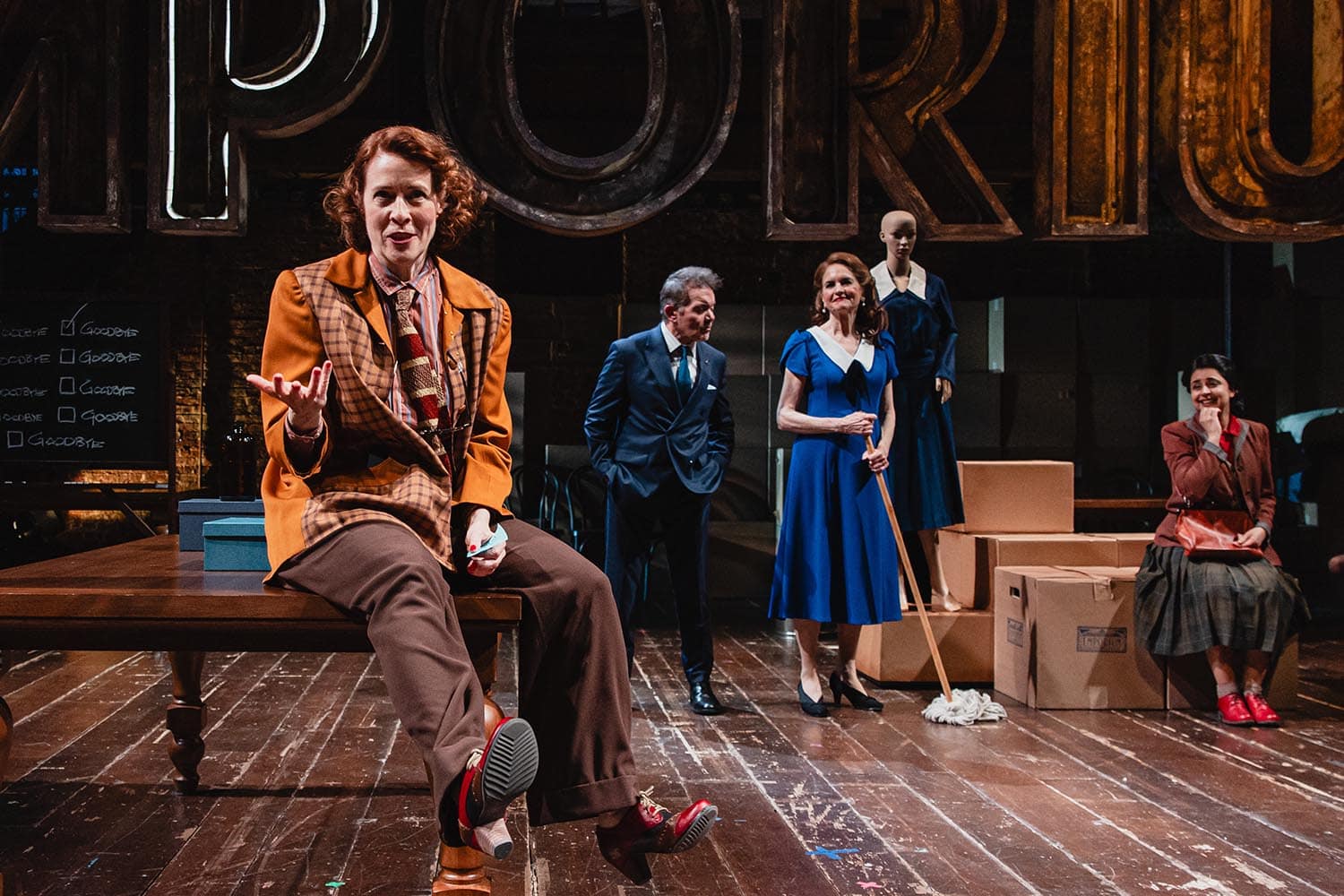
Immediately upon being introduced to the audience, Bernice (Candy Buckley), a sales associate, sends John away from the Emporium for the first time, delivering the first of several goodbye speeches in the play: “Nine tough goodbyes is generally thought to add up to a full life. It’s as much as most people can handle.” Those nine goodbyes, each ticked off on a chalkboard, provide the structure for a play whose logic and arc are ultimately circular.
Happening on Walt Spangler’s split-level thrust set, most of the action is staged front and center, under the name of the store in large, illuminated letters. The story is told in a progression of scenes, as John struggles to understand, among other things, why it’s so hard to get job at the store, if it’s even proper employment, and exactly who the directors of the Emporium, Gillespie and Schwingemeister, and their assistant really are.
There’s a meet-cute with an employee, Laurencia (Cassia Thompson), who’s prone to singing while she works, and savvier than John thinks. The first act progresses through John’s life until he arrives at a Dantean crisis of middle age. He’s no closer to his goal, wondering if he should continue to work at the Emporium or take a role at Craigie’s, the rival department store where everything is orderly and ordained. Given his disappointments thus far, he chooses the latter.
During intermission, the audience is given the choice to vote, via a ballot box in the lobby, whether they’d like to learn the central metaphor of the play in a prologue that Wilder outlined but never wrote, planning to insert it following the break (another upending of dramatic narrative structure), or see an alternate scene. Spoiler: The Emporium is a metaphor for a life in the arts, though also possibly love, or living a purposeful life. If you attend on a night the audience doesn’t vote for the spoiler, you’ll have to make those connections yourself.
The script circles back to these ideas several times throughout its two hours, hammering home the conflict between art and commerce, mystery and ineffability versus security and drudgery. If this makes the play sound too unwieldy or didactic, it’s not. The more metaphysical concerns are leavened by a committed cast, and the humor is broad but not winking.
Buckley and Derek Smith do the lion’s share of the character work, playing multiple roles. Their respective performances as the elderly department store owner Craigie and his lispy daughter Ermengarde in the second act are uproariously funny. Rob Melrose’s taut direction keeps the action moving briskly. Given the meta-ness of the show, the audience is recruited for some low-stakes participation throughout, playing sheep, orphans, the stars, and, naturally, an audience.
Quoted in a 1950 article in the New York Times, Wilder said his play was “a kind of a mixture of Horatio Alger and Franz Kafka, with a department store serving as the central image.” That did seem to be his m.o., mixing European experiments with narrative and form and a can-do American determination. It’s interesting to consider the department store as a relic, having given way to the mall, which succumbed to the big box store, before online retailers became the market leaders. Some might say that certain art forms are relics too, yet we pursue them because a life without them offers what exactly? Given the world we inhabit, which seems designed to drive us toward the monotony of Craigie’s, we probably need the Emporium more than ever.
The Emporium is now running at the Lynn F. Angelson Theater.
Since 2001, we've brought you uncompromising, candid takes on the world of film, music, television, video games, theater, and more. Independently owned and operated publications like Slant have been hit hard in recent years, but we’re committed to keeping our content free and accessible—meaning no paywalls or fees.
If you like what we do, please consider subscribing to our Patreon or making a donation.