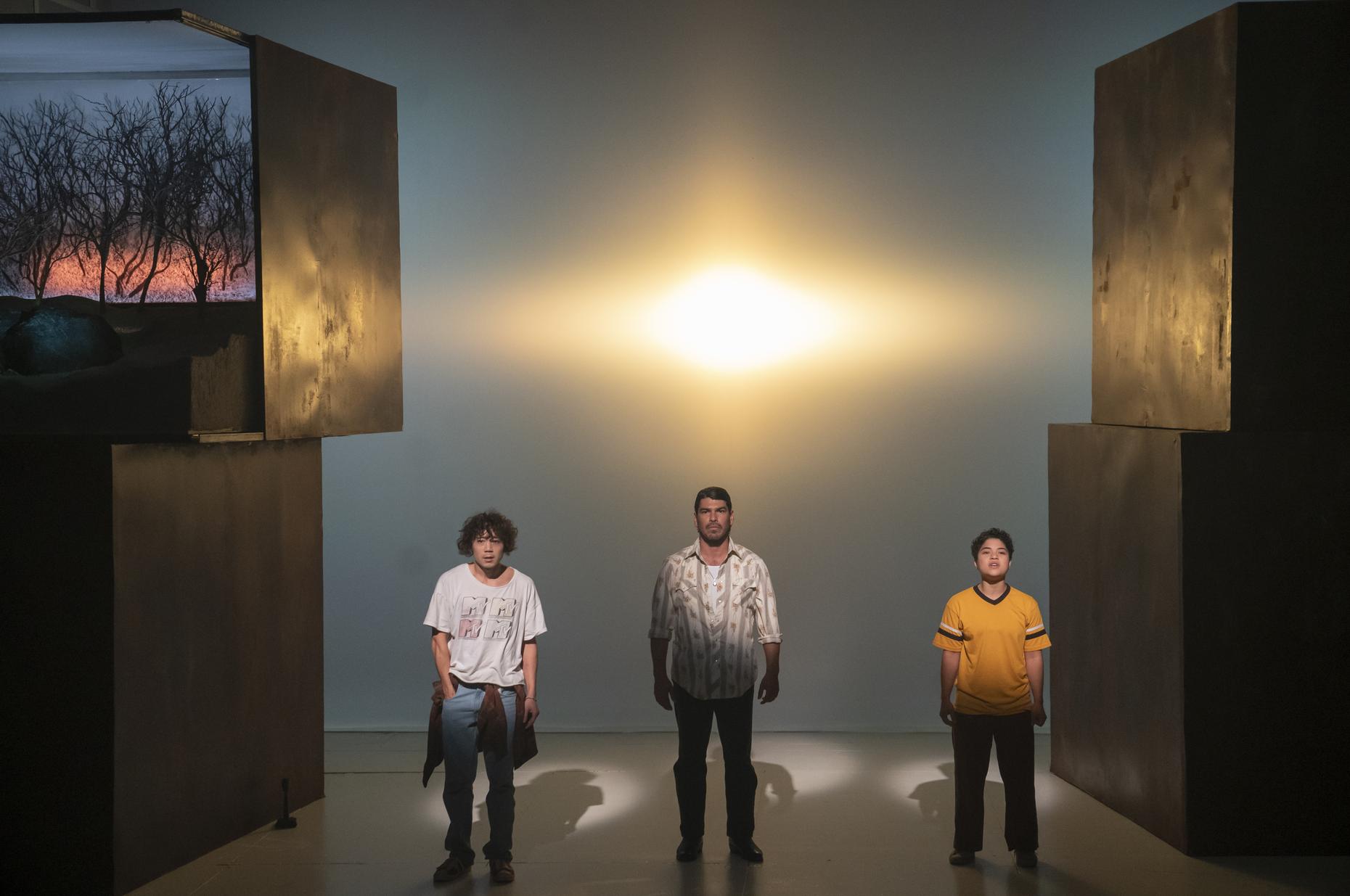
Are we what we consume? “You’re a television in the television aisle at Walmart,” the pre-adolescent Erica (Bianca “b” Norwood) tells her father, Octavio (Raúl Castillo), with blistering clarity halfway through Victor I. Cazares’s american (tele)visions. “Always on but never present, always a demo and never free.” Octavio has saved enough to hire coyotes to bring his family—wife Maria Ximena (Elia Monte-Brown), son Alejandro (Clew), and daughter Erica—across the border, but the media-flooded life that they scrabble to build together isn’t the one he imagined. There’s a sense that the characters have stumbled into a United States that engulfs them with a too-muchness that’s both seductive and destructive.
If it was want—for a better life, for freedom—that fueled the family’s migration, it’s a different kind of want that awaits and inundates them on the other side, an infinite catalog of stuff that fosters insatiability. It’s truck driver Stanley’s satellite TV, after all, with its countless channels that “all have the Spanish option,” that persuades Maria Ximena to abandon her family.
That’s not a spoiler. Cazares’s play, which is now playing at New York Theater Workshop, and is directed by multimedia specialist Rubén Polendo after 15 years of development, takes place in a fantasy version of Walmart of the 1990s in which the characters swiftly reveal that the ending, at least, isn’t up for grabs. Maria Ximena will leave. Alejandro will die. In fact, the family metatheatrically asks Jesse (also played by Clew), who was Alejandro’s boyfriend, to step in and play the role of his lost love as they attempt to tell their family’s story.
At its most arresting, american (tele)visions stirs its characters’ guiding emotions—fear, desire, fury, frantic hope—into a frenzied mixture that matches and mirrors the overwhelming intensity of the on-stage screens, where ads and video games and telenovelas all mesh. The impact of those most stirring sections of the play stems from Jeanette Oi-Suk Yew’s frenetic lighting and the Theater Mitu group’s explosive technology design, projections upon projections that saturate the stage. But when american (tele)visions loosens its grip, the quieter, subtler scenes bleed into each other, revealing little about the characters that isn’t evident early on.
An infinite catalog offers infinite items for allegory, and Cazares struggles to narrow their focus. It becomes tricky to follow the recurring motifs of Fernando: The Hero of Ages Lost, the video game avatar Erica imagines herself as while striving to rescue her mother, when that metaphor intermingles with Crazy Inspectors, an invented TV show co-starring Erica and a histrionic gay neighbor, Jeremy (played with frothy panache by Ryan J. Haddad), as detectives at odds with Octatron, a monstrous version of Octavio. Alejandro’s factory job also becomes a deadly video game. By the time Maria Ximena resurfaces as Wal-Martina, a pop-up ad dressed as a Walmart receipt who describes herself as “the damsel that took a wrong turn at the intersection of Fiscal Responsibility and Reagan Era Adultery,” the too-muchness has become, well, too much.
american (tele)visions’s tragedies are bleak and horrific, and while the lingering shadows of trauma seem like they should be central here, the harrowing events don’t recede for long enough for any lasting aftermath to take shape. It’s never quite clear, until the very ending, whether Cazares intends american (tele)visions to be a memory play or something else: Are we looking back on events through Erica’s Nintendo-spotted recollections or does this jagged trip through the shattered refractions of mid-’90s media have no rules, no perspective to guide it?
This should, by all rights, be Erica’s play, since what does emerge most clearly is the effervescent talent of Norwood, who steadies the chaos with a buoyant confidence that gurgles into unchecked rage at the performance’s height. (They even offer a one-handed cartwheel for good measure.) But with all the TVs turned on in this overstocked aisle of a play, and all of them trying to convey something important, it’s hard to make out the messages through the static.
american (tele)visions is now running at New York Theater Workshop.
Since 2001, we've brought you uncompromising, candid takes on the world of film, music, television, video games, theater, and more. Independently owned and operated publications like Slant have been hit hard in recent years, but we’re committed to keeping our content free and accessible—meaning no paywalls or fees.
If you like what we do, please consider subscribing to our Patreon or making a donation.