There’s something gleefully bizarre about King Gizzard & the Lizard Wizard’s pairing of lyrics about environmental doom with spirited blues rock on Fishing for Fishies. Purveyors of sludge-heavy psych-rock and tongue-in-cheek wordplay, the Australian seven-piece is prone to trying different genres, like surf rock, stoner metal, and jazz, before then pulling them apart at the seams. But whereas the band’s most successful forays into genre-bending benefited from their delight in warping styles out of shape, Fishing for Fishies suffers from by-the-book derivations and a shortage of their usual oddball instincts.
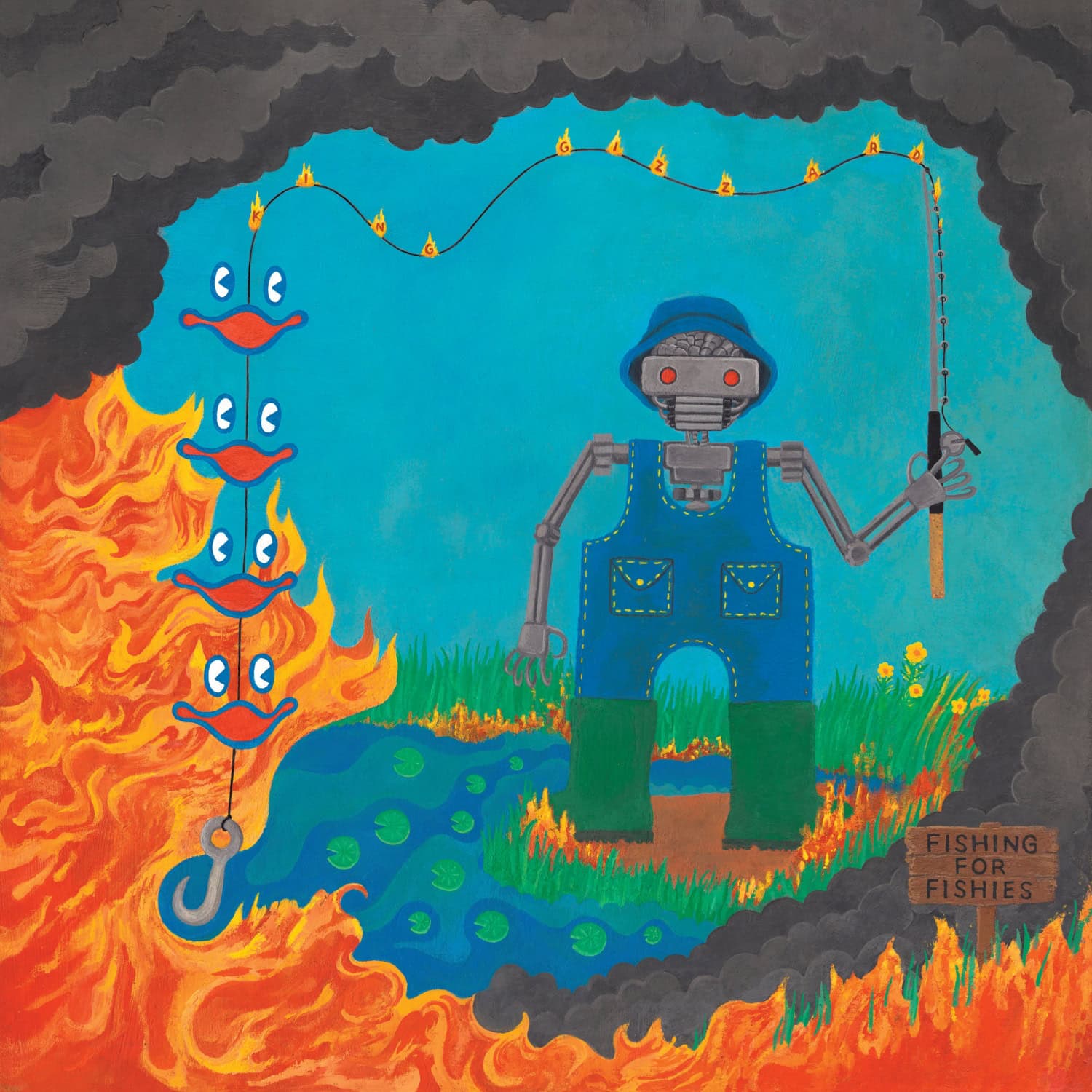
As the album’s cover of a cartoon robot fishing in a hellish lake of fire suggests, King Gizzard’s main concern is environmental and social degradation in the digital age. The band amplifies the perils of our world, envisaging an apocalyptic landscape marked by plastic-choked oceans, wildlife extinction, and millennials deprived of meaningful human interaction. They underpin this subject matter with muddy blues guitar, intensifying the sense of doom by emulating the jeremiads of the blues traditions, and with shuffle boogie rhythms. The “boogie” motif that threads through the album juxtaposes the celebration and dance of boogie music with sobering lyrics. “Death will come from plastic/Death will come from people,” singer Stu Mackenzie chants on “Plastic Boogie” as a crowd claps and cheers over a blazing guitar lick.
For all of its attempts at unconventionality, though, Fishing for Fishies fails to yield anything truly novel within the scope of blues-rock. “Plastic Boogie” and “The Cruel Millennial” sound like discarded B-sides from ZZ Top and Ten Years After, respectively. This derivative treatment of blues-rock makes the album one of the band’s most accessible to date, but devoid of their trademark absurdities (eerie soliloquys, road burn-inducing walls of sound, and jigsaw-like song structures), what’s left is arid and unmemorable.
With the introduction of electronic elements and musings about a dystopian, cyborg-dominated future, the tail-end of the album recaptures some of its initial vigor and intrigue. “This Thing” opens with another ZZ Top-influenced guitar lick, but in this case, the track transitions into a strange psychedelic brew of flute, harmonica, and synth drones. The use of microtonal tuning on “Acarine” lends it a disorienting feeling that’s supplanted by a moody house outro. The closing track, “Cyboogie,” returns to boogie rhythms but features zany Auto-Tuned vocals and a cyborg as its protagonist. Certainly, the shift from the humanity and warmth of blues-rock to the synthetic robotics of electronic music is intentional, but the album ends too abruptly for one to clearly discern the full extent of its significance.
Since 2001, we've brought you uncompromising, candid takes on the world of film, music, television, video games, theater, and more. Independently owned and operated publications like Slant have been hit hard in recent years, but we’re committed to keeping our content free and accessible—meaning no paywalls or fees.
If you like what we do, please consider subscribing to our Patreon or making a donation.