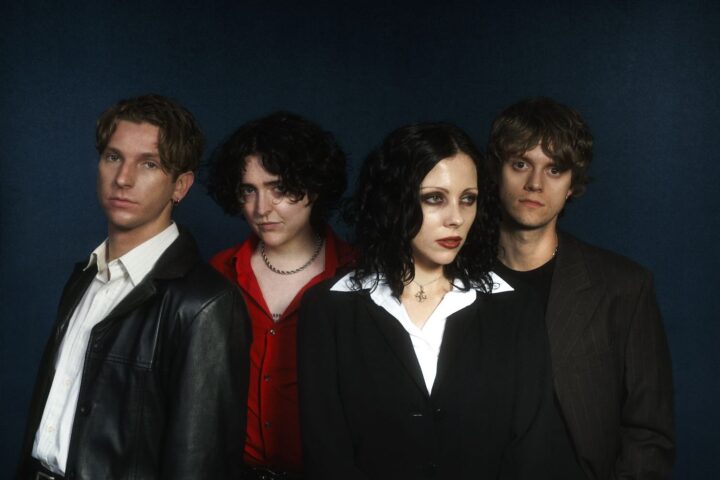
Muna’s signature open-hearted yearning and unapologetic celebration of self-expression are present and accounted for on Dancing on the Wall. The indie-pop band’s fourth studio album is chock-full of rollicking, ’80s-inflected power pop, but beneath the band’s propulsive beats and delectable hooks is a mournful plea for the girls and gays to not only get their asses to the dance floor, but open themselves up to intimacy.
With an added emphasis on charging dance-pop beats, Dancing on the Wall quickly positions the dance club as the site where these big feelings can be especially messy. This is made manifest on “It Gets So Hot,” as lead singer and songwriter Katie Gavin paints a vivid picture of a girl dancing at a party whose make-up is dripping onto the ground.
Gavin has always excelled at wringing compact metaphors out of the highs and lows of queer existence, particularly when it comes to the euphoria and humiliation that can come with it. “On Call” finds her subsuming her dignity for someone not willing to reciprocate (“I wanna be somebody to you/But if you just want a warm body, that works too”), while the slightly clichéd premise of “Wannabeher” is remediated with some choice double entendres (“If I can’t be her, then I wanna be with her/Hoping that she rubs off on me when I kiss her”).
Throughout, Gavin uses a raspy belt to shake awake her disaffected, despondent queer brethren, specifically the green-eyed stoner of “Mary Jane” and the non-monogamous dumpee of “Eastside Girls.” Even the anthemic title track is laced with queasy desperation, as Gavin’s emotionally avoidant object of affection drives her (literally) up the wall.
Around the album’s midpoint—signaled by the melancholic outro of “So What” followed by the brief, uneasy interlude “Party’s Over”—things shift into more explicitly political territory. “Big Stick,” for one, sees Gavin coolly railing against the patriarchal machinery that maintains the status quo. This move is a bit jarring, as the breadth of the topics ranges from cosmetic surgery to the U.S.’s funding of apartheid states, replete with well-intentioned but corny lines such as “We give kids in Palestine PTSD/But we’ll never fucking ever give them something to eat.”
Dancing on the Wall also finds Muna making music with a slightly harder, darker edge. Guitarist and producer Naomi McPherson’s drum lines are thick, and guitarist Josette Maskin’s licks blaze across tracks like “Girl’s Girl.” It’s an invitation for listeners to dance and groove without fully checking out from their righteous anger. Even Gavin’s undeniable chemistry with a suitress forces her to take pause and second-guess her own bliss over an arrangement of neurotic strings on “Why Do I Get a Good Feeling.”
This provides Dancing on the Wall with a relative tonal cohesiveness that has the paradoxical effect of making the project feel at once more complete than Muna’s prior efforts yet also less surprising, infectious, and perennial. But maybe I should take Gavin’s advice on the plaintive final track, “Buzzkiller,” to just “give it a month” and maybe “it’ll feel like a drug.” After all, pop music needs some room to mature alongside the times, just as Muna has proven they can.
Since 2001, we've brought you uncompromising, candid takes on the world of film, music, television, video games, theater, and more. Independently owned and operated publications like Slant have been hit hard in recent years, but we’re committed to keeping our content free and accessible—meaning no paywalls or fees.
If you like what we do, please consider subscribing to our Patreon or making a donation.