Writer-director Jonas Bak’s semi-autobiographical Wood and Water is a gentle depiction of modern alienation. The film unfurls through a series of echoes across time and space, starting with Anke (Anke Bak, the director’s mother), an elderly widow, walking around her beach house on the Baltic Sea reminiscing about the past before a montage of old photographs illustrates what she’s reliving. Pointedly, the most meaningful difference between the film’s present-day shots of the house and its grounds and the old photos is that Anke’s adult children dot the latter while the former are bereft of people.
Anke, who’s just retired from her career as a church secretary in her small town in the Black Forest region of southwestern Germany, is a taciturn and reflective woman. To commemorate her retirement, she plans a getaway to the family beach house that will serve as a reunion with her children, only to receive a last-minute text from her son, Max, that he’s trapped in Hong Kong because of the government crackdown on pro-democracy protests.
Though external factors clearly play a role in detaining him, Max’s siblings make grousing, vague references to his unreliability, and though Anke doesn’t clearly express any disappointment, her already withdrawn body language tells no lies. Using his mother as something close to a Bressonian model throughout Wood and Water, Bak mostly explores Anke’s reaction to her son’s latest absence through elegant compositions and editing that communicate the depths of her feelings lurking just beneath the placid surface of her life.
Those aforementioned echoes across time and space reverberate further when Anke resolves that, if her son cannot come to her, she shall go to him. The early emphasis on long shots of Anke and her hometown, which highlight the heavy intrusion of trees and foliage into all aspects of her surroundings, soon give way to no less patient glimpses of Hong Kong’s stark urban landscape. Her figurative loneliness in her usual environment becomes more literal when she roams the dense streets near the protests, with the woman forced to speak English with the mostly older locals who offer her guidance and companionship.
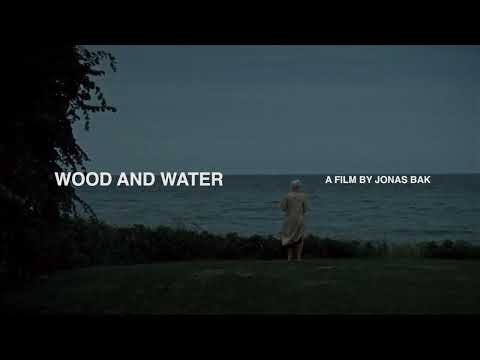
The degree to which Anke’s changing surroundings are both radically different and functionally similar is most arrestingly illustrated when Anke first leaves Germany. As she gets in a taxi to the airport, the camera moves into a not-quite-POV position in the backseat with her, the lens pointed out the rear window and tilted up toward the sky. As the car drives out of the town, the trees that line the streets disappear when the cab heads into a tunnel, the open sky and forest replaced by an inky darkness punctuated by dots of overhead lights that scroll by at the edge of the frame and vaguely resemble sprocket holes.
Suddenly, the yellow, circular tungsten lights lengthen into strips of fluorescent white before the car emerges from a tunnel into the concrete jungle of Hong Kong, trees replaced by looming towers. The obscured cut between locations, and the tunnel being equated to a giant film strip, makes an abstract, metatextual gesture of cinema’s ability to bridge distances.
And yet, Wood and Water never falls into the trap of using an exotic locale to give its protagonist a false sense of “finding herself.” Bak’s reliance on long shots over close-ups consistently places Anke as just one figure among many, and the way that she’s always near the protests but never finds herself among the marchers highlights the film’s shrewd refusal to exploit very real political turmoil as a springboard for personal betterment.
Instead, Anke’s arc is one of learning to accept her feelings of disconnect and to seek moments of humanity as mundane, unremarkable interactions. Throughout, the film stresses the transience of things, as when Anke stays one night at a hostel and speaks with a woman who notes of Hong Kong: “They say it’s going to be quite different here in five years’ time. I don’t really know if I want to be here for that.” She, of course, refers to changing political tides, but Wood and Water suggests that even the most seemingly permanent things are always changing, and that the only way not to drown is to drift with the flow.
Since 2001, we've brought you uncompromising, candid takes on the world of film, music, television, video games, theater, and more. Independently owned and operated publications like Slant have been hit hard in recent years, but we’re committed to keeping our content free and accessible—meaning no paywalls or fees.
If you like what we do, please consider subscribing to our Patreon or making a donation.