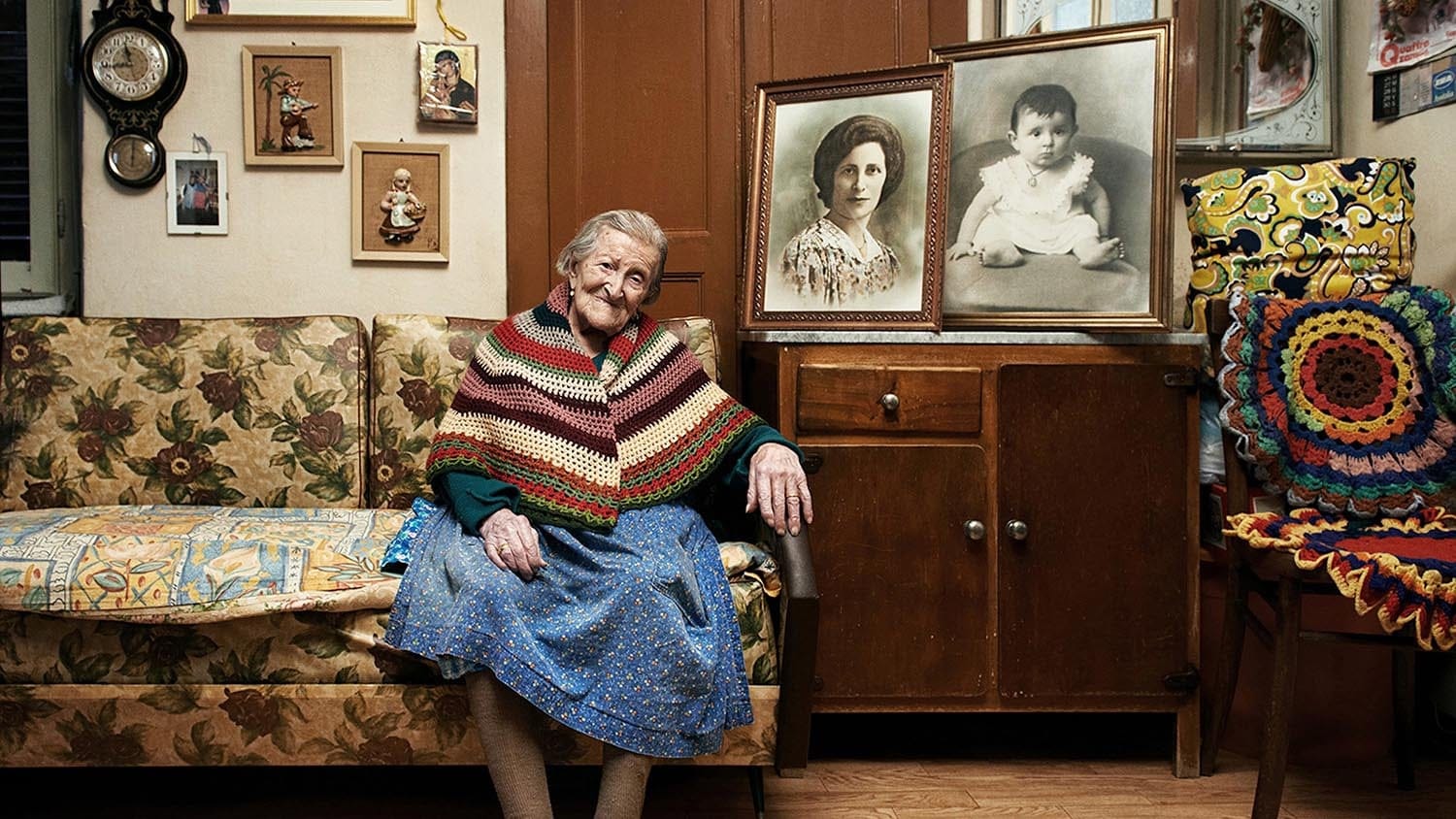
Some things from our school days seem to end up etched indelibly into our minds, so there’s nothing especially remarkable about watching Violet Brown recite a poem she was taught as a child—except for the fact that she learned it 110 years prior. The Oldest Person in the World has a knack for finding moments like this where we can feel the broad sweep of a supercentenarian lifespan, condensed down into a single, everyday occurrence.
Sam Green, director of the Oscar-nominated The Weather Underground, set out to make his documentary with a clear plan in place: to find the oldest living person in existence, interview them, and see what wisdom he could glean in the process. When a new oldest person was crowned, he would go and meet them to do it all again. And again, and again, and again.
That’s because “oldest person alive” isn’t a title that people tend to hold on to for very long. That shouldn’t be surprising to anyone, yet it still feels like a meaningful realization anyway when Green’s documentary points it out. There’s a particular sense of melancholy that comes from seeing each new title holder celebrated and our knowing that their coronation means that their predecessor has passed away. It’s through obvious yet oddly moving observations like this that The Oldest Person in the World continually confronts us with our mortality.
As keen as it is to draw philosophical insights from its subjects and their extraordinary life spans, the film doesn’t shy away from the physical realities of extreme age. Green meets his first subject, Susannah Mushat Jones, at a 115th birthday party that she spends slumped in a wheelchair, drifting in and out of consciousness. There’s something a little unsettling about the zeal with which the guests and politicians in attendance parade an oblivious Jones around. As a Guinness World Records official will later point out, it’s often the friends and families of the entrants who seem to be most enthusiastic about claiming the record.
The feelings of the title holders that Green meets certainly vary. Lucille Randon is a French nun with a stern demeanor and a bone-dry sense of humor, admonishing God himself for “going too far” by making her live so long. The 119-year-old Tanaka Kane, on the other hand, is excited about her prospects of overtaking Jeanne Calment to become the oldest person of all time. Calment smoked almost every day for the better part of her 122-year life, while Tanaka is rarely seen without a bottle of Coca-Cola at hand. Another of the obvious yet profound insights offered by The Oldest Person in the World is that the amount of time we get is a crapshoot.
Every journalist who encounters the world’s oldest person seems to feel obliged to ask them what the secret to living so long is—the subjects here attribute their longevity to everything from a fondness for sleep to a strict avoidance of men—but Green wisely spends more time focusing on what it means to live in the world for so long. Even the most ordinary life seems extraordinary when stretched out across a century, and each interview in The Oldest Person in the World zeroes in on something that gives us a sense of that immense history, from Brown’s poem to 117-year-old Emma Morano’s performance of a song from the 1932 film What Scoundrels Men Are!, which she saw in theaters while going through marital strife. From religious devotion to familial dedication and a simple ability to take things as they come, each oldest person has arrived at a clear idea of what their time on this Earth has meant.
The concept of age and mortality is something that Green also personally confronted during the 10-year making of his documentary. During that time, he became a father, lost a parent, and received a terrifying diagnosis while working on the project, ultimately deciding to weave his personal story into the film. Thematically it makes sense, as these seismic events bring him face to face with the questions of life and death that The Oldest Person in the World exists to ponder.
And Green makes for an engaging narrator, managing to strike a wistful yet wryly self-aware tone that’s perfect for a film dealing with both the marvel of supercentenarian life spans and the blunt realities of death. But The Oldest Person in the World never seems as insightful when the camera is trained on Green himself as it does when he has it pointed at someone else. Perhaps he’s simply too close to the events of his own life to process them fully, though it’s hard to blame any human being for struggling to wrestle with that amount of personal turmoil.
In the end, it’s Green’s subjects who provide the film with all of its most memorable moments. Maybe that’s because they’re able to gaze back at their lives from a perspective of such incredible distance. Hopefully in 50 years’ time, Green, too, will enjoy their kind of clarity.
Since 2001, we've brought you uncompromising, candid takes on the world of film, music, television, video games, theater, and more. Independently owned and operated publications like Slant have been hit hard in recent years, but we’re committed to keeping our content free and accessible—meaning no paywalls or fees.
If you like what we do, please consider subscribing to our Patreon or making a donation.