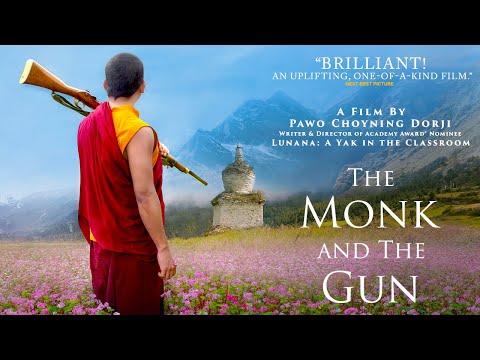
Bhutanese writer-director Pawo Choyning Dorji’s second feature, The Monk and the Gun, begins with a crackling radio broadcast. It’s 2006, but as it’s only been seven years since the Kingdom of Bhutan lifted its ban on television and internet, this is still the most efficient way to bring information to the masses. The broadcast itself informs the people of a bold new form of modernity that’s about to arrive in the country: democracy.
The main plot of The Monk and the Gun concerns the old lama (Kelsang Choejay) of a small village named Ura. He seems disturbed by the news that the king will be stepping down, so as to cede power to the people, and asks his young disciple, Tashi (Tandin Wangchuk), to help him with a ritual that will “make things right.” He won’t say what this ritual is—only that it must take place in a few days’ time and that he’ll need a pair of guns to perform it.
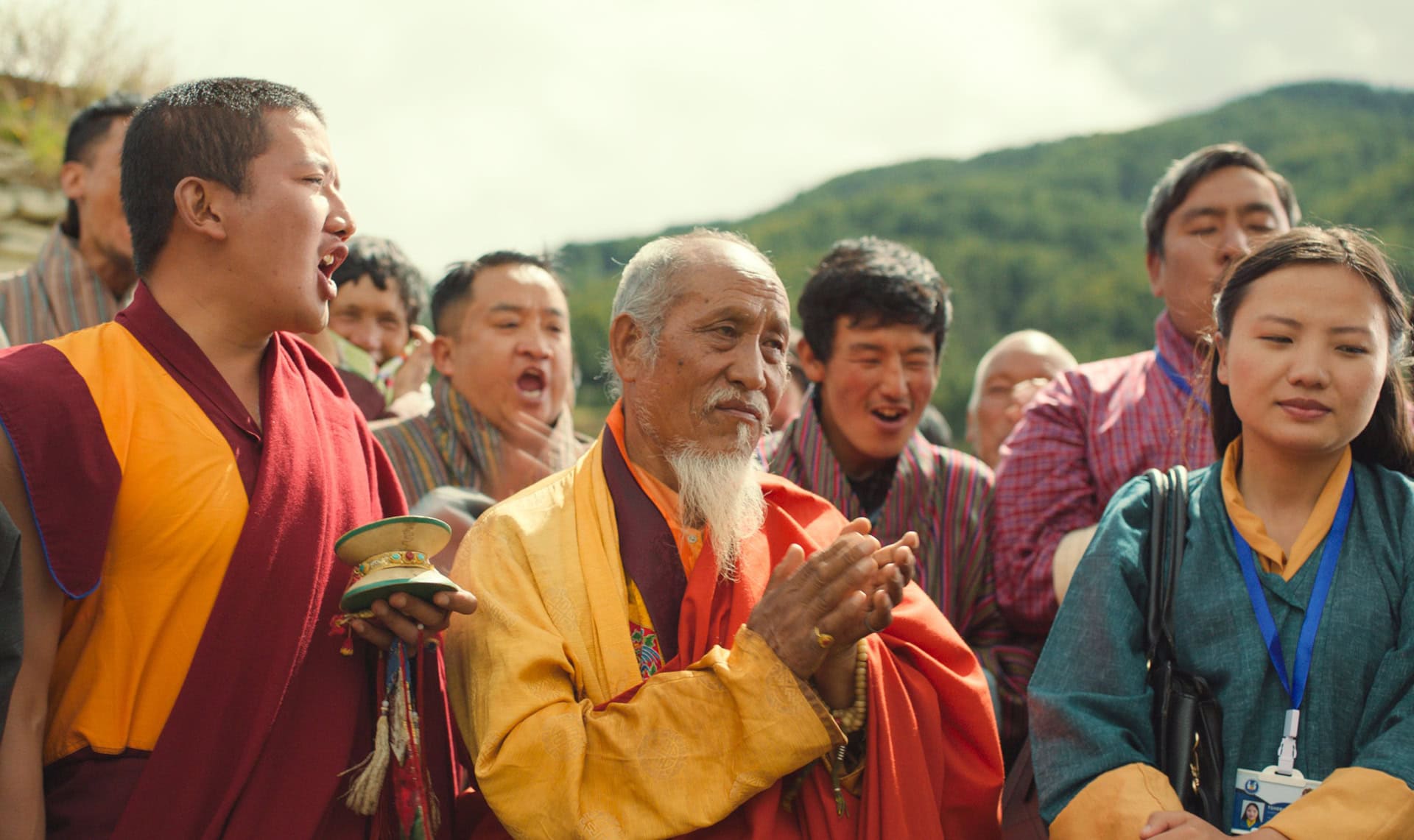
As Tashi wanders the village in search of these weapons, the film pulls away from him to investigate the lives of others as they prepare to take part in their country’s first election. It’s a mosaic-like approach to storytelling, with the narrative drifting freely between smaller tales that combine to provide a full picture of the community during this time of political upheaval.
Reactions to the news of the upcoming election vary sharply. We first meet Choephel (Choeying Jatsho) scowling from his window as a neighbor parades their new widescreen TV around the village. He’s embarrassed by his nation’s old-fashioned ways and is enthusiastic about Bhutan “joining the modern world” for the same reason that he’s self-conscious about the size of his own television: It’s a matter of keeping up with the joneses on a national scale.
Choephel’s wife, Tshomo (Deki Lhamo), doesn’t share his enthusiasm. In fact, most of the village doesn’t. They like the king and struggle to see what a bunch of politicians making vague promises about “industry” and “freedom” will do to affect the lives they lead out in the mountains. In several scenes, government officials harangue locals into turning up for mock elections that only serve to make the whole notion of democracy seems more ridiculous.
The voters are asked to choose between a Blue, a Red, and a Yellow party, with the officials even encouraging them to jeer at their political rivals, pantomiming the political division of those countries in the West that they’ve heard so much about. In the end, almost everyone ends up supporting the Yellow party not because of any of the promises in its manifesto about preserving the past, but because, in Bhutan, yellow is a color associated with the king.
The Monk and The Gun draws plenty of humor from this collision of attitudes and ideas, especially after a somewhat clueless but well-financed American named Ron (Harry Einhorn) arrives on the scene, hoping to purchase the same rifle that Tashin has been tracking down. Even with the help of his guide and translator, Benji (Tandin Sonam)—an industrious young hustler from the city—Ron still finds himself on a wild goose chase. Along the way, his bungled attempts to make a deal lead to some of the film’s funniest interactions, and a number of astute observations about the cultural differences between American and Bhutan.
“This gun is like a long-lost treasure for him and his people,” Benji says, attempting to smooth-talk one seller. It’s a funny line in a film where Bhutan is constantly described in terms of how young its democracy is and how much catching up it has to do to nations like America. Safe to say, an object barely 200 years old wouldn’t be described as a “long-lost treasure” in Bhutan.
For all the fun The Monk and the Gun has observing this culture clash, it never makes any firm statement about Bhutan’s modernization. Jigme Tenzing’s stunning cinematography captures the country’s landscapes in all their vibrant beauty, lush green hills with the brightest blue sky hung above them. It would be easy to romanticize a land like that and hope that it always remains idyllically old-fashioned. But the film also takes time to show how much harder life is when washing your clothes means hunkering over a basin and scrubbing your hands raw.
“I don’t know anything about these modern ways. I don’t know if these are good or bad for us,” the old lama admits when the day of his ritual eventually rolls around. The Monk and the Gun seems to feel similarly ambivalent. But when it finally reveals the lama’s intentions for the guns that Tashi brings him, the film pulls off something truly bold: taking what are perhaps the most emotionally and symbolically loaded items in existence and subverting their meaning completely to end on a note of peace, joy, and hope for the future.
Since 2001, we've brought you uncompromising, candid takes on the world of film, music, television, video games, theater, and more. Independently owned and operated publications like Slant have been hit hard in recent years, but we’re committed to keeping our content free and accessible—meaning no paywalls or fees.
If you like what we do, please consider subscribing to our Patreon or making a donation.