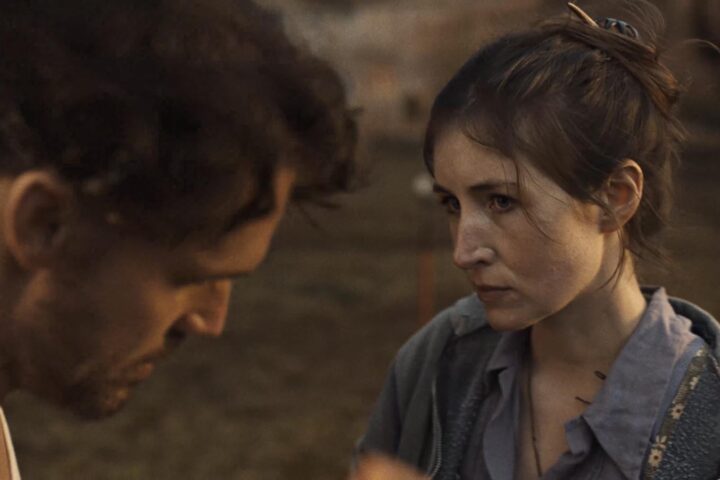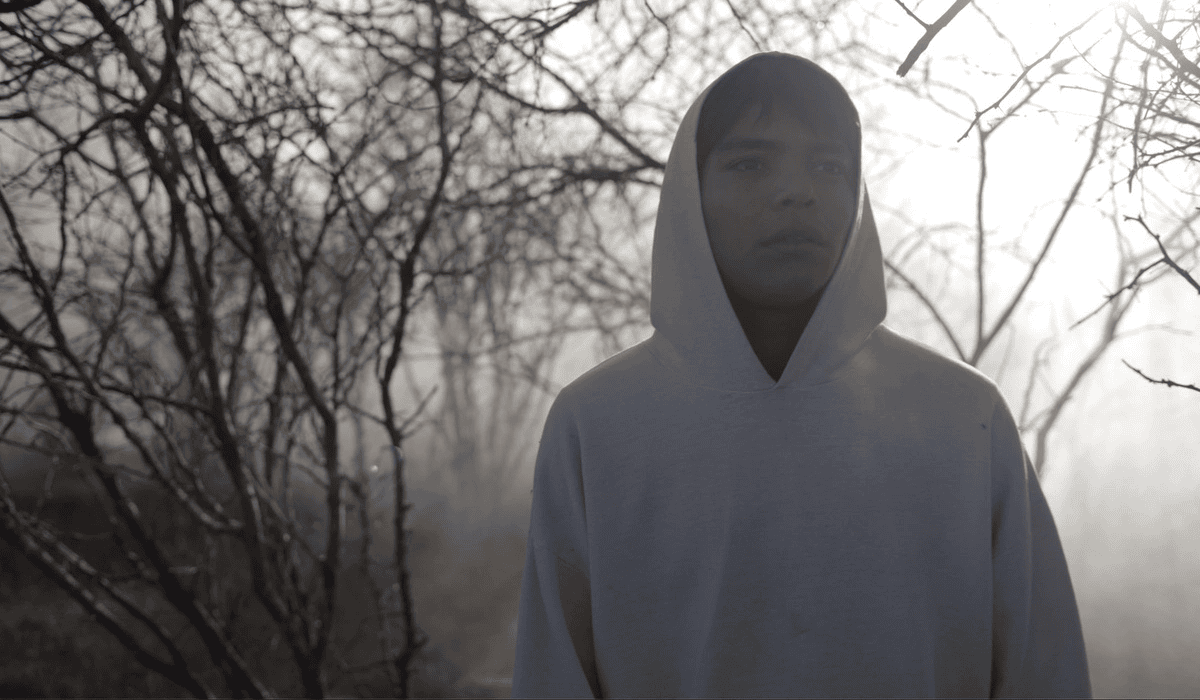
Early in writer-directors Fernanda Valadez and Astrid Rondero’s Sujo, the eponymous character (initially played by Kevin Aguilar) faces down the prospect of his own death. Josué (Juan Jesús Varela Hernández), a cartel sicario from Michoacán, Mexico, was branded a traitor and murdered, and now, Sujo, his only son, must be dealt with. The only indication that little Sujo even grasps the danger of the situation is when he wets himself while hiding under a table as a cartel assassin comes calling. But it doesn’t matter to the cartel that the boy is far too young to seek vengeance. What matters is Sujo’s connection to Josué, and that the burden of history and blood is such that it may very well shape him into his father’s son.
In this way, the film concerns itself with legacy and free will. Sujo’s aunt, Nemesia (Yadira Pérez), begs for the child’s life, insisting that he will be different from the other boys who grow up in the vicinity of the cartel. She agrees to raise him away from town, sheltering him from the world in her remote shack. Yet even as she proclaims that Sujo isn’t tainted by his father’s deeds, she clearly doesn’t completely discard the idea of Josué’s lingering influence; for one, she refuses to use the car that the man left behind, remarking that she doesn’t know what he used it for or what he did to earn it in the first place. Indeed, the audience’s first glimpse of Sujo is of Josué leaving him inside that very car and turning up the radio and stepping out to kill a man. The vehicle shelters Sujo from violence at the same time as it makes that violence possible.
Befitting the unseen forces that seem to drive the characters, Valadez and Rondero bring a haunted, dreamlike undercurrent to the film similar to sequences from their prior collaboration, Identifying Features. Cutaways capture objects against a pitch-dark background, from a door seeming to open into the night sky, to a fire flickering in reverse, as though pulled from thin air. One character calls Nemesia a witch, and she sees ghosts, including Josué’s, wandering the terrain surrounding her shack, as though passing through it on the way to the underworld.
There’s a richness to Sujo’s establishing scenes, of Nemesia adjusting to raising Sujo and her relationship with a woman (Karla Garrido) in town whose sons become like brothers to the boy. But after a certain point, much of Nemesia’s struggle begins to play out off screen, and between chapter breaks as the film skips ahead to show Sujo having broken into his nascent adulthood. We don’t watch the aunt raise him for long after she takes him in, and when she scolds him as a young man (now played by Juan Jesús Varela), she displays a certain resignation, as though aware that he can’t be swayed from the path of death by words alone.
As in Identifying Features, Valadez and Rondero’s film favors leaving things unseen and unspoken, the camera often wincing away from horrific scenes and rarely looking cartel figures in the eye for more than a few seconds. After all, the people we do observe at length, like Sujo and Nemesia, are the ones who must deal with the aftershocks of the cartel’s whims. Their lives are upended by an outside force, with the cartel casting a shadow as long as fate’s.
This approach works well to a point, and it’s succinctly expressed in an early shot of Sujo walking among a herd of goats, as though he were being steered alongside the animals. But the film hitches itself so firmly to the boy’s lack of agency for so much of its running time that, once he starts developing the interests necessary to flourish, the depiction of his attempts to exert greater control over his life comes to feel like an afterthought. The adult Sujo’s efforts to pursue an education in Mexico City hinge entirely on a few images of the child Sujo reading books and remarking that he would like to go to school. Like so many films that try to chart the years of a person’s life, Sujo is never quite convincing about conveying the passage of time.
On some level, the simplicity of Sujo’s character is the point: He’s been stuck in a state of arrested development, and the film’s abrupt jump forward in time is meant to demonstrate how little room he’s had to grow and change. But the scant emphasis on what kind of life the boy missed out on by growing up so sheltered, or even on Nemesia’s attempts to deter him from his father’s path, eventually robs the story of the full impact it might have had. In Mexico City, Sujo feels less guided by history and circumstance than by the hand of an author. Though the film never totally loses the sheer power of its somber atmosphere, its story goes out on more of a mechanical note rather than the poetic one that it’s seemingly building toward.
Since 2001, we've brought you uncompromising, candid takes on the world of film, music, television, video games, theater, and more. Independently owned and operated publications like Slant have been hit hard in recent years, but we’re committed to keeping our content free and accessible—meaning no paywalls or fees.
If you like what we do, please consider subscribing to our Patreon or making a donation.