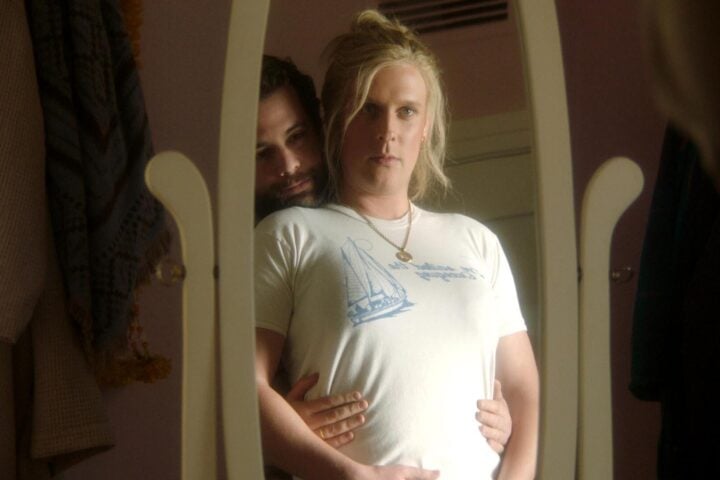
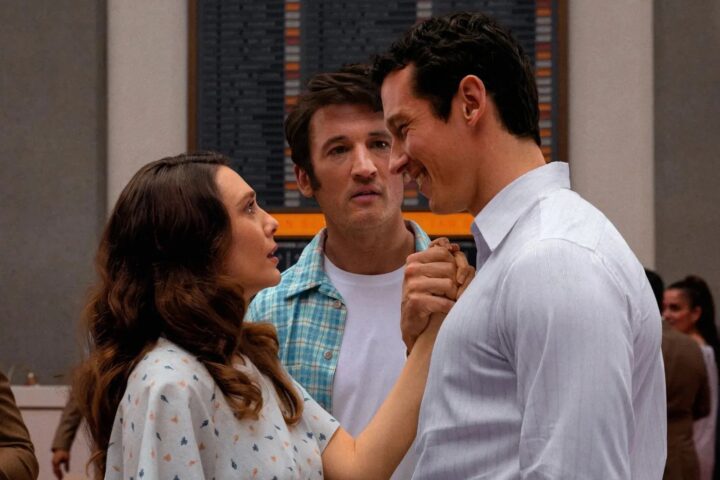
Everybody in writer-director Theda Hammel’s comedy Stress Positions wants to know about Bahlul (Qaher Harhash), the 19-year-old Moroccan model. Bahlul’s leg is broken, and he’s being nursed back to health by his white uncle, Terry Goon (John Early), who’s living in the Brooklyn “party house” of his soon-to-be-ex-husband, Leo (John Roberts). Terry shelters Bahlul like a wounded bird, vacating all evidence of whatever debauchery took place within the house and insisting that his nephew is too grievously injured for visitors. But the more that Terry tries to keep people away, the greater the mystique is attached to Bahlul.
Of course, as it’s the early days of the Covid-19 pandemic, anything that breaks the monotony of self-isolation gains a grand allure—especially if it happens to be a person whose job is to be hot for a living. Right out of the gate, Hammel’s threading of themes into her pandemic comedy is as textured, antic, and hilarious as her gift for characterization. Take Terry’s helicoptering, which is understood as a harried overcompensation for his past post-9/11 conservatism. His best friend, Karla (Hammel), needles him about his behavior when she finds an excuse to visit him at the brownstone, but she, too, is an agent of chaos. Restless in her relationship to a lesbian novelist (Amy Zimmer), Karla flirts not just with Bahlul but with a Grubhub courier (Faheem Ali).
The film’s dialogue crackles with nervy life, reveling in the self-absorbed toxicity of the characters, namely the ignorance they trumpet when they say things in ostensibly “safe” company. Hammel sketches a world of deeply dissatisfied people, and Bahlul’s presence mixes with pandemic stressors to bring their anxieties to the forefront. Karla plays up her “Mediterranean” heritage around any person of color, while her privileged partner bemoans the childhood pain of growing up around “blondes.” They’re quick to speak on the evils of America, though they’re even quicker to dismiss Bahlul’s country as some kind of backwards hellhole, even though they have no idea where it is and whether it’s part of “the Middle East.”
Stress Positions is at its most focused when it’s balancing its character observations with a gradual pileup of farcical incidents, from the weird upstairs neighbor (Rebecca F. Wright) who fixes the internet while refusing to wear a mask, to Terry throwing out his back by slipping on a piece of raw chicken. (The moment that Terry effortlessly bangs a pot out the window in support of frontline workers, and without pausing one of his shrieking spiels, is especially gut-busting.) But as the film progresses, so many threads of plot have been gathered together that you may feel worn down by the patchwork, not least of which because some of the more underdeveloped tangents, such as one about surveillance, lead the story down a more conventionally zany path.
But even as aimlessness begins to overwhelm Stress Positions, it remains an astute study of Bahlul in particular. Where another film might have reduced him to a prop in order to underline the casual racism of those around him, the film is deeply attuned to how he has to swim against currents of white toxicity. To everyone, his seemingly unsullied youth is both a source of desire and threatening. They want to possess him, to be him, or at least to shape him. Karla, for one, nudges him to explore femininity, prompting an outcry from Terry that “not everyone is trans!” Yet Bahlul possesses a life beyond what these solipsistic Brooklynites project upon him.
From the way he scribbles in his notebook and regards others, especially Terry, with quiet bemusement, it’s clear that Bahlul is still trying to figure himself out. Snippets of his life story make their way into the film’s narration, paralleling current events while providing insight into his upbringing by a conservative white mother. It’s a gesture on the part of the filmmakers that gets at how Bahlul is able to talk over the white-centric chaos all around him, showing that his attention is elsewhere and that the events of the film aren’t nearly so monumental and formative as the people fawning over him might believe. In this and other ways, Stress Positions is a sharp and funny analysis of modern discontent and the pandemonium that it breeds.
Since 2001, we've brought you uncompromising, candid takes on the world of film, music, television, video games, theater, and more. Independently owned and operated publications like Slant have been hit hard in recent years, but we’re committed to keeping our content free and accessible—meaning no paywalls or fees.
If you like what we do, please consider subscribing to our Patreon or making a donation.