The secret desire of Slanted’s protagonist, Joan Huang (Shirley Chen), isn’t very PC. Written and directed by Amy Wang, the film introduces this high school senior, the child of Chinese immigrants on the cusp of their 10-year anniversary of moving to a nondescript American town, as a victim of prejudice and isolation. The young woman wishes she could just disappear into the homogeneity of whiteness, free of dirty looks or total social stonewalling.
Joan just wants to be prom queen, and believes that she has to look like past queens (read: white) to take the crown, but the film implies that she may actually want to be an all-American white girl. When a Snapchat-esque race filter picks her as one of the top users and offers her an avenue out of her adolescent nightmare in the form of a surgical process to change her race by a mysterious company called Ethnos Inc., Joan jumps at the chance. She goes in as a peroxided young Asian Joan Huang and comes out a model blonde named Jo Hunt (McKenna Grace).
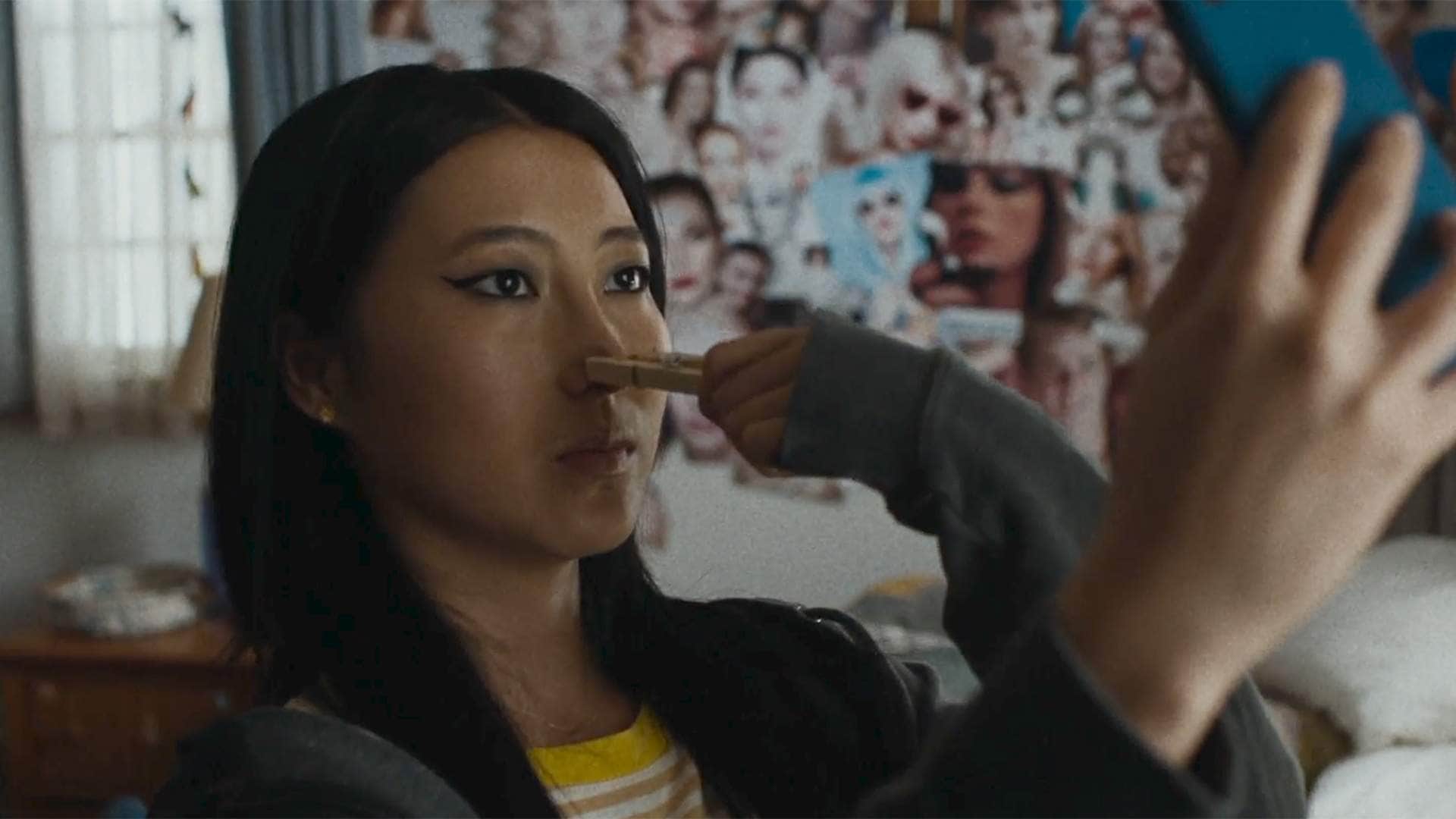
Across the film, Wang defines whiteness predominantly within the parameters of beauty standards and social acceptance. A few jokes hazily nod to the professional disadvantages of being a person of color and the connection between whiteness and ideology. There are the expected bits about Joan refusing to eat her mother’s (Vivian Hu) cooking at school and her shame over her father’s (Fang Du) janitorial job. We also get the obligatory shot of her with a clothespin over her nose, so that it can look narrower. But idealized whiteness primarily takes the form of popular girl Olivia (Amelie Zilber, doing her best Regina George impression), an actress and influencer whose social standing both could improve Joan’s chances at winning prom queen and extends the fantasy of the ease and glamour of being white.
The impulse to assimilate as white is worthy of sympathy to some degree, especially if you’re a young person in the context of a horror film, but Slanted struggles to earn ours given the single-mindedness of the nightmare of assimilation that it imagines. Even after Joan transforms into Jo, the net result is that she becomes popular and accepted, and not much else, besides throwing her Sri Lankan bestie, Brindha (Maitreyi Ramakrishnan), under the bus.
As for the sprinkling of body horror, it’s not grotesque enough to be really scary, nor does the film take the presentation or performance of whiteness to ludicrous enough ends. It’s a lot of buildup with frustratingly stagnant drama as consequence, even if it’s supposed to be a pathway for Jo(an) to experience regret over her racial change and consider what she’s lost of herself.

Slanted is most keen when imagining whiteness and the phantasmagoria of white society as an off-kilter fever dream of Stepford-esque perfection, and there are a couple of moments that hint at a more compelling and stranger project. When Joan goes under anesthesia, experiencing a morbidly cheery karaoke song about the frictionless existence as a white person, and when she wakes up and walks around in the world in her new body, Wang deploys a dreamy, almost narcoticized look to world. There’s a weird, almost genAI smoothness and uncanniness to those scenes, which are more disturbing and unsettling than the actual body horror elements.
And while its perspective on both the self-harm involved to fit white standards of beauty and whiteness’s pervasiveness in spaces carved out and defined by whiteness within American society are of interest, their execution lack verve and rigor. Wang’s film spends so much time setting up Joan’s internalized racism and the parade of microaggressions that undergird her wishes to become white that the tension of this drama starts to dissipate.
Only toward the very end do we see the film’s potential for a truly deranged take on race, identity, and horror. Even then, Slanted is unable to get over the obstacle that it’s nearly solitary concern is that it’s about a young Asian woman who wishes to be white, without the ambition to further unpack its subject matter regarding race, gender, and ideology.
It is, frankly, small dumplings in the scheme of white supremacist or nationalist violence toward Asian people, much less Asian women. Not to dismiss the psychological effects of internalized racism and body image dissatisfaction, but Slanted has difficulty threading those ideas to a larger concept of whiteness’ permeability into political, social, or economic life more broadly. Even when the Ethnos Inc. CEO, Willie (R. Keith Harris), discloses his reasons for inventing the surgery (he was “passed over for promotion by another white turd with daddy’s money”), Slanted can only imagine the deleterious effects of that assimilation boiling down to personal grievance. But of displacement, ruinous violence against communities, or social and economic marginality, Slanted has little to say, remaining only skin deep.
Since 2001, we've brought you uncompromising, candid takes on the world of film, music, television, video games, theater, and more. Independently owned and operated publications like Slant have been hit hard in recent years, but we’re committed to keeping our content free and accessible—meaning no paywalls or fees.
If you like what we do, please consider subscribing to our Patreon or making a donation.