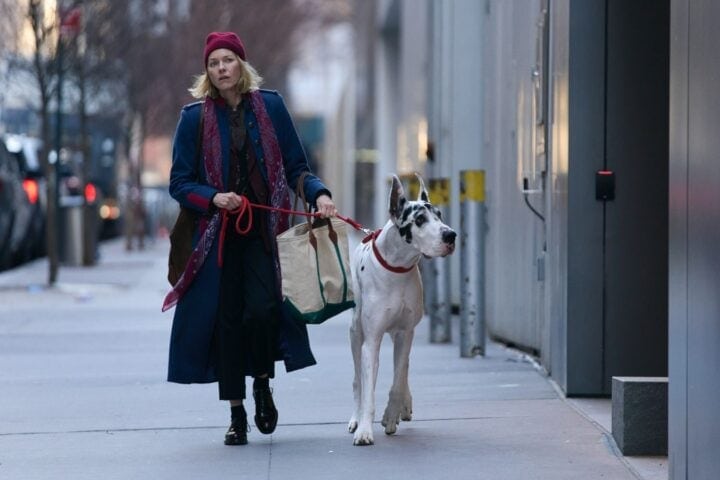
An air of decay and discomfort pervades the dingy Manhattan apartment where nearly all of The Wolf Hour unfolds. An agoraphobic recluse, June Leigh (Naomi Watts) languishes in the unit, overwhelmed with guilt from a past misdeed. The cramped, underlit apartment, full of dusty old books and overstuffed trash bags, takes on an increasingly oppressive quality as the door buzzer continues to go off with unnerving frequency. Despite June’s pleas to whomever is on the other end, all she gets in response is an ominous, crackling static. It’s an unsettling sound that’s a fitting approximation of the feminist icon and writer’s brittle mental state, which is inextricably tied to the decrepit state of a 1977 New York City plagued by sweltering summer heat and the Son of Sam killer’s reign of terror.
From the limited perspective of this tiny apartment, writer-director Alistair Banks Griffin constructs an aura of danger and alienation, filling out the broader scope of the citywide upheaval with street scuffles and snippets of news coverage that June overhears on the radio or television. It’s a provocative setting, which could have served as a compelling backdrop for June’s mental unraveling, but the acutely detailed portrait of this specific time and place never extends to that of the muddled, half-baked characterization of the woman who inhabits it.
Watts has made a career playing the most brooding and agitated of characters, and with a practically unparalleled visceral depth. Here, her subtly skittish gestures and facial expressions lend June a raw, nervous energy that suggests a woman on the verge of losing her mind. Strange, cathartic scenes, such as when June abruptly lets loose and feverishly dances to Suicide’s “Ghost Rider,” gives a strong sense of how far she’s strayed from the person she once was. But such unexpected character beats arise too infrequently throughout the film, and for all of Watts’s efforts, the roots of June’s anguish are never more than vaguely explored.
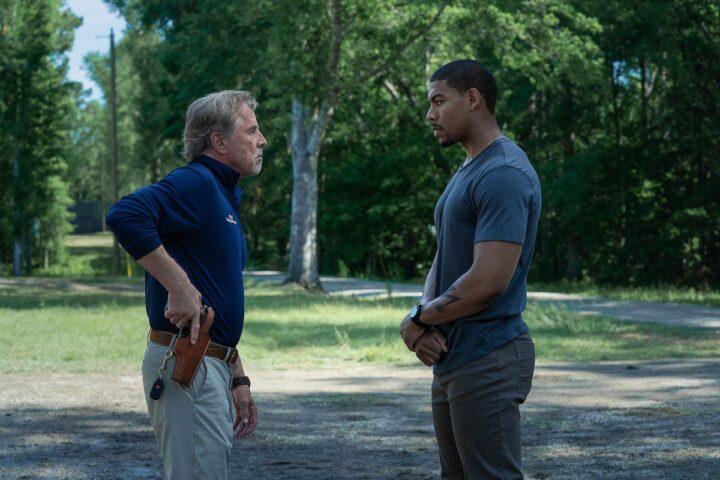
In an attempt to flesh out June’s interiority, Griffin’s script works in a handful of people who visit her apartment. But none of these characters, from her sister (Jennifer Ehle) to a grocery deliveryman (Kelvin Harrison Jr.) to a compassionate gigolo (Emory Cohen), offer much insight into the celebrated genius that June used to be. In fact, it’s only through June’s viewing of a contentious TV interview that she gave when her first book was released that we get any sense of the catalyst for her downward spiral. It’s a remarkably contrived manner of inserting much-needed backstory into The Wolf Hour, but even worse, it hints at a story far more intriguing than the miserabilism that quickly reveals itself to be the film’s default mode.
That interview reveals that June had a tumultuous fallout with her family due to her leftist screed’s thinly veiled criticism of her businessman father. It’s a turn that suggests something akin to the complicated father-daughter antagonism between Shiv and Logan on HBO’s Succession, yet Griffin does nothing with this bombshell, simply returning to June as she continues to drown in her paralyzing guilt. An abrupt and woefully misguided deus ex machina attempts to do some heavy narrative lifting, but it changes our perception of June without laying the sort of groundwork needed to make such a twist land with any gravitas.
In the end, June remains an enigma and the film’s finale only solidifies the notion that Griffin never had any interest in plumbing June’s emotional struggles. Like the sweat covering June’s face at all times or the dust that coats her apartment, The Wolf Hour is all surface, and its depiction of trauma only becomes increasingly exploitative and hollow as it moves along.
Since 2001, we've brought you uncompromising, candid takes on the world of film, music, television, video games, theater, and more. Independently owned and operated publications like Slant have been hit hard in recent years, but we’re committed to keeping our content free and accessible—meaning no paywalls or fees.
If you like what we do, please consider subscribing to our Patreon or making a donation.