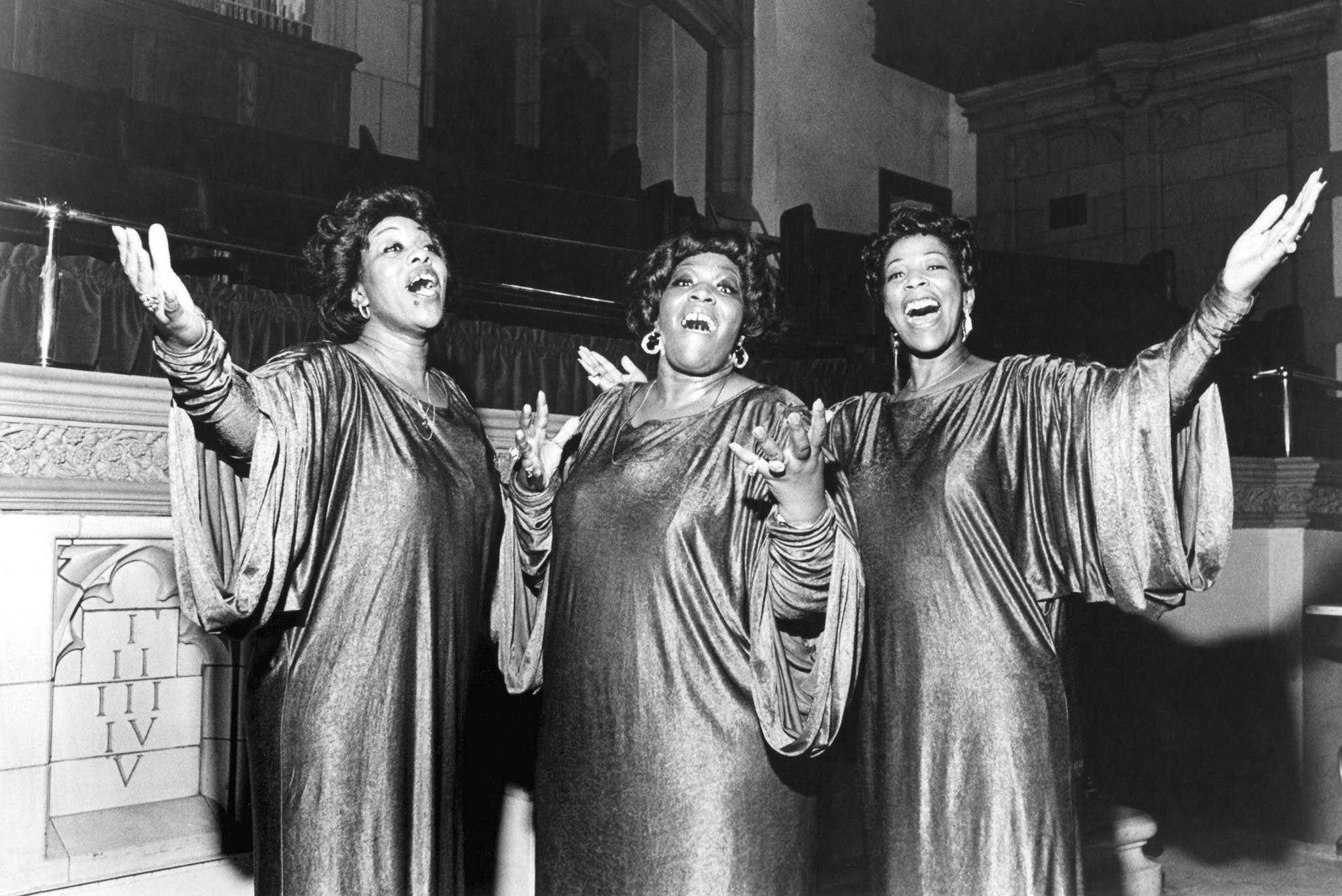
George T. Nierenberg’s 1982 gospel documentary Say Amen, Somebody honors the power of storytelling in oration as well as singing, allowing a wealth of social context to arise from the anecdotes shared by its subjects, who include such legends as Thomas A. Dorsey, Willie Mae Ford Smith (also known as Mother Smith), Delois Barrett Campbell, and Zella Jackson Price. Filming these and other gospel pioneers as they eat, talk, network, and perform, Nierenberg reveals how the political begets the personal and vice versa, uncovering inherent ironies in the artists’ devotion to gospel while celebrating their talent. The film is a rich fusion of concert doc and character study.
Like Frederick Wiseman, Nierenberg drops us right onto his stage, which in this case is the gospel scene of, primarily, Chicago. It may take a few minutes for gospel neophytes to sort out the various figures, but they have a charisma that stands on its own, especially Mother Smith, who serves as Say Amen, Somebody’s protagonist and nucleus. An elderly, heavyset woman with big glasses that amplify her kind eyes, Mother Smith wears her wisdom, empathy, and weariness with the sort of un-self-conscious strength that shames most people’s self-pity.
Mother Smith’s poignancy and power reside in the contrast between her body’s humility and her voice’s booming transcendence, which turns her various experiences—tragic as well as joyful—into operatic art. Mother Smith makes her singing look easy, as if it’s simply springing from her soul, but we learn bits of her technique in one of the film’s best scenes. When a young man auditions for the National Convention of Gospel Choirs and Choruses, Mother Smith tells him that he has a good voice that he’s throwing away. She says that a singing mouth isn’t pretty, instructing the man to cup his voice in his mouth, contorting it so that it occasionally resembles a horn. Within a matter of moments, the man’s voice attains a sense of body and variation, a kind of vocal bass, which connotes greater soulfulness.
This sort of texture is what separates great documentaries from merely good ones. After Mother Smith coaches this man, Say Amen, Somebody’s subsequent musical numbers are more powerful, as we’re made manifestly aware of the discipline and the rigorousness inherent in their creation. The riddle of art-making involves a fusion of personality and technique that’s so intricate as to render these qualities inseparable. Such devotion has a price to which Nierenberg is highly attuned, as Mother Smith and Zella Jackson Price, among other women, try to balance the expectations of their home with their desire to sing.
Nierenberg, a white man, examines black patriarchy with nimble humanist empathy, resisting the urge to code people as “martyrs” and “oppressors.” Mother Smith and Zella are singers of different generations, and Zella understandably looks to the legendary Smith—who brought gospel to wider prominence by taking it out of the church, implicitly emphasizing its universality—as a mentor figure. In a moment of profound intimacy and tenderness, Zella confesses to Mother Smith at a kitchen table, admitting that she hates to leave her home for so long to tour the country, and Mother Smith tells Zella of the time that her own husband fell down an elevator shaft trying to chase her down and bring her home. The elder woman saw this incident as a sign from God, and her husband never bothered her again.
These singers’ husbands may be traditionalists who wouldn’t pass political muster in the modern age, yet Nierenberg explores their pain and loneliness while honoring the plight of their wives. Zella isn’t solely plagued by patriarchal pressures, as she also feels an authentic need to be with her family. In a brilliant structural flourish, Nierenberg follows Mother Smith and Zella’s conversation with Zella’s astonishing rendition of “I’m His Child,” a song about religious devotion that’s also, on a literal level, about devotion to a man (in this case, Jesus Christ). As documented by Nierenberg, this is the great irony of the female gospel star: They’re resisting male pressures in order to sing about their fealty to men.
The latter form of worship, though, allows women to actualize their dreams of expression—of singing. The ecstasy of Zella’s voice is all the more wrenching because we understand the sacrifice that brokers such a performance. And similar stories keep surfacing in the film. In another moving sequence, Delois tells her husband, Reverend Price, over breakfast that she’s going away to tour in Europe with her sibling act, the Barrett Sisters. He’s heartbroken and clearly downplaying it for the camera, and she feels so guilty that she can’t look him in the eyes. (It seems as if Nierenberg has captured the entire marriage in a matter of minutes.)
Meanwhile, Mother Smith’s grown children visit an abandoned train station, tearfully remembering their mother’s departures and returns. The moment gently contrasts against the sexism of Mother Smith’s grandson, who’s nevertheless moved to tears by her singing in the film’s grand finale. Even Say Amen, Somebody’s most powerful man, Dorsey, who founded the National Convention of Gospel Choirs and Choruses, and who wrote the iconic “Take My Hand, Precious Lord” while reeling from the death of his wife and child, owes quite a bit of his legacy to a woman, Sallie Martin, who helped him monetize his sheet music. At one point, Nierenberg sits Dorsey and Martin together, as they talk of their history and listen to a record player. The filmmaker has a gift for fashioning such sequences, which lyrically boil yards of history down into a handful of warm, suggestive, tactile images.
Nierenberg is also interested in the role of money in the gospel scene. When the film’s subjects intersect, including the O’Neal Twins, they often discuss the practicalities of making it financially in music, and how much religious elements have to be watered down to appeal to wider audiences. (Dorsey’s music was once controversial for its allegiance to the blues, a reaction that’s also ironic given the aesthetic similarity between the genres. To revise an old joke, gospel’s about God while the blues is about women.) For instance, it’s said in Say Amen, Somebody that Mother Smith hasn’t enjoyed the sales of other musicians due to her devotion to communal activity, though she’s every inch the “mother figure” to artists who gained wider prominence. A few of the film’s most exhilarating passages show the artists intermingling in scenes that have been rendered with an Altmanesque sense of personal panorama.
One subject does dangle un-broached over Say Amen, Somebody: racism. Nierenberg offers a beautiful portrait of a branch of African-American culture, including many of its hardships, while refusing to define it via its tortured relationship with Caucasian America—an approach that reveals, by contrast, how often African-American culture is defined vis-à-vis whiteness. Instead, Say Amen, Somebody basks in the personalities of a glorious art, which offers solace from, among other things, the very endemic evil that Nierenberg brushes under the carpet. Although perhaps it’s too easy for a white filmmaker to declare that race is beside the point, a possibility that charges this boisterous, often extraordinary film with a lingering tension.
Since 2001, we've brought you uncompromising, candid takes on the world of film, music, television, video games, theater, and more. Independently owned and operated publications like Slant have been hit hard in recent years, but we’re committed to keeping our content free and accessible—meaning no paywalls or fees.
If you like what we do, please consider subscribing to our Patreon or making a donation.