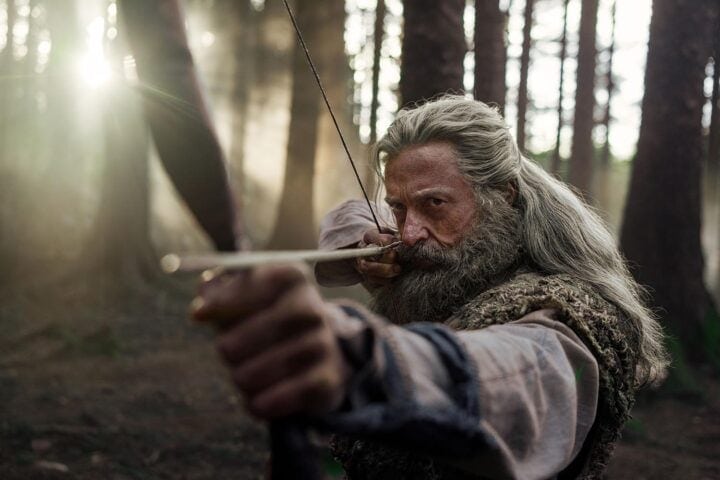
Given that it stars Nicolas Cage, now the fearless and extraordinary demigod of his own personal realm of B movies, one may approach Pig with certain expectations. After all, and as its trailer establishes, Michael Sarnoski’s film is about a nearly homeless man traveling to Portland from the woods of Washington state to find his stolen truffle pig, a setup that’s practically an invitation for Cage to indulge in his signature brand of gonzo theatrics.
Cage plays Rob, a man with a lumbering gate and graying hair and beard that, as complemented by his stylized hobo wardrobe, suggest that he has fully succumbed to resignation and melancholia. When Cage speaks, it’s with a delicacy that pointedly contrasts with his rugged appearance. At times, the viewer may be left craving one of the actor’s prototypically absurdist on-screen outbursts, or a bit of audience-gratifying violence, but what Sarnoski has up his sleeve is a subdued rumination on the contours of grief.
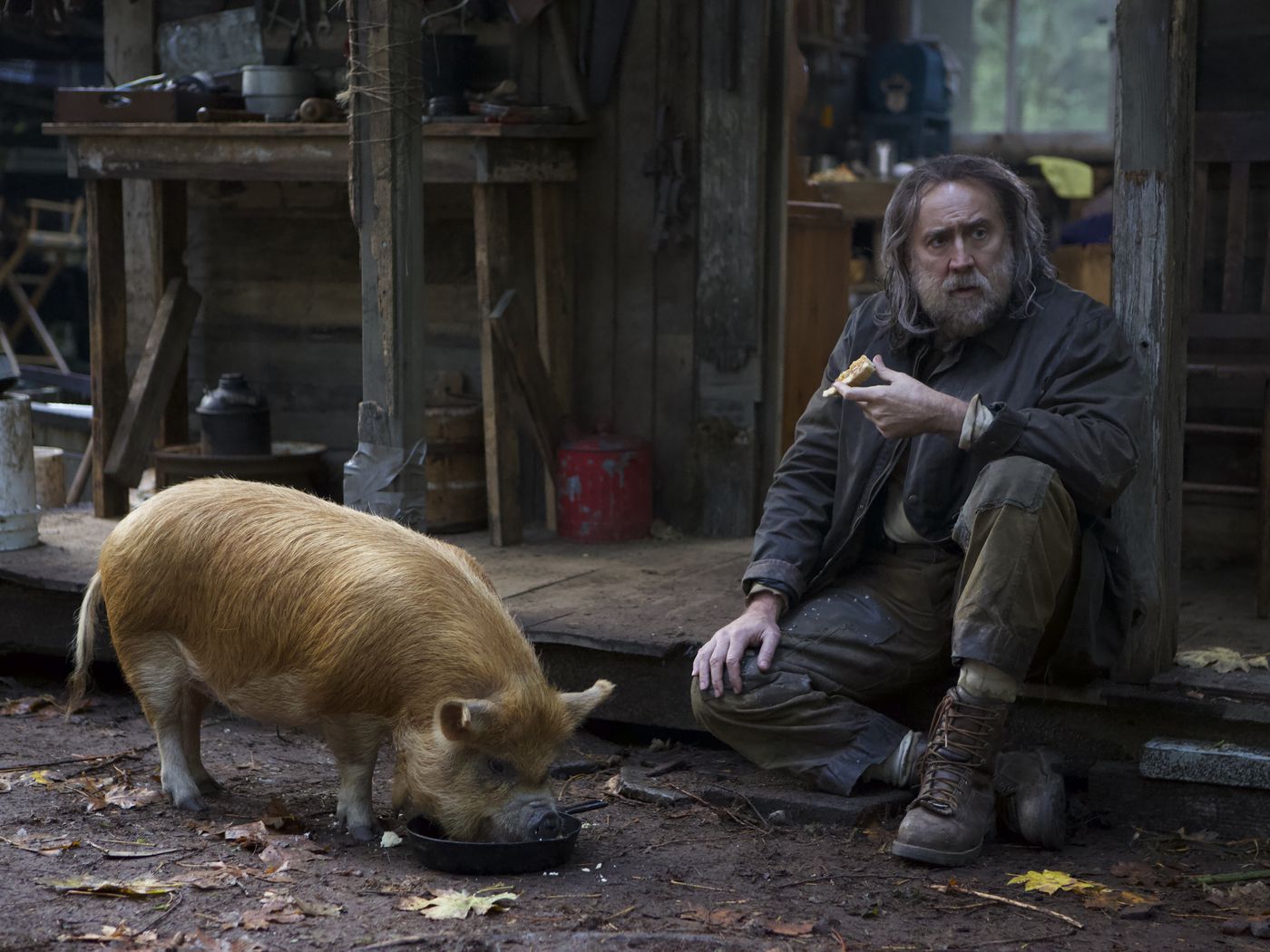
With his pig, Rob hunts for precious truffles that he uses to barter with Amir (Alex Wolff) for goods. Amir, a wheeler and dealer in Portland’s hipster foodie scene, styles himself as a Hollywood agent on the make, and Rob initially treats him as below contempt. For a bit, we’re allowed to enjoy Rob and his pig’s idyll in the wilderness. Few of us could hack such an austere lifestyle, but here, as in many movies, it looks appealing, serving as a refutation of the noise and baggage of modern life. One of the images in this stretch, of Rob sitting on the porch of his shack sharing a truffle tart in silence with his friend, is poignant, as anyone who’s ever been close to an animal will recognize the restorative power of such rituals.
Of course, Sarnoski is setting us up for a sucker punch. Unseen interlopers break into Rob’s cabin in the middle of the night and bash him in the head, taking the pig. Again, this sounds like a pretext for a Cage revenge vehicle that will have him bellowing “You took the wrong fucking pig!” at a pitch that’s somehow poignant and ludicrous at once. Instead, Rob travels to Portland with Amir in tow and gently reminds the luminaries of the foodie scene of his disenchantment with their world. At one point, we’re overtly primed for and denied Rob’s wrath. The man goes to an underground fight club for industry figures and allows himself to be brutally beaten, as if offering his flesh to the gods for answers. Cage, in full martyr mode here, seems to get off on the perversity of, well, caging his brand of operatic hysteria.
It’s eventually revealed that Rob was once a hot-stuff chef, and Pig begins to flirt with becoming a criticism-slash-satire of the pretensions driving modern restaurant culture. First the film gives birth to the evocative notion of an industry fight club that pivots on the exploitation of restaurant workers, only for Sarnoski to quickly abandon the thread. But more piercing anyway is Rob’s plea to a hip restauranteur (David Knell) to return to his roots and open the pub he always wanted, rather than marketing captured vapor as cuisine.
Such scenes underscore Pig’s reactionary qualities, as it clearly sees critics and fancy chefs as ubiquitous fakes taking the power of true, essentially proletarian food from the populace. Like Brad Bird’s Ratatouille, Pig may not be able to imagine a critic who’s as ecstatic about their passions as any regular person (though this critic can attest that a few of them do exist). That said, the mini op-eds that Sarnoski places in Rob’s mouth are persuasive. For one, the extreme rarefication of food, our lifeblood and a source of profound pleasure, is indeed obscene.
Pig is a revenge film that’s ultimately about the futility of vengeance to ease the baggage of the soul. The ostensible villain here is Darius (Adam Arkin), Amir’s rich, bullying father, the alpha of Amir’s chosen profession, who picked a fight with Rob out of heartache, bitterness, and some believably inexplicable issue with his son. Rob and Darius are understood to be reflections of one another—people who, gripped by loss, can no longer seem to fully function. Rob has his forest, while Darius has his chic estate, with Amir looking for a place to fit in.
Pig is a little too in love with its own moroseness—which is to say, it could use a joke or two—but its devotion to its alienated protagonist is cumulatively moving. And the film almost serves as a metaphor for Cage’s own career: He was once the toast of Hollywood, with an Oscar and several Jerry Bruckheimer blockbusters under his belt, who left for the wilderness of eccentric low-budget cinema. This wilderness has allowed Cage to purify his art, honoring his own instincts, as the woods have presumably simplified and enriched Rob’s cooking.
Since 2001, we've brought you uncompromising, candid takes on the world of film, music, television, video games, theater, and more. Independently owned and operated publications like Slant have been hit hard in recent years, but we’re committed to keeping our content free and accessible—meaning no paywalls or fees.
If you like what we do, please consider subscribing to our Patreon or making a donation.