As an auteur film, Nanni Moretti’s Caro Diario inhabits a kind of beyond, because instead of presenting a world filtered through his subjective lens, the filmmaker allows the viewer inside his very subjectivity. Here, the matter of cinema is the process of creativity, arduous and unrealized, as it ebbs and flows. Moretti’s 1993 film is an essayistic portrait of the self through the portrait of his native Italy. And throughout, he uses vulnerability and doubt not as raw material, but as the creative artifact itself.
Caro Diario is divided into three chapters, which are stitched together with the meta self-deprecative presence of Moretti playing a version of himself: a peripatetic filmmaker looking for impossible answers or impossible places. In the first section, Moretti essentially gives us a tour of Rome, cobbling together a self-portrait by introducing us to the idiosyncrasies of his habitat, and in ways that recall Manoel de Oliveira’s Visit or Memories and Confessions, also from 1993. But instead of a home tour that exposes the knots between autobiography and national history through furniture and other objects, Moretti’s camera glides behind him on his Vespa as he roams around various Roman neighborhoods: Garbatella, Spinaceto, Casal Palocco. It’s as though he’s seeking the ideal location for a film. But the quest quickly replaces any notion of a final destination. Because isn’t that precisely what a tour is for its guide: a more performative, perhaps circular, re-visitation of very familiar places?
Moretti stares at buildings, in sheer awe of their architecture, or simply savors the sight of a beautiful penthouse. Other times he toggles between diegetic and non-diegetic spheres, starting a narration off camera and continuing it in the frame, Woody Allen-style. He watches Silvana Mangano in an old film that’s playing on a television set at his local bakery, mimicking her dance moves, runs into American actress Jennifer Beales, and strikes up a random conversation with a fellow Rome resident in a convertible while waiting at a red light.
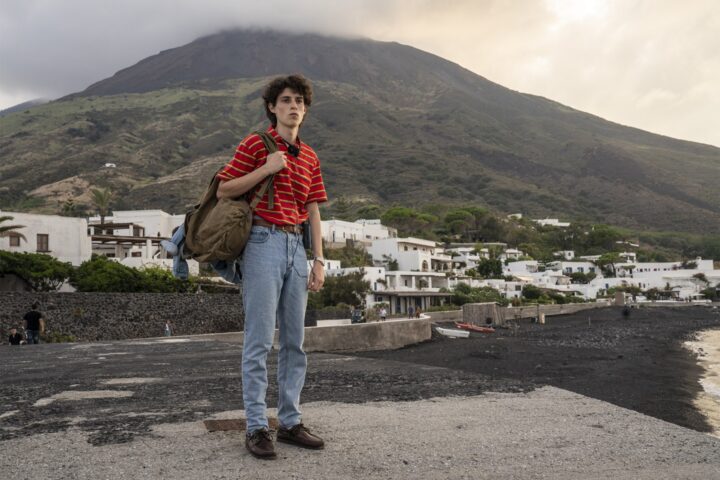
In chapter two, Moretti plays another version of himself, a filmmaker on the run and in search of a peaceful place to write a screenplay. He leaves Rome and goes hopping from island to island—Lipari, Salina, Alicudi, Panarea, and Stromboli—with his friend Gerardo (Renato Carpentieri), but not even the most paradisiacal island seems conducive to creation. At times, the first interaction with a local is anticlimactic enough—too vulgar, too banal—for him to immediately move on to the next island. But, of course, the journey for a magical site where the fantasy of a film will at last become real ends up becoming the very film.
And this is what Caro Diario testifies to above all: the sketch as the most fruitful evidence of the zigzagging vacillations that plague artists, at once crippling them from finding adequate form for their ideas and doubling as the work itself. And Moretti’s playful contemplation on the risks of self-implication takes a psychosomatic turn in the final chapter of the film, which is inspired by Moretti’s battle with Hodgkin’s lymphoma. Here, the filmmaker’s travels are limited to doctors’ offices as Moretti tries to find a cure for a mysterious and uncontrollable itch. No one is able to tell him what is the cause of his condition. Each doctor gives him a different remedy to try, from Calendula extract to wearing knee-high cotton socks in the summer. Nothing works, until he is finally diagnosed as having Hodgkin’s lymphoma.
Stylistically, this last section is an outlier of sorts. Moretti’s restlessness is suddenly limited to domestic and institutional spaces. The subject of the filmmaker’s musings is no longer the interminable, and interminably tortuous, pursuit of inspiration, but the much more somber threat of total creative breakdown as a man is given a few months to live. Still, for a while Moretti succeeds in turning even life-threatening illness into ironic vaudeville, where the ones who are supposed to know largely do not know. Once “cancer” is uttered, a final destination presents itself, and while we may know that in real life Moretti survived and continues to make films, he ends Caro Diario somewhat abruptly, as if acknowledging that once death comes knocking imagination can only be placebo, not panacea.
Since 2001, we've brought you uncompromising, candid takes on the world of film, music, television, video games, theater, and more. Independently owned and operated publications like Slant have been hit hard in recent years, but we’re committed to keeping our content free and accessible—meaning no paywalls or fees.
If you like what we do, please consider subscribing to our Patreon or making a donation.