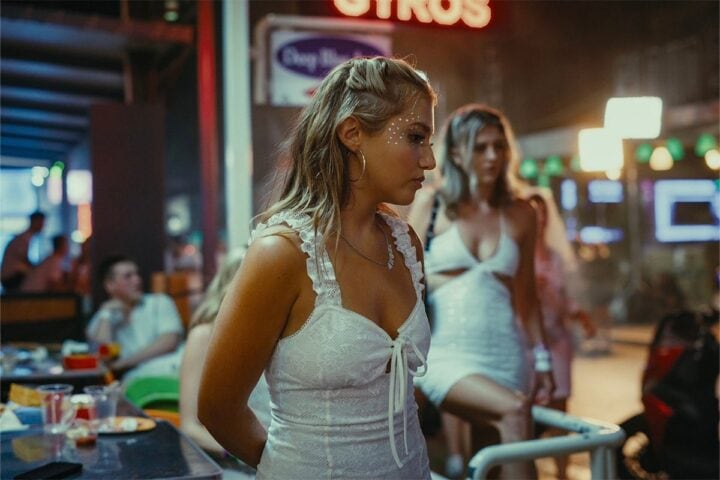
“You don’t have to be so strong,” chants the singer Romy over a trance beat, leading viewers of How to Have Sex out of the film and into the closing credits. The irony is that after viewing Molly Manning Walker’s tale of adolescent exploration, it’s hard to come to any other conclusion than today’s youth must indeed steel themselves for an unforgiving landscape of choices and consequences. As teenaged Tara (Mia McKenna Bruce) learns on the big fat Greek quest to lose her virginity, childhood friendships and romantic relationships alike come under serious strain when the specter of sexuality enters the equation.
In How to Have Sex, Walker filters the bacchanalia of films like Spring Breakers through a lens of social realism reminiscent of Andrea Arnold’s work. Her background as a cinematographer, most notably for Charlotte Regan’s Scrapper, emerges most clearly in how she captures the pursuit and portrayal of pleasure. As two groups of British teens descend on the beach town of Malia for a rite-of-passage trip, sparks fly between interested parties in adjacent hotel rooms.
But with alcohol obscuring an already murky language around consent, formative sexual experiences for Tara and her crush, Badger (Shaun Thomas), tip over into exploitation and abuse. Meanwhile, less scrupulous partygoers like Paddy (Samuel Bottomley) prove adept at navigating the moral gray area for their self-gratification. The film frames its coming-of-age narrative not merely as the loss of innocence, but also as the dawning of a different consciousness. To drown out the noise of their surroundings and understand what happened to them, they must come to terms with the cultural underpinnings that prop up this wild world.
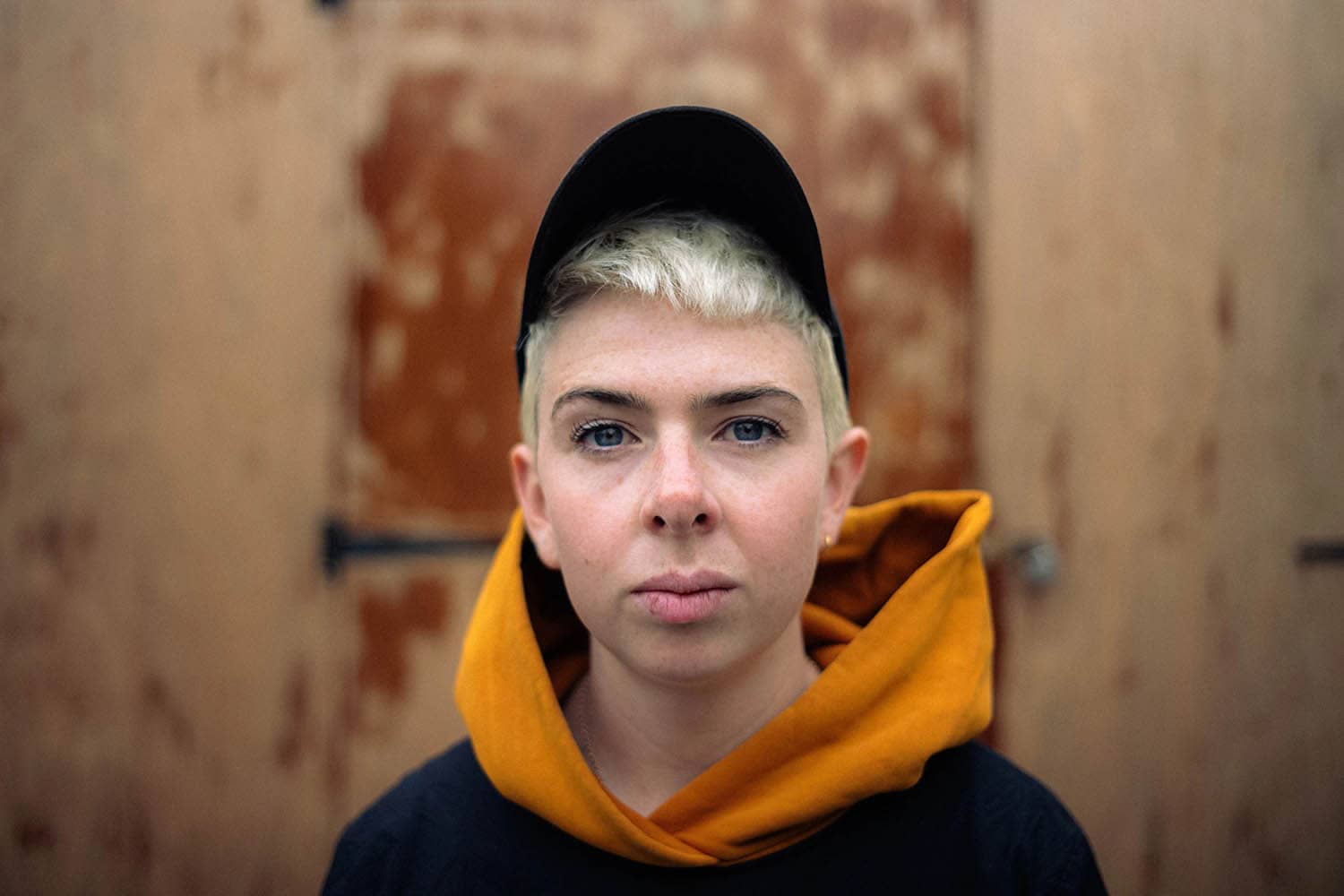
I spoke with Manning Walker shortly after How to Have Sex made its stateside premiere at the 2024 Sundance Film Festival. Our conversation covered how she developed her debut feature, why she approached the depiction of assault differently than her short films, as well as what different cultures and audiences have made of the film’s ambiguities.
I’m not sure if you see yourself as a cinematographer before anything else, but given that it’s where you have the most credits, were you creating the treatment and script thinking in images?
I definitely wrote with a lot of images in mind and think it affected the script. I was constantly rewriting when we were finding new locations or visual intrigue.
This was a pandemic project to some extent. Did that time when we had some opportunity for self-reflection lead you to this concept?
It’s funny that I wrote a party film during the pandemic when no one was allowed out. I definitely think it had a huge effect on that, for sure.
Do you think that affected the way that you approached shooting parties? There’s both a longing for their immediacy and a realization of their darker underbelly that’s hard to realize at the moment.
I think it definitely affected the way we shot them. I think a lot of the crew hadn’t been allowed out for a long time, and lots of the extras were really excited to be around people. The way we shot it was definitely affected by the fact that people had been inside for a long time.
We’re roughly the same age, so did you feel that you had a lot to learn making a movie about people from a younger generation?
I did a really extensive research process before the film where we interviewed young people, but I guess the sad thing about it was that I felt like it hadn’t moved on. I think we’re sometimes tricked into the Netflix version of a Gen Z person, and I think there are lots of different variations of younger people out there that maybe don’t have the same access to conversation.
Technology and smartphones are such a big part of contemporary adolescence now. While there are some moments in the film where we see the characters on devices, these are fairly limited. How were you approaching that depiction?
I hate phones on screen, and I hate shooting phone screens. They’ve ruined our society. So I tried to avoid using them as much as possible. I was always trying to find a route through. They don’t want to learn about their exam results, so they leave their phones. Whatever we could do to get away from them having phones with them.
Maybe it’s an American thing, but Gen Z is getting a reputation for Puritanism when it comes to sex on screen. What do you make of the way they process sexual images on screen?
We’ve had a lot of conversations post the film, and people are very grateful that it’s not hypersexualized or they’re not made into comic book versions of themselves. It hits a realistic note rather than something different to that.
How to Have Sex explores the subject of sexual assault once again following your short Good Thanks, You? You mentioned Gaspar Noé’s Irreversible as an important aesthetic touchstone there for its uneasy, hectic quality. How did you decide to go for a different visual angle in the feature?
Often, especially for women, seeing an 18-minute rape scene is unnecessary. In How to Have Sex, it’s mostly very quick. Hopefully, what happens is you visualize it through her emotions and how she’s feeling rather than being very graphic with it.

Tara and Badger’s first experiences with assault are both shown a second time as she processes them. What motivated that editing decision letting viewers in on her headspace of reliving the events without retraumatizing?
Many people we showed the beach scene to didn’t see anything wrong with it, which was quite upsetting. The idea that we cut back to it later allows them to recognize how affected she is by it.
When you’re getting the note that people don’t understand it’s assault, can you separate the reactions as a reflection of societal values from the deliberate ambiguity of your storytelling?
It was that, and it was also trying to build tension. You don’t want to totally know what’s happened. You’re realizing what she’s feeling, and then you understand what’s happened.
Part of your casting process involved the creation of TikTok videos by your performers. Was that to understand how they see the world and create their own reality, not just who they are on camera?
Totally. I think you see that livewire energy of how creative they are. It says a lot when you give someone the opportunity to do what they want rather than [being] prescriptive with the scenes.
Did that help the collaboration process knowing they had a filmmaking vision, even if it is something as small-scale as a TikTok?
I think Mia was very anxious about making a TikTok! [laughs] I’m not sure.
You worked through creating backstories with the actors for these characters. Were you also thinking about what happens after the film ends? I get the sense these childhood friendships are reaching their terminal stage.
We definitely never wrote anything about the future. We only wrote about the past.
“Love” might not be the right word for it, but that care and affection is something Tara seems to uncouple from sex as she gravitates toward Paddy to lose her virginity to even as she feels more affection for Badger. How were you thinking about the disconnect between the body and the brain for these characters?
She’s really into Badger, and I think they have an instant connection. [There are] those moments where you closely miss each other. And he often gets too drunk, so they end up in a more brother-sister relationship.
A documentary-like aesthetic was the goal of the film. How do you balance realism and something more subjective or staged, if you even see them as separate?
Everything was storyboarded, prepped, and planned very strictly. Then, we let it unfold in front of us and tried to be reactive to what was going on. It was a real combination of setting it up precisely and then destroying it. We hired a cinematographer [Nicolas Canniccioni] who has done lots of documentary work to try and implement that reactive look.
How do you find the balance of introducing more composed shots to make a point? There’s such symbolism, for example, in staging Tara’s confession about the assaults in front of both a mirror showing multiple faces and a bunch of makeup. But it does feel quite natural!
For me, we built the mirrors in because I was like, “I don’t want her to make eye contact with Em, but how do we see her face?” She’s sort of hiding away. It was about what we hide from each other, how we conceal it, and how we don’t communicate with our faces.
Moving beyond the well-worn observation that women feel shame and men feel pride when being openly sexual, what did you find about how internalized gender roles influence sexuality?
I think we’ve all learned how to have sex wrong. There’s so much pressure on young men. Our plan was to make a film that doesn’t lock men out of the conversation. It actively talks to everyone about the pressure we put on each other in order to perform, have sex, or have the most sex. I think that’s a dangerous place to be.
What did you learn about gender that might affect your next film, which takes gender as its subject?
I just want to continue to talk to people about subjects that they feel emotionally engaged about.
What were the conversations like at Sundance when you showed it for the first time in America?
It was an amazing reaction. We were unsure whether it would sit well in America. I’m really excited about the release because I just felt like it sat well with everyone.
Have you been surprised by different cultural reactions to it as you’ve toured it around?
Yeah, there are very different cultural reactions to consent. It’s very interesting when you go to a country and different people react in different ways. Everyone’s taught how to be and how to hold themselves. In some countries, older women are like, “Well, no, of course, she deserved it.” And you’re like, “Whoa, what the hell?!”
On the note of cultural differences, I picked up on there being some kind of regional distinctions between the two main camps in the film. For those outside the U.K., can you unpack where they’re coming from and how those different regional differences might show up in how they’re interacting with each other?
The boys and Paige are northerners, and the girls are from London. There’s not too much difference, but wherever we went on those holidays, the northern guys were always like, “Southern fairies! You guys are soft.” It was always a joke between two sets of friends.
A better title for the film might be How NOT to Have Sex. What does the positive vision look like?
I think we should connect with humans better to understand what two people are going through. Sex should be a communication about pleasure, especially female pleasure. I don’t think it’s talked about enough.
Since 2001, we've brought you uncompromising, candid takes on the world of film, music, television, video games, theater, and more. Independently owned and operated publications like Slant have been hit hard in recent years, but we’re committed to keeping our content free and accessible—meaning no paywalls or fees.
If you like what we do, please consider subscribing to our Patreon or making a donation.