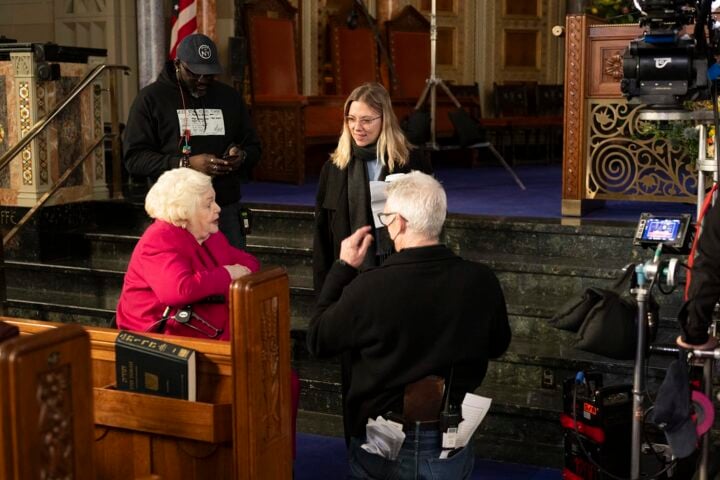
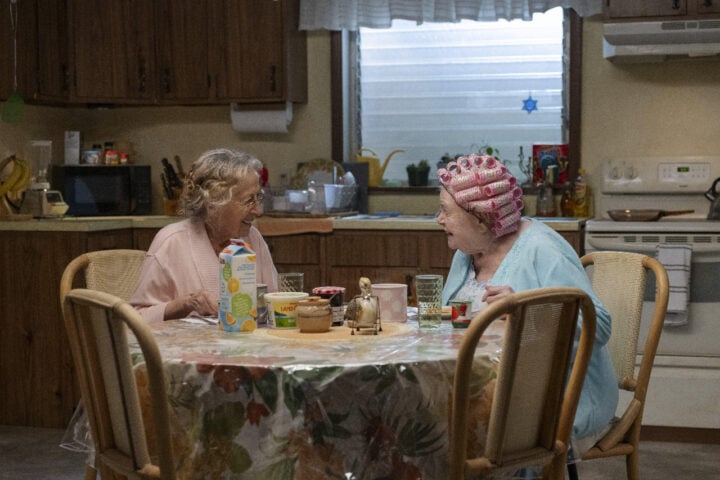
June Squibb has been acting for the past seven decades, and she shows no signs of slowing down at the age of 94, even performing her own stunts in Josh Margolin’s Thelma, in which her character goes on a reconnaissance mission across Los Angeles that metatextually channels the exploits of Tom Cruise from the Mission: Impossible movies. And she does it all with an impeccable sense for comedic timing and an infectious pathos.
The film tells the story of a grandmother who’s scammed out of $10,000 by a man pretending to be her son. When she decides to take matters into her own hands and get back what’s rightfully hers, she enlists the help of an old friend, Ben (Richard Roundtree, in his final film role before his death from cancer last year), and the man’s trusted motor scooter.
Hilarity and heartwarming moments ensue in Margolin’s loosely autobiographical film almost as soon as Thelma decides to follow in the footsteps of Cruise’s Ethan Hunt, trying to evade her family members—daughter Gail (Parker Posey), son-in-law Alan (Clark Gregg), and grandson Daniel (Fred Hechinger)—as she attempts to track down the persons who took advantage of her.
Recently, I had the opportunity to speak with Squibb and Margolin about Thelma’s inception, the unique challenges of the film’s stunt work, working with Roundtree, and more.
Josh, where did the idea for the film originate?
Josh Margolin: The event that sort of kicks off the movie is something that really happened to my grandma—the scam and sort of the family chaos that ensued. Luckily, in real life, we intervened before she actually sent the money, but it was a bit of a nail-biter. And just seeing my grandma, who’s always been so sharp and resilient, get duped that way, sort of got my wheels turning. And I started imagining what might have happened if she’d sent it and the lengths I know she would go to in order to get it back. So it sort of became a way of writing something that was an ode to her strength, and a way to explore this moment in life where she was reckoning with losing some autonomy but also fighting for what was left of it. And [it just so happened that] my love for action movies at the time got fused into the idea.
That’s a great example of art imitating life.
JM: Yes. They got pretty intertwined in this one.
So Fred’s character is pretty close to you, then?
JM: I definitely lost my ID a number of times. So how do I get out of that? How can that become an actual through line in the entire movie? But, yes, definitely. Fred’s character is very much inspired by me in the way that her character is very much inspired by my grandma.
June, you did your own stunts in the film, which is awesome. How did you and Josh land on this decision?
June Squibb: I think I wanted to do as much as I could. Things would come up, and I would say, “I could do that.” And everybody would say, “Are you sure?” And the guy that was there doing the stunts was like, “Are you sure you want to…” And then I tried things, and I could do them!
JM: It was sort of ever-evolving. We started with a contingency plan for everything. And then little by little, as we started to realize June could do a lot of them and liked doing them—
JS: Wanted to!
JM: —we started building them more and more around that, which was always the best-case scenario because we wanted the movie, within its genre, to be as grounded as it could be. So, to feel her actually doing them and kind of hew to those limitations, felt like the best version of it. And, luckily, June was very game and had been training, unbeknownst to me, for months.
What was the toughest stunt to pull off?
JS: The toughest? I guess that stair was kind of hard. Climbing up the stairs.
JM: Just going up and down there. I think the resetting of that too was just—
JS: Yeah. Doing it over and over and over again.
I love the meta reference to Tom Cruise doing his own stunts. That had to be inserted in the script after shooting wrapped, once you kind of agreed upon this.
JM: It’s funny. So, the sort of Mission: Impossible DNA was always in there, in the idea of having the photo of him and having that and them watching it—that was all written into the script before we knew we could get the footage. And then we got lucky in that we got, I think, a clip of the table read and that scene to Tom while he was shooting, and he graciously said, “Go forth.” And so we got the thumbs up, and then Paramount gave us the rights, which we were super lucky to get it because I think it really helps signal kind of the thing that we are trying to ping there in terms of, yeah, the doing things oneself.
And what was it like for both of you working with Richard Roundtree?
JM: It was great.
JS: He was wonderful. You always were aware that this was Shaft sitting beside you. But he was such a dear, lovely guy. He really was.
JM: He sort of lit up the set whenever he showed up. And you guys got along so great.
JS: Yeah, we did.
JM: I feel really lucky to have gotten to work with him on this.
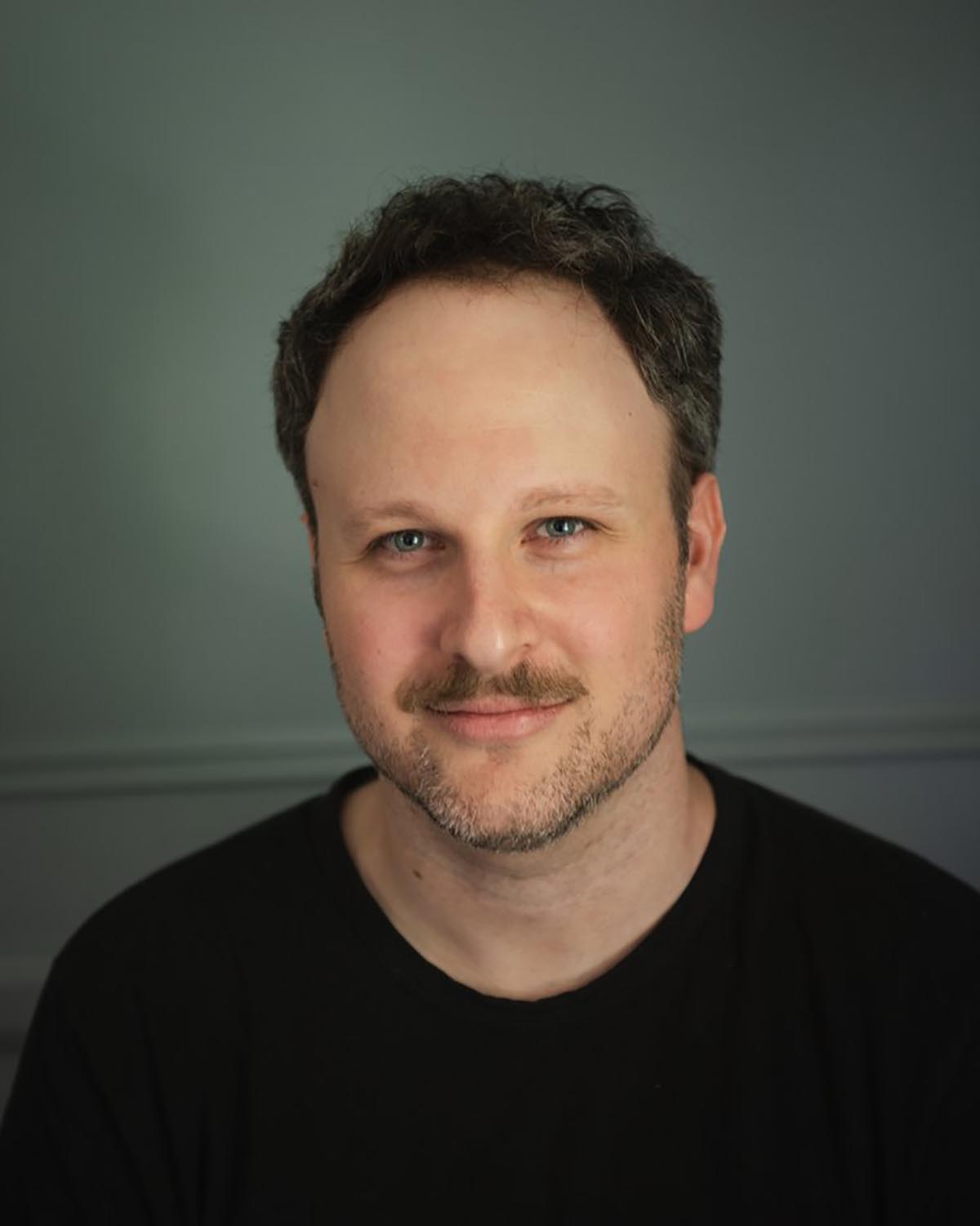
I saw a few other films, besides Mission: Impossible, inside the story’s DNA. So what were your main influences aside from Mission: Impossible, Josh?
JM: I was always thinking about how to essentially take some of these action tropes from something as big and boisterous as Mission: Impossible, shrink them down, and play them straight, even within the comedy of finding a way to play them in earnest so that we can juice a little bit of tension and a little bit of thrill from them, as well as, obviously, humor. We just never wanted them to play the butt of the joke. So, for me, tonally, I would sort of joke about it as—in our pitch deck, we said it was like Nebraska meets Mission: Impossible. Just take something that feels really kind of grounded and human and textured and overlappy and find a way to take that anxiety and that feeling and ratchet it up enough to the point where it gets to become literal action. And so, tonally, that was always kind of the slide.
My DP [David Bolen] and I watched Punch-Drunk Love, which is an awesome movie and an aspirational one. Just the energy of the filmmaking in that and the way that anxiety is dramatized, it’s a different animal. Movies like that, Nebraska, those kind of grounded dramedies with style and pop, were at least threads that we were sort of pulling on tonally. Because I think, structurally, it actually [was] probably closer to—I don’t know that I had a reference in mind as much as just sort of a lo-fi action movie, get-across-L.A. kind of movie.
One of the lines that stuck with me most is that nobody cares about old things. And I think it’s one of the main themes of the film. I mean, to me, old things are a treasure. I’m a collector. Many things. But what did both of you want to sort of impart upon the audience with this story?
JM: I think a big part of it is not counting people out.
JS: We can still do many things. We can still decide something and do it.
JM: Yeah. And that limitation, or accepting that limitation isn’t an admission of weakness. That’s something I think about in my own life, as well as in seeing my grandma get older—that just because you honestly face up to some of the things that have become harder for you or that are hard for you, that’s not an indicator that you’re not strong or capable and that life feels like it’s always kind of a give and take between pushing through and clinging to autonomy and accepting help. And finding that balance is part of the journey at every chapter. That was something that was very much on my mind, at least through the writing and making.
JS: The acceptance of help, that’s a thing that happens between Richard and I in the film. I wouldn’t accept help in the film [up to then].
JM: You let yourself have a partner, finally. But you’re still pretty much running the show with a little bit of assistance.
Regarding the other actors, did you write any of these roles specifically for them, or was it happenstance that you just got pitch-perfect performances?
JM: I felt very lucky to have everyone that we had. With each actor, we would do a pass. I would do a pass and show it to Zoë [Worth] and Chris [Kaye], my producers, to get their thoughts. We’d kind of work through that together, just to make sure that when we were sending to an actor, we had done just a little zhuzh, so to speak, for their voice, just to make sure it felt like the most “them” version of it, or at least how we saw that at that moment.
So, for Fred, that part was originally written for a thirtysomething year old. And then, when I saw Fred, I was like, “Oh, this guy, he’s perfect. He’s the guy.” And so I’m really glad we aged [the part] down [for him]. I’m really glad it’s Fred because I can’t imagine anybody else, and he was so wonderful to work with and such a great, smart, collaborative guy.
For Parker and Clark, they felt like the right people for the parts. But then, we would do little adjustments to make sure it felt like [the parts] fit them as best as they could. Parker [even] brought a decent percentage of her own props just because she had such a specific idea of who this person is. And what’s funny is she showed up basically with my mom’s haircut, and she’d never seen a picture of my mom. Somehow she intuited so much about what this person looked like—not that that’s exactly my mother [in the film]. She was way closer to life than I had anticipated. So, again, it was collaborative, but I felt in really good hands with everybody there.
June, this is your biggest role since Nebraska. And I think it’s your first starring role. How did you go about approaching the character? Were you nervous at all with taking up so much screen time?
JS: No. I don’t think I ever thought about that. It never occurred to me. I go through everything the same way with each role, no matter the size. If it’s one scene, I would do the same thing. I study the script. I learn the lines through the script. So, I’m so invested in the script that by the time I get in front of a camera, it’s the same for everything I do.
It’s just more days.
JS: Yeah. More days. I just worked longer on this than I did on a lot of things.
And you’ve been acting for seven decades. Like many actors and directors, Daniel Day-Lewis or Quentin Tarantino, they often announce retirement for one reason or another. Do you have any plans to retire from acting?
JS: Well, I keep wondering why people ask me still to do things. But I guess as long as they ask me, I will still do them if it’s something I want to do. I’ve been very busy. I have really been shooting a lot. So I don’t know. Maybe there’s something about older people that everybody’s more interested in scripts about them.
People won’t let you retire. You’ve got too many offers.
JS: Yeah. I mean, it’s crazy.
What’s next for both of you?
JM: I’m trying to cook up some new stuff, [especially now] in the downtime after the festival run. [It’s] been nice to kind of get back to writing and getting to that zone a little bit.
JS: Yeah. I had Don’t Tell Mama the Babysitter Died. I played the babysitter in that. That just opened. And [I voice Nostalgia in] Pixar’s Inside Out 2. And I just shot Eleanor the Great in New York. It’s directed by Scarlett Johansson, and it’s her first feature film!
Since 2001, we've brought you uncompromising, candid takes on the world of film, music, television, video games, theater, and more. Independently owned and operated publications like Slant have been hit hard in recent years, but we’re committed to keeping our content free and accessible—meaning no paywalls or fees.
If you like what we do, please consider subscribing to our Patreon or making a donation.