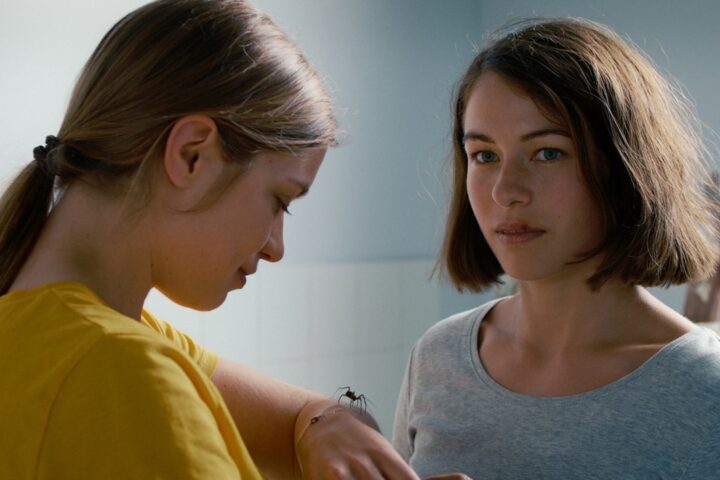
Jan (Mark Waschke) and Nina (Sabine Timoteo), co-owners of an advertising agency, arrive at their seaside vacation home in the Baltic Sea with their two children, Emma (Jule Hermann) and Max (Wanja Valentin Kube), in tow. But after settling in, the French-German family experiences a mysterious home invasion, as no intruders are actually ever seen, with Nina being the sole person to hear and come close to interacting with them.
This unnerving event is the point around which Human Factors pivots, as writer-director Ronny Trocker revisits the invasion from each member’s perspective, freely hopscotching in time to before and after the crime. As such, the film suggests another in a long line of Rashomon imitators, but it eventually reveals itself to be an entirely different beast.
For one, Trocker doesn’t shift between points of view to explore the slippery nature of subjectivity and how one family member interprets the home invasion. Whether or not the crime has something to do with Jan and Nina’s decision to take on a politically charged client is ultimately beside the point. In the end, Trocker compellingly reveals to us a family that’s already fractured, with the film’s key event essentially constituting a great undoing.
In coolly detached fashion, Human Factors details the various indignities faced by each family member. These include Emma being angry over her parents talking to a teacher about her performance at school and the workaholic Jan stubbornly taking on the new client against Nina’s wishes. Throughout, past grievances are constantly being aired, and a biting picture forms of how major and minor slights accumulate over time to fan the flames of resentment.
The home invasion, then, is a red herring of sorts, as it becomes unmistakable at a certain point that any external entity is much less a threat to dismantling this family’s comfortable bourgeois existence than the family itself. And this idea is underlined in one of the many moments of disarmingly cheeky humor, when a major tip-off concerning the intruders is casually presented through the unassuming POV of another character: Max’s pet rat Zorro.
Despite the mystery of the crime becoming increasingly tangential across its runtime, Human Factors remains a compelling puzzle-box film. At one point, Nina presumes to know what her daughter likes in a home as they tour a potential new apartment, to which Emma tersely replies that her mother generally never asks her what she likes. The moment reveals that even the characters’ unconscious behaviors breed contempt, as well as forces the viewer to consider all the signs that Trocker may have hidden in plain sight throughout this fascinatingly fastidious film that point to how a seemingly stable family is anything but.
Since 2001, we've brought you uncompromising, candid takes on the world of film, music, television, video games, theater, and more. Independently owned and operated publications like Slant have been hit hard in recent years, but we’re committed to keeping our content free and accessible—meaning no paywalls or fees.
If you like what we do, please consider subscribing to our Patreon or making a donation.