While David Mamet is celebrated for the potent lucidity of his dialogue and his clear-eyed portrayals of deceit and manipulation, successful film adaptations of his writing also tend to benefit from some kind of conventional genre glaze. Homicide, his most assured work as a director, staged its complex exploration of identity and racial resentment as a tight, propulsive crime thriller, while James Foley helped make an entertaining hustle-culture drama from Glengarry Glen Ross’s precise dissection of capitalism and masculinity.
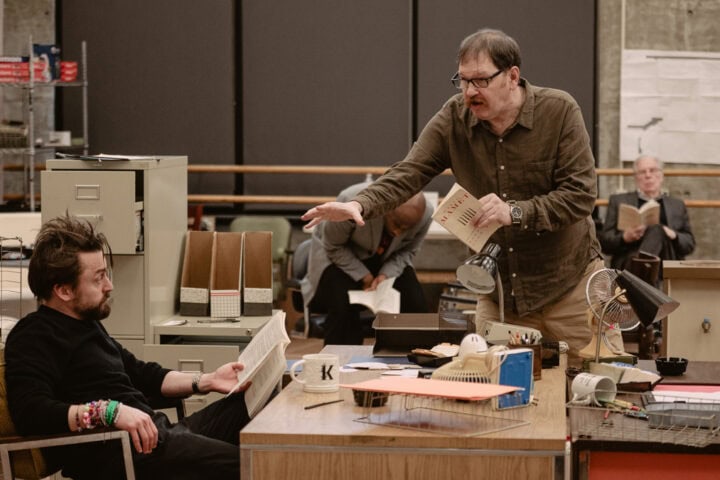
With Henry Johnson, no such formal leavening is present. This is the first film that Mamet has directed based on one of his own plays since 1994’s Oleanna, and it’s similarly straightforward in terms of translating the material’s elaborate plot machinations to the screen. The eponymous character (Evan Jonigkeit) is an employee at an unspecified corporate business whose job is threatened when he decides to carry out a favor for an old college friend facing some heinous criminal charges. After an extended discussion in his boss’s (Chris Bauer) office goes awry, Henry soon finds himself sharing a prison cell with the charismatic Gene (Shia LeBoeuf). The latter’s friendship with a prison officer, Jerry (Dominic Hoffman), affords them access to the library and potentially a way out of Henry’s increasingly grave predicament.
The film comprises four stagey two-handers, each set in a single room. Mamet’s use of blocking is primarily functional, conveying little beyond Henry’s increasing isolation and claustrophobia. As uninspiring as his directorial approach can be here, the extent to which he refuses to adopt a more palatable cinematic sensibility could generously be interpreted as an aesthetic decision. The self-contained starkness of the film’s setups does occasionally convey the uneasy moral vacuum around which its naïve protagonist seems to be spiraling, each elliptical scene transition throwing him abruptly into another more desperate situation with no sense of resolution.
What makes the flat visual style more limiting is the sketchiness of the milieu. In his best work, Mamet elevates the stop-start patterns and sharp register of everyday speech to a kind of poetry, building people who are both ordinary and archetypal from fragments of language. His characters here are adept at using words to craft their sense of reality, but he struggles to convey anything more concrete about them beyond this. Lacking in recognizable humanity, their back-and-forths more closely resemble the ruminations of people talking to themselves in the shower, or thematic preoccupations being spelled out by a writer with little regard for the audience.
If these Mamet mouthpieces can be said to have any differentiating characteristics, it’s primarily in the vocabulary they use to exploit or indict Henry, a blank slate whose motivations remain impossibly opaque. Representing perhaps the sole touch of irony in what is a remarkably po-faced affair, the legally inflected pedantry of Bauer’s senior law firm associate is revealed to be nothing more than the hollow distraction to which he equated the function of law in society, helping him to keep his troubled employee occupied while the locks are changed on his office. And in the film’s climax, Jerry’s more reasoned, humble observations and nostalgic, yet still implausibly unspecific, recollections serve as a more subtle kind of showmanship.
The most fascinating character in Henry Johnson is Gene, to whom LeBoeuf brings a sketchy, dead-eyed intensity that makes the convict’s streetwise, philosophical diatribes particularly engaging. At times echoing any number of manosphere-adjacent provocateurs, Gene frequently digresses from a probing analysis of prison etiquette and Henry’s relationship with his counselor to hold forth about rape, power, gender, and the psychosexual subtext of fairy tales.
It’s never entirely clear whether Gene is merely grooming Henry with his macho posturing, or attempting to guide and instruct him in his own idiosyncratic way. But what starts out as intriguing ambiguity devolves into a frustrating lack of focus. Here and elsewhere, the dialogue is burdened by Mamet’s juggling of the demands of character, plot, and messaging all at the same time, in the absence of more dynamic storytelling techniques.
Ultimately, Henry Johnson’s cynical assertions about society and human nature are the only aspects that end up resonating, for better or worse. Is it a coincidence that this film seems more interested in its ideas than the people expressing them? It’s definitely misguided to conflate an artist’s work with their personal beliefs, but for someone with such an insistent authorial voice and a keen fixation on America’s thorniest sociopolitical issues, it’s hard not to interpret Henry Johnson in the light of Mamet’s enthusiastic embrace of right-wing politics.
In Henry Johnson, the contrast between the film’s ascetic presentation and its imposing, elliptical dialogue serves to make its creator a kind of accidental Brechtian, the fictional artifice often falling away to expose the reactionary obsessions and Hobbesian moral outlook of an outspoken conservative battling modern America’s complacency and hypocrisy. So when the prison guard refutes the plausibility of Gene’s escape plan by insisting that “he likes it in here,” it’s possible to imagine the plight of Mamet himself, locked in a relentless civilizational struggle that nevertheless provides him with ample opportunity to bloviate from the sidelines.
Henry Johnson will be available for rental starting May 9, directly from its official site.
Since 2001, we've brought you uncompromising, candid takes on the world of film, music, television, video games, theater, and more. Independently owned and operated publications like Slant have been hit hard in recent years, but we’re committed to keeping our content free and accessible—meaning no paywalls or fees.
If you like what we do, please consider subscribing to our Patreon or making a donation.