Elvis Presley is among the best-selling solo music artists of all time, and he remains an internationally recognizable icon 45 years after his death, so he’s hardly undervalued. These days, though, Elvis is less of an enduring influence on emerging artists than many of his contemporaries, namely the Beatles. His legacy has also been subjected to intense scrutiny as the understanding and language around cultural appropriation has evolved, which has turned the first white rock ‘n’ roll star into an understandable repository for justifiable grievances surrounding white artists profiting from African American music.
Baz Luhrmann’s Elvis predictably offers a frenzied journey through Elvis’s life, though it’s also conspicuously fixated on the machinations of the figure arguably most responsible for his success: Colonel Tom Parker (Tom Hanks), a flimflam carny on the magnitude of P.T. Barnum. Tom Parker, who wasn’t a real colonel and whose real name wasn’t Tom Parker, illegally immigrated to the United States from the Netherlands and transitioned from music promotion to talent management in time to latch onto the hottest new act in the world. It’s also the former Andreas van Kujik, not Elvis (Austin Butler), who serves as the audience’s guide through the kaleidoscopic world of Luhrmann’s film, and Hanks’s heavily accented narration is filled with cajoling self-justifications, running commentaries, and unreliable details that assert the same control over the narrative that the man did over Elvis’s career.
Hanks’s domineering on- and off-screen presence as Parker threatens to overshadow Butler’s revelatory performance. Your average Elvis impression typically boils down to a curled lip, a ducktail haircut, and a mumbled “thank ya very much.” Butler never stoops to cheap impersonation, though this is one of the most uncanny channelings of the King that you will ever see. The actor imbues the young Elvis with a believable insecurity and vulnerability that lasts well into the singer’s megastar era; even when Elvis is at his most strung-out and aggressive, there’s a certain softness in his eyes that reminds us of the humble farm boy that he once was. That tender quality also helps to explain how he so consistently fell for Parker’s manipulations, even when he was trying to extract himself from under his manager’s thumb.
Of course, this being a Luhrmann film, the principal focus here is mainly the filmmaking that exists at a rush, propelled by over-saturated colors, intense lighting, and in-camera and post-production editing techniques that tend to bleed shots together instead of relying on hard cuts. A sped-up shot of Elvis and Parker hashing out a partnership on a Ferris wheel, for example, dissolves into the rapid spinning of one of his 78 rpm singles on a turntable.
Throughout, the clatter of music is also pushed to overwhelming extremes. As he did in The Great Gatsby, Luhrmann attempts to communicate the scandalousness of a new form of popular music pioneered by Black artists infiltrating white America by infusing now-dated genres with more contemporary sounds. Conceptually, it makes sense, but the lurches into hip-hop and modern R&B that blend with bluesy oldies is more distracting than revelatory.
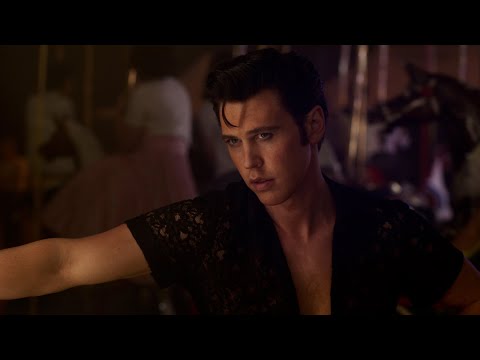
Far more effective in conveying the visceral effect that Elvis had on contemporary listeners are the images, which Luhrmann arranges in rapid-fire collages of close-ups on the star’s gyrating hips and crotch and the unglued reactions of teenyboppers. When an older Elvis settles in the gilded cage of his Vegas residency, spotlights burn just a little too brightly, and the initial spark of inspiration that informed the revamped, big-band sound that he brought to the gig becomes a suffocating morass of tackiness. At its best, Elvis taps into the frenzy that the King ignited in the world, and how he was unable to grasp the social implications of his art as he was too caught in the headlong rush of performing the music that inspired and moved him.
But there are moments where the film does touch on more serious topics, such as the debate over Elvis’s appropriation of Black music and his general relationship to Black America. We see the childhood poverty that forced his family to live in segregated neighborhoods meant only for people of color. Later in the film, he’s surrounded by a revolving door of Black performers ranging from Sister Rosetta Tharpe (Yola Quarterly) to B.B. King (Kelvin Harrison Jr.), and he’s tellingly at his most relaxed and happy when listening to them perform. The film even makes space for a crucial detail that’s often elided in the Elvis story: that many of the artist’s early critics in the press and even government explicitly condemned him for representing the possibility of desegregation in his mixture of country and R&B.
But because such insights into Elvis’s social impact are just one part of Luhrmann’s endless barrage of blink-and-you’ll-miss-them peeks at the man’s life, the potential rewards of unpacking Elvis’s star power or the music that birthed him are lost in the shuffle. And with the film constantly returning to Parker’s perspective, Elvis too often feels like a helpless bystander in his own life. There’s value in that approach, emphasizing how the man became a pawn of his handlers, but Luhrmann lacks the focus to consistently drill down on that idea.
Like the man himself, Elvis ends up bloated and unfocused, the initial feverish pitch of the film’s momentum slowing to a crawl as the icon succumbs to addiction for a punishing chunk of this biopic’s 160-minute runtime. It leaves the viewer feeling drained and piteous of Elvis in his final years but with no greater insight into his downfall than the general image of him as being washed-up—an ever-slurring version of his former self. The protracted rubbernecking at Elvis’s inexorable decline epitomizes a film that regularly backs away from its keenest observations about the icon to merely, and superficially, bask in his star power.
Since 2001, we've brought you uncompromising, candid takes on the world of film, music, television, video games, theater, and more. Independently owned and operated publications like Slant have been hit hard in recent years, but we’re committed to keeping our content free and accessible—meaning no paywalls or fees.
If you like what we do, please consider subscribing to our Patreon or making a donation.