Not long into Natalie Rae and Angela Patton’s alternately sweet and quietly devastating documentary Daughters, on-screen text states that, since 2014, there has been a significant decrease in “touch visits” in U.S. prisons. The importance of touch between a parent and child—and, in the case of this film, specifically between a father and daughter—is rarely discussed openly in Daughters, but it looms large over nearly every scene.
Patton, the CEO of the non-profit Girls For A Change, came up with the idea for an annual daddy-daughter dance to ensure that young Richmond-area Black girls remain connected with their incarcerated fathers, and when she briefly mentions touch in the film, the gesture takes on an existential significance. “When children are removed from touching their parent…they doubt the possibility of surviving in the world,” she says in voiceover midway through Daughters.
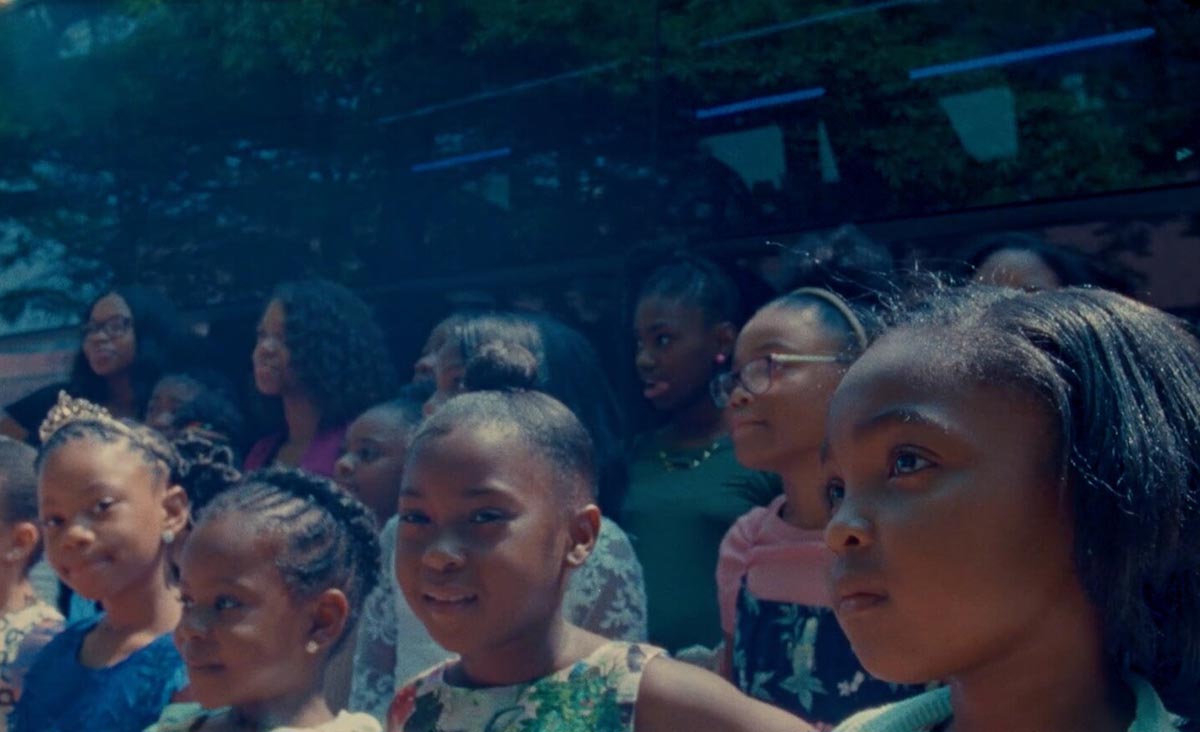
The purpose of the father-daughter dances is to quash that doubt, and Patton and Rae’s documentary seeks to show how that’s possible as it examines the immediate and lingering effects that one 2019 dance—the first in the D.C. area—has on four young girls. Daughters also uses the tumultuous emotional journeys of the girls as a means to subtly critique the mechanisms of dehumanization in our nation’s prison industrial complex.
Opening six months before the dance, the documentary introduces us to Aubrey, Ja’Anna, Santana, and Raziah, who all suffer emotionally as a result of the barriers of the criminal justice system. Eleven-year-old Ja’ana, who’s not been allowed to contact her father since his imprisonment, feels alienated from her friends and family. Ten-year-old Santana is filled with anger at her dad, asserting that she’s “done shedding tears” for him as she fights against doing just that in front of the camera trained on her. And 15-year-old Raziah suffers from suicidal thoughts, struggling to cope with her life “not feeling right” since her father went to jail.
By contrast, the spunky, wildly precocious five-year-old Aubrey is a bright light in a sea of adversity. Watching her, you understand that she’s protected by the naïveté of youth, and as we take in her hopefulness at home when discussing her father or when repeatedly quizzing him at the dance about how soon he could be released on good behavior, we’re witness to a resilience that has yet to be shattered by years of strain on her relationship with her father.

As the filmmakers explore the emotional ebbs and flows of these four girls as they prepare for the dance, they counter these scenes with footage of the fathers in the large group coaching program they must complete in order to attend the event. These sequences—the best of which are reminiscent of Gethin Aldous and Jairus McCleary’s soul-crushing The Work from 1017—reveal a group of men who, despite being united in their eagerness to reconnect with their daughters, aren’t endowed with the necessary vulnerability and emotional sensitivity to make the most of the four short hours in which they can hold their daughters in their arms.
Daughters captures the importance of the camaraderie between these men on a shared quest, of them being led on a journey of self-determination to heal the “father wound.” Throughout, there’s little mention of the purely punitive nature of our prison system because the filmmakers are more interested in touting the potential of restoring dignity to the men trapped in that system, understanding that doing so would truly result in a decreased recidivism.
By not ending soon after the dance, the film elides the easy, sentimental finish that it seems almost destined to land on. By checking in on their young subjects one and, then, three years after the dance, Rae and Patton respect that the relationships between the girls and their fathers are malleable, subject not only to the best of intentions but also to the winds of fate and, for some of the fathers, further hurdles put in place by the prison system.
Rae and Patton’s documentary certainly celebrates the program that it highlights, noting that 95% of the men who’ve gone through it have stayed out of prison. But by the end of Daughters, it’s clear that this program is far from a panacea, and that even the strongest bonds between the fathers and daughters seen in the film can fray. Still, while not all of the girls have rid themselves of the doubt about their ability to survive in the world, Daughters makes it clear that they’re all, to varying degrees, better off because of the program.
Since 2001, we've brought you uncompromising, candid takes on the world of film, music, television, video games, theater, and more. Independently owned and operated publications like Slant have been hit hard in recent years, but we’re committed to keeping our content free and accessible—meaning no paywalls or fees.
If you like what we do, please consider subscribing to our Patreon or making a donation.