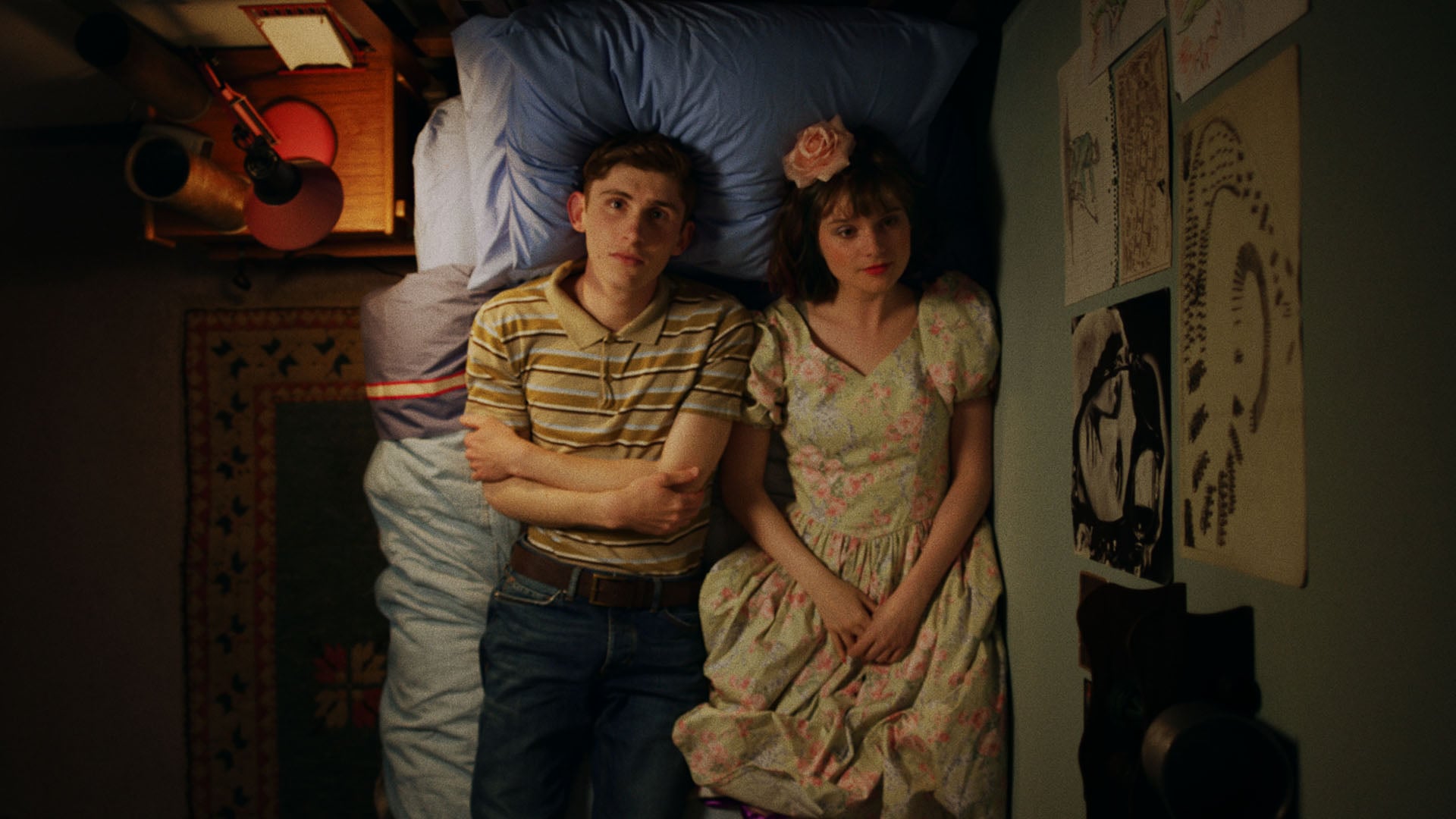
“This place will kill you.” That’s a recurrent refrain in Dating Amber, writer-director David Freyne’s dramedy about two queer teens, Eddie (Fionn O’Shea) and Amber (Lola Petticrew), who pretend to be a couple so that they can make it through high school a little less scathed. It’s one of those lines that sometimes captures a character’s plight with such biting precision, and simplicity, that the viewer is caught off guard and the film is left feeling haunted. The place that “will kill you,” as Amber warns Eddie as well as her herself multiple times in one way or another, is rural Ireland in the 1990s, where divorce is still illegal—an idyllic meadowland plagued by backward prudes and homophobic bullies.
The demands of heterosexuality are lethal to both straights and gays in County Kildare. Amber’s father, for one, took his own life, and ever since then she’s been charging her classmates to use her family’s caravan as a place to have sex, so she can save enough money and move to London and work for a punk zine. By contrast, Eddie wallows in sorrow and denial, his gait the grotesque result of him trying to mimic butchness. He plans to do exactly what’s expected of him—that is, to join the army and marry a nice girl who will probably just make him sleep on the living room couch like his mother (Sharon Horgan) does to his father (Barry Ward). Amber knows that living one’s life according to the desires of others will kill you, so her offer to fake-date Eddie so their peers will stop harassing them seems more like an act of solidarity, an attempt to spare Eddie from the violence that she herself can take in stride.
The film is initially hyper-stylized, recalling Jamie Babbit’s But I’m a Cheerleader. The colorfully coordinated precision of the mise-en-scène and campy over-acting all point toward satire. But there’s a gravitas to Dating Amber that keeps pricking us little by little until it completely takes over in the film. Our first warning that humor may have been only the sheen of a much more serious cinematic proposition, a cheeky red herring of sorts, comes in a sequence in which Eddie and Amber take the train to Dublin and happen upon a gay bar. Instead of lusting over male bodies or dancing the night away on drugs (that comes later), Eddie is instantly transfixed by a drag queen singing Brenda Lee’s “You Can Depend on Me.” He approaches her on stage as if, at last, untethered from the world. In a kind of communion, Eddie embraces the drag queen like a lost child re-encountering his mother. She keeps on singing, rocking Eddie as if casting a queer spell, or baptizing the “baby gay,” as she calls him.
From that scene on, Dating Amber rather seamlessly strips itself of its hyperbolic affectations to reveal a heartbreaking story of emancipation through friendship. Freyne manages to indict the societal expectation of heterosexuality as a traumatizing force while also humanizing its straight victims. A brief scene when Eddie’s doleful mother is, for once, alone at home and puts on a vinyl is particularly wonderful. She looks at her husband’s framed photograph and smiles, reminding us that while the fantasy of heterosexual domesticity holds many promises, in practice, it can be an exhausting hell. “Anywhere!” Amber tells Eddie when he asks her where he could escape to. And as their own faux love affair begins to crumble, they can at last embrace the queerness and messy feelings for which there is no required language, no blueprints, and as such the opportunity to actually find a place that won’t kill them.
Since 2001, we've brought you uncompromising, candid takes on the world of film, music, television, video games, theater, and more. Independently owned and operated publications like Slant have been hit hard in recent years, but we’re committed to keeping our content free and accessible—meaning no paywalls or fees.
If you like what we do, please consider subscribing to our Patreon or making a donation.