Benjamin Brewer’s Arcadian runs on the sort of day/night mechanic found in many survival video games. When the sun is up, it’s an intimate family drama featuring a trio of strong performances and a script that never says more than it has to. And when the sun goes down, it turns into a strikingly effective creature feature, starring some of the most inventively designed and viscerally realized monsters to scuttle across the screen in some time.
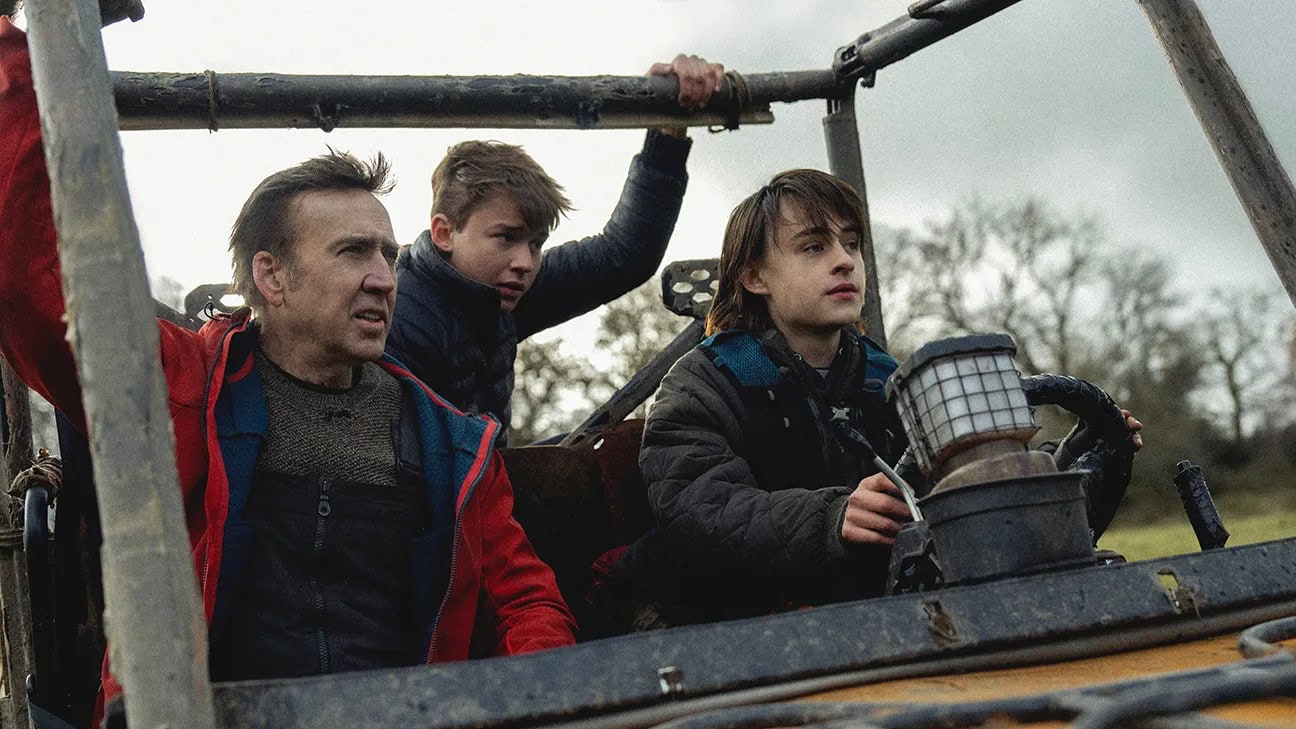
Arcadian takes place in a patch of idyllic countryside that lives up to the film’s title. Paul (Nicolas Cage) and his twin sons, Joseph (Jaeden Martell) and Thomas (Maxwell Jenkins), live in a farmhouse surrounded by rolling green hills. It’s an inviting, peaceful place, but as sundown approaches, Paul anxiously corrals his boys back into the farmhouse and the three of them reinforce every door and window with hefty wooden shutters. We can tell from the swift way they go about this process that they’ve done it a thousand times before. And we can tell from Paul’s strained expression that whatever they’re trying to keep out is very, very bad.
After a few years of transforming himself into vampires, cue-balled cowboys, and paunchy dream-invaders, Arcadian finds Cage operating in a much more realistic register. There are hints of his Pig character in Paul’s gruffy style of parenting, and he’s still a force to be reckoned with as an action hero. When he steps in to deal with a threat or solve a problem, he seems invincible. The fact that he’s far and away the most famous person in Arcadian also works to the film’s credit, lending Paul a sort of mythic quality that’s felt all the more keenly in his absence.
Arcadian teases out the reveal of its creatures at just the right pace, building tension without stringing us along too far. First, we only see the signs they’ve left behind, like the deep scratches gouged into the farmhouse’s front door. Then we start to catch flashes of them—a gray, spindly hand here, a snapping jaw there. And, then, one of them finally comes creeping into a well-lit room, at which point you may wish that it would go back into the darkness.
“We must always stay vigilant,” Paul warns his sons at one point. Their security procedures have protected them since the boys were babies, but he knows that a single slip-up will leave them all dead. But teenage boys are, in some ways, much harder to protect than infants. Joseph is the more introverted of the two, a scientifically minded kid who’s determined to devise some way to overcome the monsters and doesn’t mind taking a few risks in the name of research. Thomas’s interests lie further afield—at a neighboring farm, to be specific, where a red-headed beauty, Charlotte (Sadie Soverall), has caught his eye. Joseph and Thomas know that they should never stay out past sunset, but that knowing happens inside an adolescent brain that can’t quite be trusted to accurately weigh risks against the prospect of a passion project or a pretty girl.
Perhaps expectedly, disaster strikes, with Joseph and Thomas left to fend for themselves after their father is gravely wounded. It’s a straightforward, streamlined plot, and Arcadian never feels the need to overburden itself with excessive backstory. We don’t know much of who Paul was before the world fell apart or exactly how humanity came to be hunted by these nightmarish beings. We don’t know how many survivors there are, or what the world looks like beyond this small, pastoral portion of it. And we don’t need to know any of that either.
From here, Arcadian rockets toward an action-packed finale filled with inventive touches, including more meaty effects work. Even as the shotgun shells start flying, it makes time for the quiet dramatic moments that carry its family drama forward amid the carnage. All told, it’s an extremely well-crafted survival tale. And while it might seem like a film that doesn’t reinvent the wheel, the bombastic sequence that closes out its climactic battle actually does that too.
Since 2001, we've brought you uncompromising, candid takes on the world of film, music, television, video games, theater, and more. Independently owned and operated publications like Slant have been hit hard in recent years, but we’re committed to keeping our content free and accessible—meaning no paywalls or fees.
If you like what we do, please consider subscribing to our Patreon or making a donation.