Fatih Akin’s Amrum is a delicate coming-of-age parable tracking national identity and violence to their most intimate origin points during the waning days of the Third Reich. Set on the titular north German island, where both German and the Frisian language are spoken, the film follows Nanning (Jasper Billerbeck), a fictionalized version of co-screenwriter Hark Bohm, Akin’s old friend and mentor, who died last year at 86.
Nanning, a member of the Hitler Youth, is an oblivious little Aryan whose temperament is as soft as his puffy red cheeks. His parents, though, are true Nazi believers, and his rarely smiling, pregnant mother, Hille (Laura Tonke), has taken him and his younger brother (Kian Köppke) to Amrum to escape the Allied bombing of Hamburg while his unseen father serves in the SS.
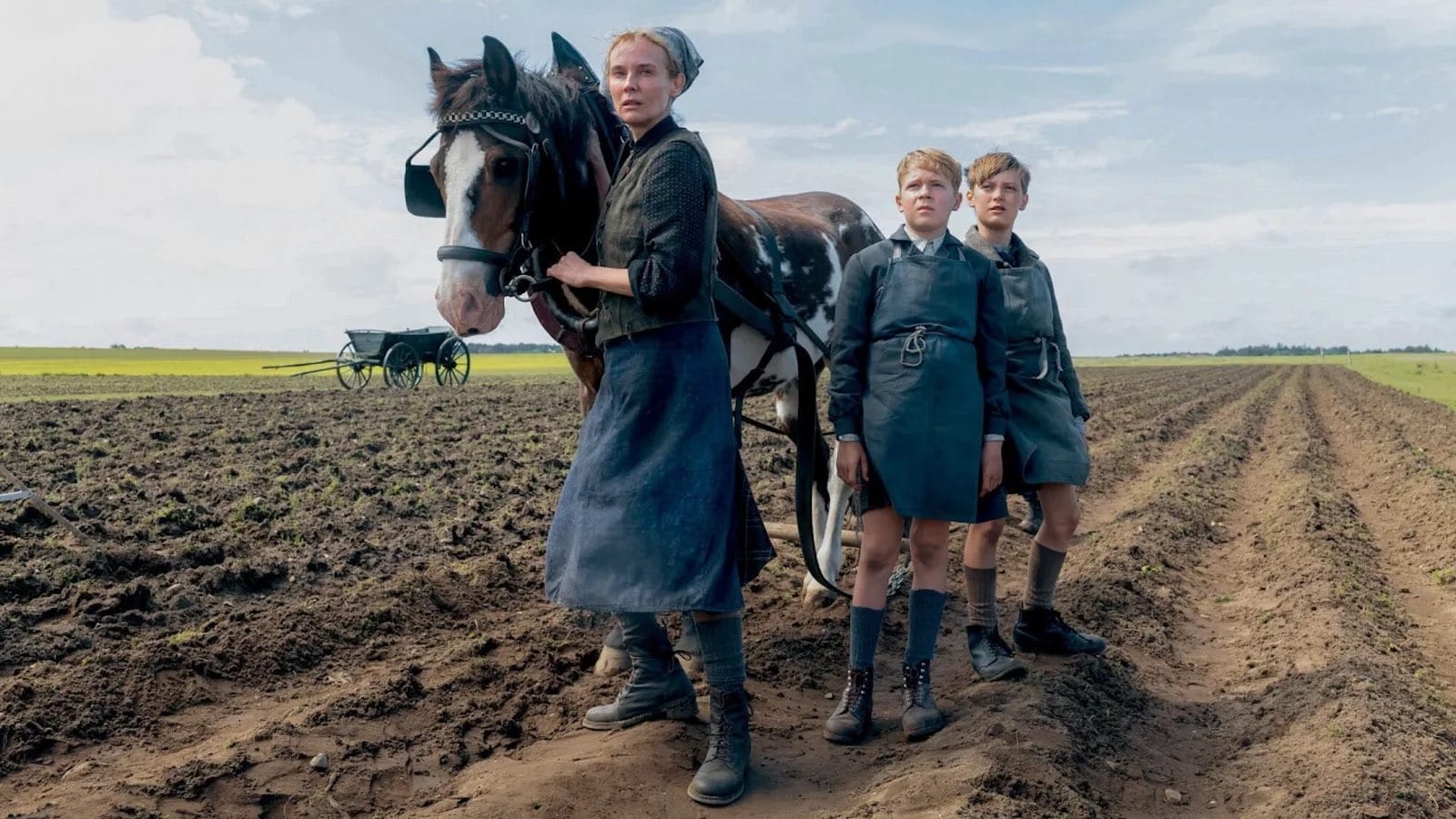
Far from sheltering him, though, the new environment begins to awaken something in Nanning. As he watches wagons of ethnic German refugees expelled from Soviet-controlled territories pass through his small village, local schoolboys bully him for his mainlander identity and accent. Hille assures him that, despite having never set foot on the island before, his descent from Amrumer blood makes him as much a native as any of them, just as his German blood makes him a duty-bound warrior of the Führer. Her iron-jawed loyalty to the Third Reich and its philosophy, meanwhile, comes into tension with the creeping reality of its imminent collapse and the divided sympathies of the islanders, some of whom—such as the spirited farmer Tessa (Diane Kruger)—speak ill of the regime and secretly listen to “degenerate” jazz music.
Struggling to process the contradictory messages he receives from adults, the shy Nanning assigns himself special responsibilities scrounging and bartering for food to please his mother when her mental and physical condition rapidly deteriorates; in the film’s most melodramatic scene, Hille wails herself hoarse as news of Hitler’s death sends her into labor, dooming her to postpartum depression. From there, Nanning contemplates the Amrumer way of life and his own burgeoning awareness of a world and morals beyond his family unit.

Bohm and Akin’s script is meandering, continually turning away from themes, characters, and plotlines, never drawing clear lines between all of them. Faces and motifs, like a fascination with Moby Dick (Captain Ahab is likened to Hitler) weave in and out of the narrative; some threads go unresolved, while others are tied up too cutely in blunt, declarative dialogue.
But Amrum’s formlessness is mitigated by the impressionistic sense of milieu. The film was shot on location in Amrum, which seems to be frozen in time, its brick buildings, fields, and sea banks hardly changed through the centuries, save for the raising (and, eventually, lowering) of the Nazi flag. As Nanning crisscrosses the island on his quests to acquire scarce commodities like bread, sugar, and honey, the roomy frames and soundscape emphasize the dance of light on gentle waves, the rustle of wind in the reeds, and the nestling of fresh eggs into a rolled-up shirt.
Akin’s protagonist, like the film’s camera, is transfixed by death and mankind’s violent relationship with nature. A graphic sequence sees friendly villagers teaching a squirming Nanning how to kill and skin rabbits—the animals shriek for their lives as their necks are broken—and, in a separate scene, he encounters the rotting corpse of a fighter pilot, its eyes torn out by the gulls or crabs, washed up on the shore in the moonlit dead of night. In these confrontational moments, this otherwise quiet film gestures toward both the unseen monstrosity of the Third Reich and a Malickean struggle, in Nanning’s heart, between the way of nature and the way of grace, which only manifests in decisive (small) action toward the end of the narrative.
Billerbeck gives a subtle performance as a character who grows significantly without always expressing himself in dialogue or passing clearly marked turning points. Given the sometimes thin writing and impassive characterization he has to work with, the young actor depicts Nanning’s burgeoning selfhood and moral sense commendably through little changes, often halting, in tone of voice and body language. The film isn’t overly close to the delirious impressionism of Terrence Malick’s work or even the charged didacticism of prior Akin works—indeed, it’s billed as “a Hark Bohm film by Fatih Akin”—but it’s a humble monument to the capacity for generational change, specifically to the awakening of an individual who tried to assume responsibility for and redefine the tainted inheritance of his parents.
Since 2001, we've brought you uncompromising, candid takes on the world of film, music, television, video games, theater, and more. Independently owned and operated publications like Slant have been hit hard in recent years, but we’re committed to keeping our content free and accessible—meaning no paywalls or fees.
If you like what we do, please consider subscribing to our Patreon or making a donation.