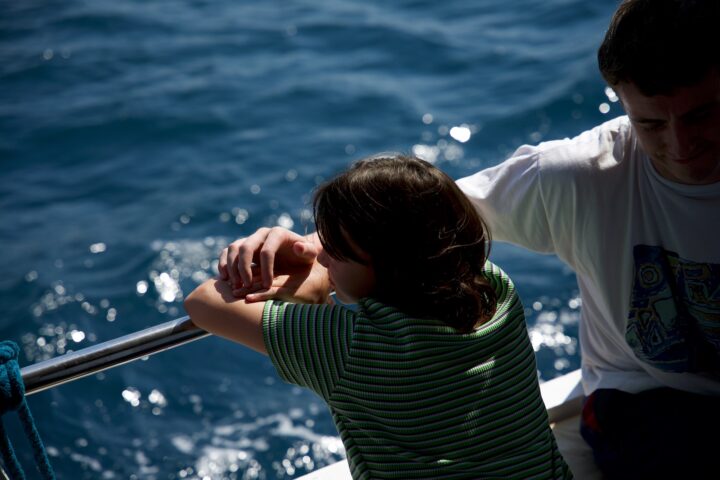

Scottish filmmaker Charlotte Wells drew an amused, if somewhat bemused, reaction from a packed house at the New York Film Festival when she introduced her feature-length directorial debut, Aftersun, as a New York movie. The core of the film unfolds along the Turkish coast as 11-year-old Sophie (newcomer Frankie Corio) vacations with her young father, Calum (Paul Mescal), an experience drawn heavily from Wells’s own childhood.
There’s nothing immediately traumatic or sensational about the holiday, especially not in the DV footage of the trip captured by the characters. But as an adult Sophie (Celia Rowlson-Hall) revisits the pixelated textures of that time from her apartment—presumptively in New York—a melancholy emerges that can only arise with the passage of time and great physical distance.
The maturity of the approach to memory stems from Wells’s own position above and outside the ’90s-set crux of Aftersun, not unlike the adult Sophie’s point of view. The film resists facile coming-of-age flashpoints or reductive father-daughter dynamics as the trip progresses toward its natural conclusion, and not any kind of forced narrative climax. Wells captures how family members strive mightily to understand and support one another, fixating on the discordant moments where it’s clear that their love has no limits, even if their sense of perspective does. She finds the majesty in the mundanity, amplifying a simple gesture or glance to imbue it with the gentility inherent in the moment—and the tragedy that surfaces in retrospect.
I spoke with Wells shortly after the film won over the New York Film Festival crowds. Our conversation covered how she baked certain visual choices into her script, when she discovered others on set or in the edit, and where she makes delineations between memory and story.
I was at the Alice Tully Hall screening at the New York Film Festival where you mentioned your professor said there was a shot you needed to take out so the people in the third row didn’t get nauseated. Did you actually keep the shot?
I got an email from her afterwards saying there was more, not less. And she’s right. It was DV! I was trying not to imply that it was the rave. We cut it, and it was wrong. So we put more.
On the note of the DV, did putting that camera in the hands of the actors help them unlock anything about the way that their characters see the world or each other?
That’s probably more of a question for them. Certainly, there was no bad take with the DV. There were rarely bad takes, but there was always something surprising in the DV footage. There was never, ever a sense of performing. It always felt incredibly natural. I think that was just by virtue of having some control over what they were doing. The weirdness of being on a film set playing into the idea of having a camera in hand.
You mentioned that you wrote the screenplay to Aftersun visually. What does that process look like in practice?
Two examples come to mind, one of which is really more about the sound than the visuals, but it’s the same sentiment. When they arrive in the hotel room, he’s on the phone and she’s asleep on the bed. Then he’s untying her laces and there’s a cut in picture but not in sound. That was in the script. It cut exactly there in the script, and then you see him continue to put her to bed while the phone call is playing. Or the shot of television that’s one of the longest shots in the film when the camera is hooked up with a live feed to the DV. That was written in the script, but it was written a little differently in that once the power cord is pulled, the rest of the scene played out in just a sliver at this side of the television, their feet on the floor while they sat in the bed. Maybe you’d see their lower bodies or their hands. And, as it was, the room didn’t lend itself to whatever idea exactly I had for that shot as it was written in the script. But Greg [Oke, cinematographer] instead found this reflection, which is what really makes the shot at the end.
Can you discover a motif like the reflections in the writing, or is that something you have to find on set?
Were there reflections written in the writing? Not as many as there are in the film. But I know how Greg shoots, and I know that he likes reflections and mirrors and frames. I think I knew that would always be a part of it, but that was the camera in Greg’s hands.
How did you discover the first and last shots, which I understand both changed from your initial vision?
The opening always began in the rave. I think that’s true—now, though I’m fact-checking that—but the first draft certainly did. There was a little bit of experimentation around DV as well. The opening was always a combination of rave and DV that led onto the bus, which is still how it starts. But it never began with that middle scene up front. That was a suggestion that actually came during a feedback screening from Barry Jenkins’s editor, Joi McMillon. I was quite reluctant to try it, but I did. And it worked. [chuckles] Which is why I do like to try everything proposed, and it doesn’t take long to try notes like that. They often do surprise you. And the end is generally how the script ended. The end of the script actually comes back around a couple of times. There was a full 360-degree rotation that lands us back in the room after the airport and then eventually to a final image. And that image is in the film, it’s just not the last shot.

There are often images of Calum in private or away from Sophie where he’s obscured in some way or his back is to the camera. Is that because Sophie, the character, can’t understand? Or is that also you as the author acknowledging the limitations of your own perspective?
Those are hard to separate. To whatever degree my perspective is limited, it’s played out through the adult Sophie, so I’ll answer from her point of view. Which is to say that the scenes of Calum alone are, to some degree, her imaginings of what he may have been doing when she wasn’t around. The best way to visually communicate that, even though we wouldn’t necessarily be able to articulate in the moment what we were doing, was to keep Calum at arm’s length and abstract him from view. There’s an unknowable quality to him and a searching for more.
Keeping in mind the inscrutability of Calum, you gave some leeway to Paul to discover the character and take him in different directions. Where did he surprise you or illuminate things you didn’t necessarily see at the beginning?
That’s an interesting question. We both had a very common understanding of the character. We both contributed to the character. I would say that I laid the foundation for the character, and he built upon it for his own sense of backstory and entry into understanding and empathizing with Calum. But Paul was just so reliably good and always so open to being reactive to Frankie. I think some of the most surprising moments on set were when he was open to her.
Actually, I talk about the karaoke scene in relation to this when he’s wounded by what she says about asking him to stop pretending to be able to pay for things that he can’t pay for. He’s so hopeful in his response, trying to bring her back around in a way that really feels like that’s Paul in that moment. We played with a lot of different versions of that scene, and my instinct was for him to be much, much colder. I think what works so well, ultimately, in that scene is that he actually is able momentarily to rise above it. Until he can’t anymore, and he leaves.
Calum has such a great line about leaving home and feeling like you never can really come back after a certain point. It’s very much referencing physical place, but given the way that you collapse boundaries between place and time in the film, do you think it could also be read about childhood and age?
I think those two things are connected too. especially if you leave a place that you grew up as you enter adulthood. Those two things become inextricably connected. Leaving home was leaving childhood. Then you can go back to neither, in a certain way.
Does the rave in the film represent your own journey making the film? It’s the creation of a liminal space where you can, inside of a dark room, tackle the image or idea of your past?
Yes! Thank you for articulating it for me. Absolutely, it was the element of the script that was never intended to be there. And I think it’s a result of the process of trying to write the script.
I saw Aftersun about 12 hours after All the Beauty and the Bloodshed, so there was a quote from that film’s subject, Nan Goldin, still rattling around in my head: “It’s easy to make your life into stories, but it’s hard to sustain real memories. Real experiences are not wrapped up in simple ethics.” Do you have a philosophy for delineating memory from story?
They’re both stories. I’ve gotten into some pretty heated arguments with people about the degree to which memories are stories. I try to delineate them for myself because I think I fear overwriting memories through making films so closely associated with them. I’ve learned that through work in the past, and I tried this time to protect myself from it a little by creating some record of those memories—or allowing certain memories to be off-limits in making the film so that I didn’t overcomplicate them. But memories, as they relate to a shared experience between two people, are so limited by your own perspective of them. Something that came up during the talk I did with Mia Hansen-Løve [at the New York Film Festival] is that I think often about the point of view inherent in memory and what it means when the person you shared an experience with is no longer there to fill out the memory or the picture.
That reminds me of the moments in the film when Calum looks at the DV footage, especially the footage that Sophie shot, and starts to see himself as a character in her life. You sense what’s lost in that passage between memory and story.
That was a gift the DV camera offered that I was aware of upon adding it as yet another complicating factor to the script. It offered a direct point of view but also an insight from one character to another of how the other perceives them. That was something I really enjoyed playing with. I haven’t really considered it as a character within the story, but it absolutely is.
Since 2001, we've brought you uncompromising, candid takes on the world of film, music, television, video games, theater, and more. Independently owned and operated publications like Slant have been hit hard in recent years, but we’re committed to keeping our content free and accessible—meaning no paywalls or fees.
If you like what we do, please consider subscribing to our Patreon or making a donation.