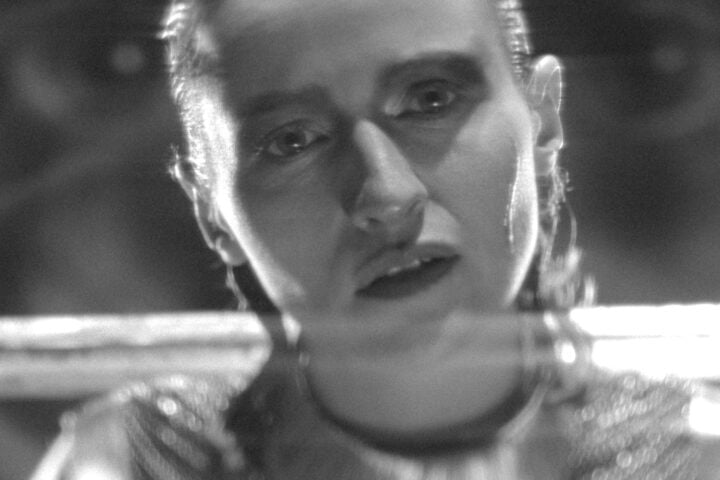
Jacques Rivette’s films possess a certain lilting quality that sits in a lineage with movie musicals, but it wasn’t until 1995’s Up, Down, Fragile that one of his works could be outright classified as such. Inspired by the backlot MGM musicals of the ’50s, the film uses the real streets of Paris as its own “set,” with parks and alleys and nightclubs as backdrops for a narratively diffuse series of scenes that, in true musical fashion, build a vaguely interlocked emotional world.
The film’s title refers to adjectives that one might use to describe the three women whose independent and intersecting movements drive the narrative, such as it is. The “up” character is Louise (Marianne Denicourt), an upper-middle-class woman who’s recently awoken from a five-year coma to find that her beloved aunt is dead and that she’s inherited a roomy manor. “Down” is Ninon (Nathalie Richard), an earthier, more streetwise figure who, at the start of the film, is seen escaping from her violent pimp. And “fragile” perfectly describes Ida (Laurence Cōte), an introverted librarian whose status as an adopted child has left her with no concrete sense of self. Reinforcing Ida’s self-confusion is the occasional intrusion of passersby (including Rivette in a cameo), who mention that she reminds them of someone but cannot place her face, as if she were only a vaguely familiar outline of a person rather than a defined being.
Aptly, Rivette builds his compositions around each woman’s distinct mien. Frames featuring Louise always look a bit brighter; verdant tree canopies surround her in the parks and avenues where she walks, and her home’s high ceilings let in ample sunlight during the day. Meanwhile, Ninon’s scenes tend to be darker and grimier, either noir-like across the interiors or just dimmer with drabber backgrounds across the exteriors. For her part, Ida often appears to be inching toward the edge of the frame, as if trying to slip out of view without attracting attention.
Even though it takes almost exactly an hour for one of the main characters in the film to actually burst into song, such minute aesthetic flourishes make Up, Down, Fragile feel like a musical from the start. Rivette barely has to tweak his longstanding directing style, so dependent on long takes and theatrical camera movements, to convey something of the language of musicals. Each elegant track-pan of the camera reorients not merely an actor’s position in the frame but conveys shifts in mood that are compounded by the smallest change in expression or body language by the leads, two of whom had prior dance experience.
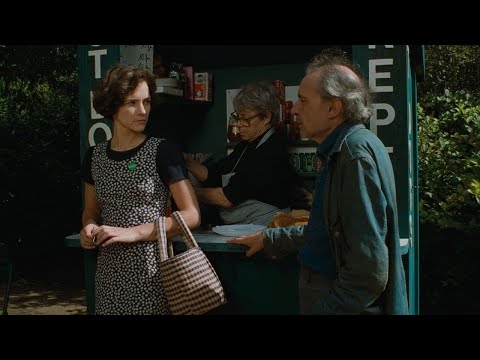
Denicourt, trained in ballet, moves with lithe, careful poise that conveys both her wealthy upbringing and her character’s uncertain attempt to reconnect to the material world after years of unconsciousness. Richard came from a background in more contemporary dance, and Ninon has a sultry, swaggering gait and cuts loose with undisciplined, unpredictable flailing. Ida befits Cōte’s lack of training in her generally shrunken, stiff posture, and the camera always moves a bit skittishly to capture her nervous, start-stop attempts to interact with others.
The usual Rivettian plot touches of paranoia and a (usually correct) sense of being surveilled are present in Up, Down, Fragile, but perhaps none of the filmmaker’s works is less concerned with even the vaguest demands of story than this one. Instead, it operates purely on the moods generated by the aforementioned emphasis on visual composition, actor blocking, and the persistent intrusions of the real world around all of this immaculate composition.
Louise and Ninon often intersect, and the film’s most exuberant musical moments communicate the increasingly close bond that they form as they circle the same man, a set designer named Roland (André Marcon). Ida, mostly isolated from the other two women, at first emanates waves of lonely depression, but slowly her scenes start to convey an increasing confidence at facing a world from which she initially cowers. Fittingly, the film ends on her, ambiguously but liberatingly casting off of her obsessive desire to track down her birth mother. The moment also perfectly epitomizes Rivette’s gift for sublimating his cinephilia into not only his own aesthetic form, but his means of seeing and processing the material and emotional realities of life.
Image/Sound
For the fourth straight month this year, Cohen Media Group has not only resurrected a long-unavailable Jacques Rivette classic on home video, but provided it with a mesmerizing transfer. There isn’t a blemish to be found on this transfer, and the frequent shifts in lighting caused by uncontrollable natural elements on Parisian streets never produce any abrupt fluctuations in contrast. Colors are consistently bold, be they the greens of local parks or the shocks of neon on signs that illuminate the city at night, and skin tones are full and natural.
The lossless stereo track ably captures even the slightest ambient noises, while dialogue is always clear and situated at the front of the mix. The musical numbers similarly bring the music and singing to the foreground and keep each instrument cleanly separated from the others.
Extras
Once again, Cohen offers a commentary track by professor and programmer Richard Peña. The looser narrative structure of this film, not to mention its length, perhaps understandably invites Peña to take more than the occasional breather, but he nonetheless ably unpacks Rivette’s use of musical film grammar to generate and sustain the film’s emotional logic.
Overall
Jacques Rivette’s street musical looks gorgeous on Cohen’s excellent Blu-ray.
Since 2001, we've brought you uncompromising, candid takes on the world of film, music, television, video games, theater, and more. Independently owned and operated publications like Slant have been hit hard in recent years, but we’re committed to keeping our content free and accessible—meaning no paywalls or fees.
If you like what we do, please consider subscribing to our Patreon or making a donation.