Like Pedro Costa’s Vitalina Varela, Lemohang Jeremiah Mosese’s This Is Not a Burial, It’s a Resurrection explores the impossibility of mourning. In Mosese’s film, Mantoa (Mary Twala Mhlongo), an 80-year-old widow living in a rural village in Lesotho, learns that her last surviving son, a migrant worker laboring in a coal mine in South Africa, has died. Having lost all of her loved ones, she decides to plan her own funeral. She wants a simple coffin. No golden angels or other gaudy nonsense.
The Lesotho-born, Berlin-based Mosese’s mise-en-scène and camerawork are breathtaking. The opening of the film, for one, is reminiscent of the Titanik Bar scene from Béla Tarr’s 1988 film Damnation, where the camera glides through a God-forsaken nowhere, certain of where it needs to go, despite the darkness, all the way until it spots a cabaret performer singing the most melancholy of all songs. In This Is Not a Burial, It’s a Resurrection, the camera also sneaks gracefully through a dark nowhere until it finds, not a singer, but an old man playing a strange instrument and eager to tell us a sad tale about lands that weep, miners coming home, and “cups that could never be filled.”
Mosese takes us back to this non-space a couple of times, as if the old man, played by Jerry Mofokeng Wa Makhetha, were a non-diegetic master of ceremonies for the story of Mantoa that unfolds. It’s a story told through the gracefulness of the camerawork, the stunningly lit tableaux, and, most remarkably of all, through fabric. Not many films, especially ones with a documentary sensibility, use texture—wool, mud, cement, ashes, and cloth specifically—as a storytelling device the way that This Is Not a Burial, It’s a Resurrection does.
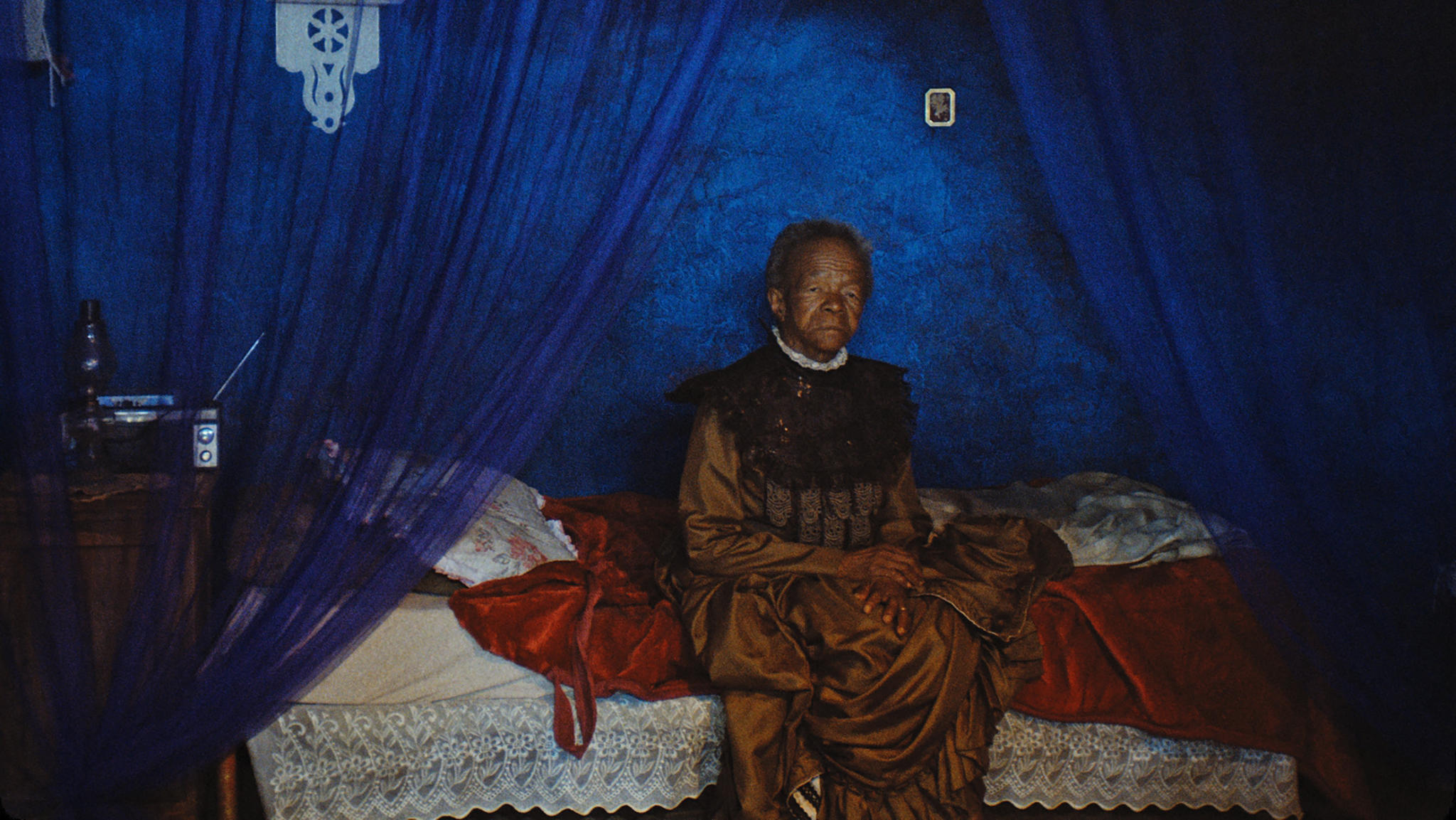
Consider the moments where Mantoa, faced with the many obstacles that keep her from being able to dig her own grave, takes refuge in the gown her husband once gave her: an exquisitely lustrous damask dress with a black frill and white-collar trim. It’s a great sartorial departure from the sober blackness of her usual widow’s attire, which clashes with the flashy satin swathed around the bodies of the women around her and the blindingly yellow uniforms of city workers building a dam right where the dead lay, draped in white bedsheets.
In one of the film’s many unforgettable scenes, Mantoa gets up from the chair where she usually sits to listen to the radio and dances with her dead husband, raising her arm as if holding an actual body that isn’t there, a voice in the background telling her to take off her “cloak of mourning.” And she certainly takes it all off in a bewildering final sequence when Mantoa simultaneously surrenders to loss and spurns it.
Image/Sound
Criterion’s 2K transfer does a spectacular job of highlighting the stark contrasts in the film’s color palette. The deep reds, purples, and blues, often found in clothes or walls, practically pop off the screen, and the image is richly detailed, particularly benefitting the close-ups of lead actress Mary Twala Mhlongo’s expressive face. Because of its distinctive look, This Is Not a Burial, It’s a Resurrection is often mistaken for being filmed on 16mm, though it was actually shot digitally and paired with 16mm grain and an emulsion to give the illusion of super 16mm. Criterion’s transfer further heightens that illusion with perfectly even grain distribution and color grading that mimics the look of 16mm. On the audio front, the 5.1 audio effectively captures all the ambient sounds of nature and the eerie beauty of Japanese noise artist Miyashita Yu’s score.
Extras
In a newly recorded commentary track, director Lemohang Jeremiah Mosese and producer Cait Pansegrouw have a wonderful rapport, sharing various stories from their on-set experiences in the traditional rural village where they shot. They also discuss their meeting at a screenwriting residency and touch on virtually every aspect of the production and the genesis of the film. Mosese, in particular, is very open about what he was trying to express with his film and why he made certain decisions, such as shooting in the academy ratio and pacing the film in such a deliberate manner. The disc also includes two of Mosese’s short films and his 2019 essay film Mother, I Am Suffocating. This Is My Last Film About You., along with a 15-minute introduction to all of them by the director. The package is rounded out with a booklet essay by novelist and playwright Zakes Mda, who focuses on the film’s poetic approach to storytelling, paying particular attention to its cinematography, score, and structure.
Overall
Criterion has outfitted Lemohang Jeremiah Mosese’s transfixing fiction feature debut with a vibrant transfer and a small but solid slate of extras.
Since 2001, we've brought you uncompromising, candid takes on the world of film, music, television, video games, theater, and more. Independently owned and operated publications like Slant have been hit hard in recent years, but we’re committed to keeping our content free and accessible—meaning no paywalls or fees.
If you like what we do, please consider subscribing to our Patreon or making a donation.