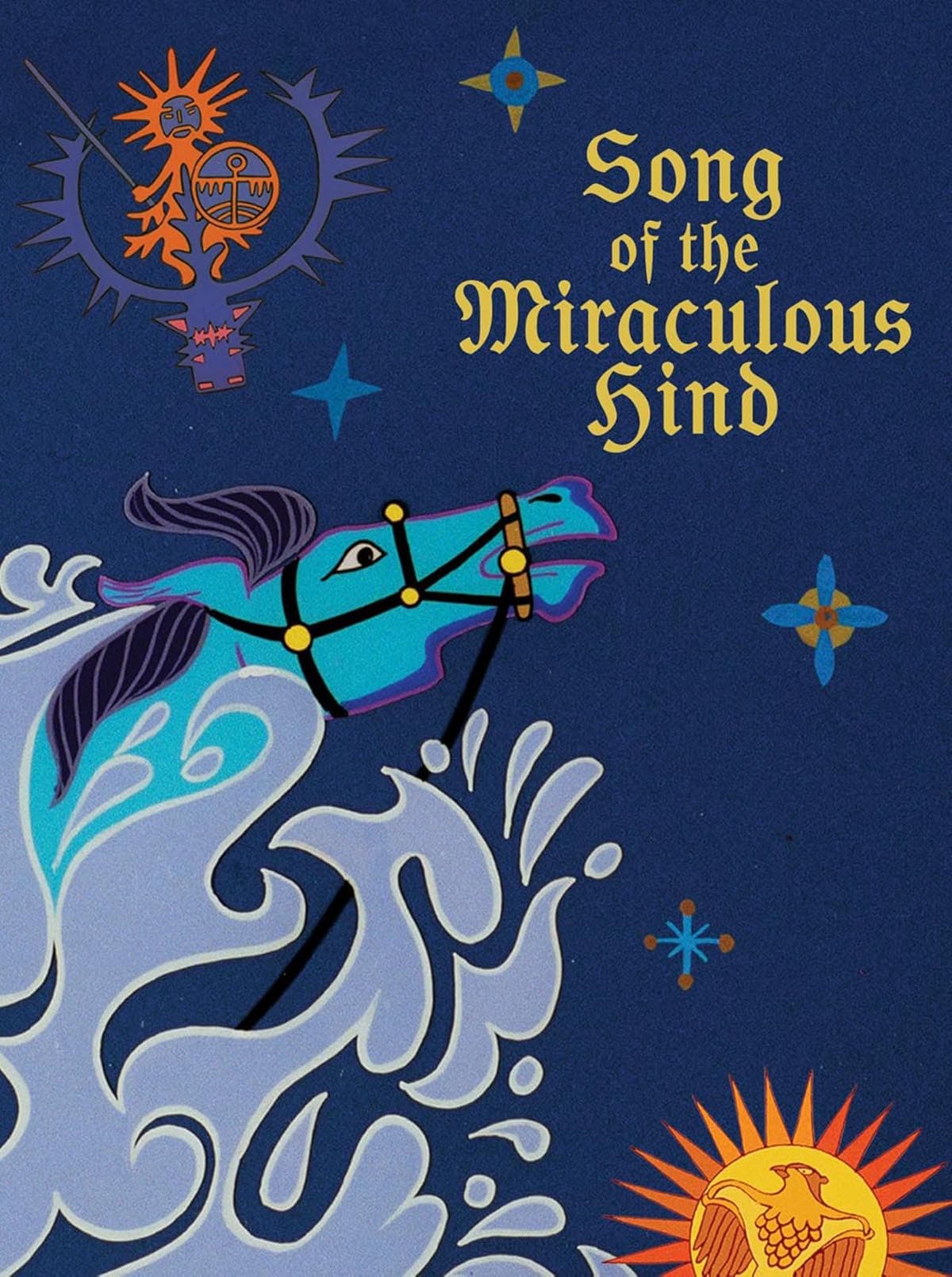
 Marcell Jankovics’s trademark psychedelic animation style perfectly lends itself to the blend of actual history and pagan myth that Song of the Miraculous Hind leans into. Framed by a monk recording stories in an illuminated manuscript, the film traces the history of Hungary from the prehistoric era right up to the cusp of Christianization under Prince Géza at the end of the first millennium A.D., turning national history into a fairy tale, one where facts slip into fantasy without warning.
Jankovics uses a variety of retro stylings to convey the steady march of time. At the start, the film incorporates rough figures and smeary colors redolent of cave paintings to depict early humans on the Great Hungarian Plain, while the final scenes draw from the techniques of Byzantine art that Christian missionaries might have brought with them to the region. In between, there are moments where objects and characters move with a stiffness redolent of woodcarvings. In mimicking techniques that precede theories of perspective, the film often looks flattened, conveying depth in the stacking of various planes of action and tapestry-like horizontal movement.
Song of the Miraculous Hind also leans into the idea of no one object being a fixed entity. Across the film, animals, people, and various props are prone to morphing suddenly into an entirely different creature. People shapeshift into deer and birds, gods and monarchs abruptly made into prey for hunters. Scene transitions occur in these moments of transfiguration, as in a lion shot with an arrow on a hunt freezing into the insignia of a shield carried by a knight into battle.
At times, the film, driven by the monk’s calm narration, becomes a dry recitation of highlights of Hungary’s Dark Ages past. But through its vibrant, undulating animation, forever upending the most straightforward bits of Hungarian history with shocks of electric color or unpredictable pivots, Song of the Miraculous Hind becomes something of an ecstatic vision. It embodies a basic truth that even after centuries of Christianization and the often brutal suppression of beliefs and identity it entails, Europe still retains memories of its strange, eldritch old self.
Image/Sound
Deaf Crocodile’s 4K transfer of Song of the Miraculous Hind is completely blemish-free, with no instances of debris or fading in any of the frames. The many shades of red, blue, and yellow all radiate with intensity. The linework and various textures of the animation, whether glossy, picture book-like figures to slightly rougher, etching-like cutouts, are all perfectly rendered, giving each object in the frame clear delineation. The 2.0 soundtrack is filled mostly with music and voiceover narration, and both sound crisp and balanced in the mix.
Extras
Deaf Crocodile’s release includes a handful of new extras, starting with a commentary track by film podcasters Adam Rackoff, James Hancock, and Martin Kessler. Unsurprisingly, the track is conversational, with each speaker admitting his unfamiliarity with the history and mythology that Song of the Miraculous Hind covers while analyzing how the film’s symbolism and visual language communicates meaning through context clues.
A visual essay by film historian Evan Chester unpacks Marcell Jankovics’s career and the making of Song of the Miraculous Hind. Particularly interesting is the revelation that Jankovics received government funding for the project on the grounds that, for all its visual phantasmagoria, it qualified as educational entertainment to be shown in classrooms.
Finally, Deaf Crocodile co-founder Denis Bartok and translator Anna Klaniczay moderate an interview with animator Piroska Martsa and composer Levente Szörényi, who discuss their careers and recurring collaborations with Jankovics. It’s particularly interesting to hear their insights into working under the rapidly changing social and political conditions in Hungary over the last half-century, navigating everything from Soviet standards and censorship to the post-communist mixture of private and public arts support in Hungary.
Overall
Song of the Miraculous Hind is one of Marcell Jankovics’s most phantasmagoric works, and Deaf Crocodile’s UHD release presents its colorful animation in all its radiance.
Since 2001, we've brought you uncompromising, candid takes on the world of film, music, television, video games, theater, and more. Independently owned and operated publications like Slant have been hit hard in recent years, but we’re committed to keeping our content free and accessible—meaning no paywalls or fees.
If you like what we do, please consider subscribing to our Patreon or making a donation.