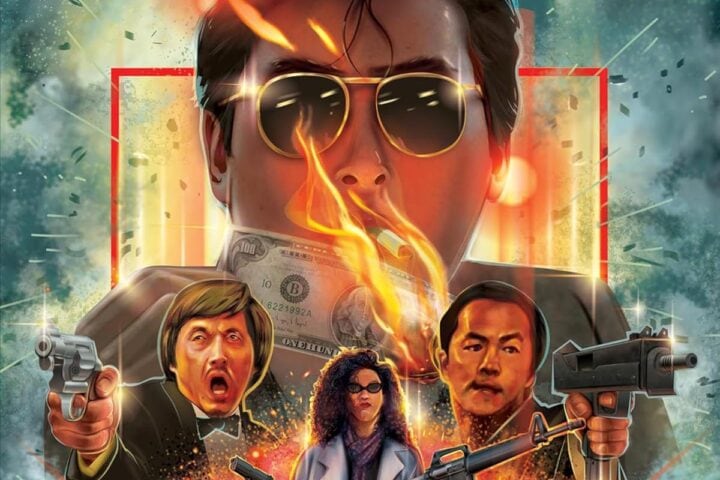
Johnnie To was already a hitmaker when he formed his independent production company Milkyway Image in the late 1990s, but it was under his own banner that he truly became the greatest modern genre filmmaker in the world. Running Out of Time, one of a trio of films that he released in 1999, is, on its face, the least captivating of the three. It lacks the moral curiosity of Where a Good Man Goes and the sleek formalism of To’s first masterpiece, The Mission. And yet, all of the strengths of To’s work are on florid display in this simple but engaging thriller: compositions that use every inch of the widescreen frame, camera shots that are constantly in motion without losing spatial clarity between characters, and the blink-and-you’ll-miss-it approach to imparting information visually and without repetition.
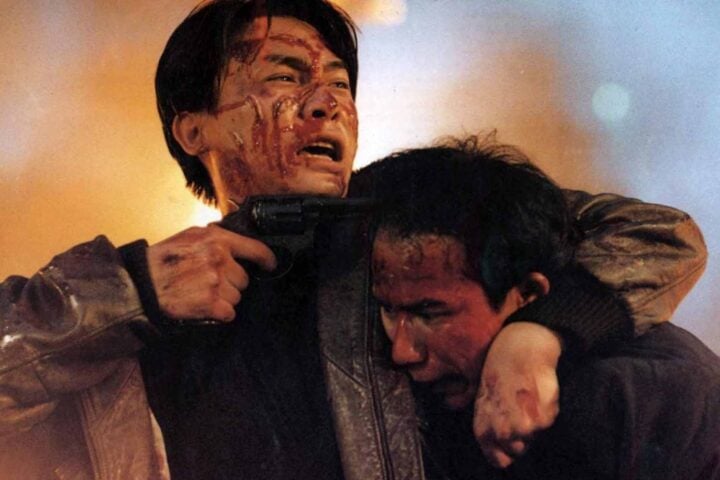
To’s facility with comedy lends a playful quality to even his most serious work. Running Out of Time is a prolonged game of cat and mouse between Ho Sheung-sang (Lau Ching-wan), a police negotiator, and Cheung Wah (Andy Lau), a man dying of cancer who stages elaborate chases in order to lure the cop into his orbit. To get Ho’s attention, Cheung does everything from staging a bank robbery to suddenly appearing in the back seat of the cop’s vehicle, and his elaborate scheming only makes the purpose of such antics all the more tantalizing.
Admittedly, the eventual reveal of Cheung’s motive—that he’s seeking revenge against the criminal who usurped his gangster father—fails to live up to the depth of his masterminding. But the convolutions of the plot gradually give way to deliriously atmospheric visuals, with Cheung’s worsening health and Ho’s cavalier attitude toward dangerous situations providing the foundation for an unlikely and deeply cynical buddy pairing that reflects the identity crisis at the heart of contemporary Hong Kong cinema. Andy Lau rivetingly channels his superstar charisma into his character, especially when Cheung is at his most puckish toward Ho, but the actor’s rakish smile takes on an increasingly bleaker edge the more that his character coughs up blood. And for all the richly hued objects in the frame, the overall color scheme is ice-blue, draining the whimsy out of the leads’ game in a reflection of Cheung’s rapidly dwindling time.
Less somber is Running Out of Time’s 2001 sequel, which brings back Lau Ching-wan’s Ho but this time pairs him with a nameless thief and street magician (Ekin Cheng) who’s trying to extort money from a businesswoman, Teresa (Kelly Lin). Right out of the gate, the film suffers from a sense of narrative retreading, and just as Lau Ching-wan and Cheng don’t produce the same chemistry that Andy Lau and Lau Ching-wan do in the prior film, Running Out of Time 2’s criminal mastermind has a less-than-compelling motive, if indeed the thief can be said to have any motive at all beyond the amusement of his schemes as an end unto themselves.
Slowly, though, that ostensible lack of purpose becomes the film’s strength. If Running Out of Time operates as an exceptionally crafted but mostly generic thriller, its follow-up indulges experimentation for its own sake. The police bureau, an unremarkable office in the first film, is now thick with cigarette smoke that gives the space a suffocating quality, and there’s a similarly claustrophobic quality to the conference rooms where Teresa spews meaningless (and, pointedly, English-language) pronouncements about her company’s impending merger with a Beijing firm. The arcing pans of the first film are augmented by rushing forward pushes, angular, dimension-warping compositions, and a dynamic mastery of blocking that regularly triangulates characters’ positions in various pockets of the frame.
And where the first film, co-written by Laurent Courtiaud and Julien Carbon, stressed the procedural methods of its main characters, the sequel—crafted by Milkyway’s in-house team of writers, including key To collaborators like Au Kin-yee—plays into a trademark of To’s later work: an interest in Buddhist notions of cause and effect and the way that fate plays out in ways cosmic and quotidian. For example, one subplot involves one of Ho’s colleagues (Lam Suet), whose mounting gambling debts are reflected early on in how he gets conned repeatedly by the thief’s rigged coin toss, which he despondently sees as proof of his bad luck.
Later in Running Out of Time 2, a bald eagle appears intermittently to guide Ho and Teresa toward the thief, the first of many blatantly surreal affectations to come. Throughout, the exacting formal precision of each self-reflexive moment shows how seriously To takes his craft, even when he’s having a laugh. If its predecessor represented the culmination of nearly three decades of studio-honed craftsmanship, Running Out of Time 2 finds To operating in pure auteur mode, displaying the technical and tonal chops that would lead to a nearly unbroken string of modern action and comedy classics stretching to the present day.
Image/Sound
Both films’ transfers are sourced from 2K restorations, and anyone who had to track these down on import DVDs back in the day is in for a treat given the dramatic boost in image clarity and color saturation. The neon-tinged city streets now pop with renewed intensity, while the daytime scenes sport healthy contrast between the bright skies and characters’ dark suits. Both films come with 5.1 soundtracks in the original Cantonese and a dubbed Mandarin, as well as mono English dubs. The Cantonese tracks are obviously the preferred option, and they make excellent use of ambient space across the entire soundstage for everything from street traffic to the clanking of silverware in restaurants, while dialogue is always clear in the center channel.
Extras
Translator and programmer Frank Djeng provides two new commentary tracks, one for each film. Djeng’s background in marketing can be felt in the rapid-fire cadence and fact-oriented emphasis of his observations, which occasionally makes for dry stretches, especially when he offers background information about the locations used in the films. Nonetheless, his extensive knowledge of Hong Kong cinema is such that we’re offered valuable insights into the films’ place within a tumultuous period in the region’s art. The first Running Out of Time also comes with a commentary track from screenwriters Laurent Courtiaud and Julien Carbon, who offer more intimate details on the film’s production. Also included on the first disc are brief interviews with the cast and crew that appeared on earlier international DVDs of the film, while the second disc includes a brief, superfluous making-of video about Running Out of Time 2 and a 50-minute documentary by French filmmaker Yves Montmayeur that uses Courtiaud and Carbon’s experience working on several Hong Kong films as a means of discussing the region’s contemporary cinema. Film historian David West contributes a booklet essay on both films that contains ample information on the movies’ commercial properties while also delving into the way that Johnnie To subtly plays up noirish loneliness in the margins their goofy escapades.
Overall
Johnnie To’s popular capers come to home video with solid transfers and informative extras from Arrow Video.
Since 2001, we've brought you uncompromising, candid takes on the world of film, music, television, video games, theater, and more. Independently owned and operated publications like Slant have been hit hard in recent years, but we’re committed to keeping our content free and accessible—meaning no paywalls or fees.
If you like what we do, please consider subscribing to our Patreon or making a donation.