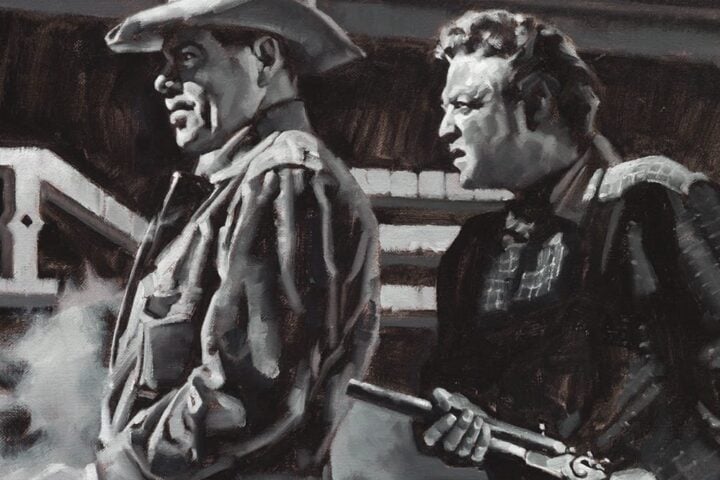
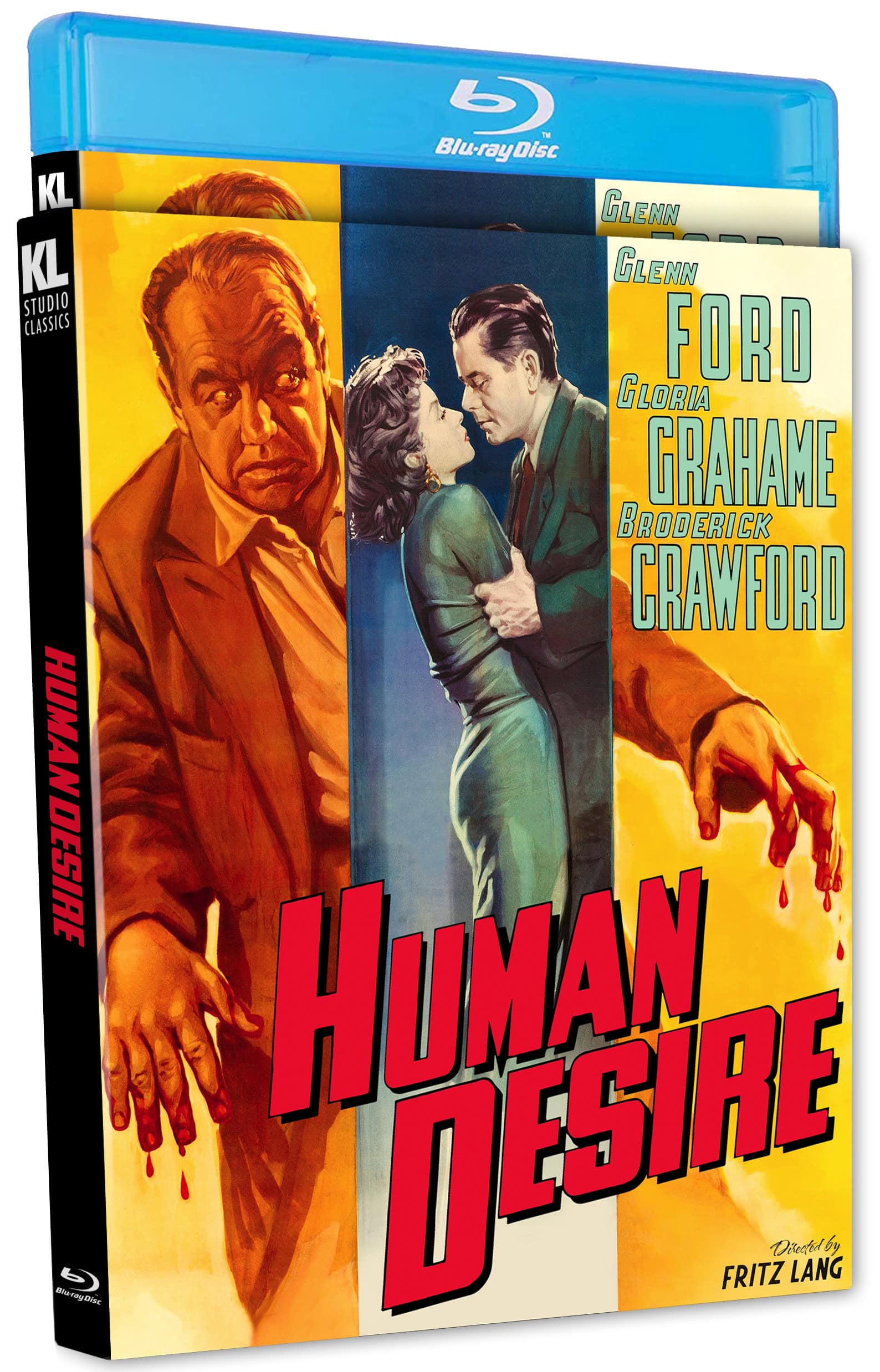
 Based on Emile Zola’s 1980 novel La Bête Humaine, Fritz Lang’s Human Desire is an entirely different beast than Jean Renoir’s 1938 adaptation. The Renoir film’s pointed humanism and everybody-has-their-reasons ethos is swapped out here for a considerably steelier point of view. Indeed, the film is less interested in its characters’ interiority than it is in viewing their lives through a fatalistic lens.
What’s most compelling about Lang’s film is how elegantly it toys with noir tropes and subverts our expectations, particularly with regard to Vicki (Gloria Grahame), who’s initially presented as your prototypical femme fatale. Vicki is trying to convince her new lover, Jeff (Glenn Ford), to murder her slovenly, abusive husband, Carl (Broderick Crawford). It’s a setup familiar from countless noirs, most notably Billy Wilder’s Double Indemnity and Tay Garnett’s The Postman Always Rings Twice, so the audience is already primed to expect an innocent man to inevitably find himself wrapped in a web of deception and lies carefully woven by a devious, manipulative woman.
Jeff, a railroad engineer, appears to be that man. Damaged from his recent stint in the Korean War, he resists the wholesome advances of Ellen (Kathleen Case), including an invitation to the local “dance and frolic,” to pursue the unhappily married Vicki. Sure, Jeff is a sympathetic fellow, but it’s his lustful instincts, not Vicki’s, that get him into trouble.
Vicki, though, is the one who’s binded by the forces of patriarchal dominance, making her the film’s ultimate victim. She’s not only stuck with Carl, but she can’t escape the orbit of an older man from her past, John (Grandon Rhodes), who repeatedly assaulted her as a teenager. She sees a glimmer of hope in Jeff, a seemingly decent man who wants to extract her from her miserable marriage. Of course, once Carl blackmails her so that there’s no way she can divorce him, she nudges Jeff in the direction of murdering him. It’s a violent impulse whose justification—rooted in a need for survival, not vengeance—that we’re made to feel with incredible ferocity.
Despite Jeff’s initially good intentions, he, too, turns on Vicki, eventually deciding that she’s rotten for convincing him to try and snuff out Carl, and he goes on to treat her nearly as callously as the other two men in her life. Shots of tracks and speeding trains figure largely in Human Desire, serving as visual signifiers of the inevitability of each character’s trajectory and the inescapability of fate. For one, while Jeff is the engineer, it’s Vicki’s fate who’s sealed by both the actions and, in the case of Jeff, inaction of the men in her life.
Pleading with Jeff at one point, Ellen says, “There are other kinds of love and they’re not hard to find.” That may be true for them, but for Vicki, who’s been hurt by men her whole life, love can never be a panacea. It’s a notion that’s made explicit in the remarkably chilling juxtaposition that ends the film, with Jeff, ready to accept Ellen’s love, sitting at the front of the train, while Vicki is in the back, defenseless and alone to face the dire consequences of her past.
Image/Sound
There’s no mention of this transfer being made from a new restoration, but outside of some light scratching and softness in some of the nighttime exterior shots on moving trains, Human Desire looks beautiful in 1080p. The image is crisp and rich in detail, the grain is tight and even, and the range of grays highlights the subtle beauty of Burnett Guffey’s cinematography. Despite being presented in a dual-mono track, the audio is fairly immersive, especially in the numerous scenes where the background sounds of trains are used to ratchet up the tension.
Extras
Aside from a handful of trailers of films released by Kino Lorber, the only extra feature on this disc is a short interview from 2010 with actress Emily Mortimer, who briefly discusses the rage of all the characters and her admiration for Gloria Grahame.
Overall
The lack of a commentary track feels a bit like a slight to a film in Fritz Lang’s canon that could benefit from more adulation, but Kino’s A/V presentation is at least a strong one.
Since 2001, we've brought you uncompromising, candid takes on the world of film, music, television, video games, theater, and more. Independently owned and operated publications like Slant have been hit hard in recent years, but we’re committed to keeping our content free and accessible—meaning no paywalls or fees.
If you like what we do, please consider subscribing to our Patreon or making a donation.