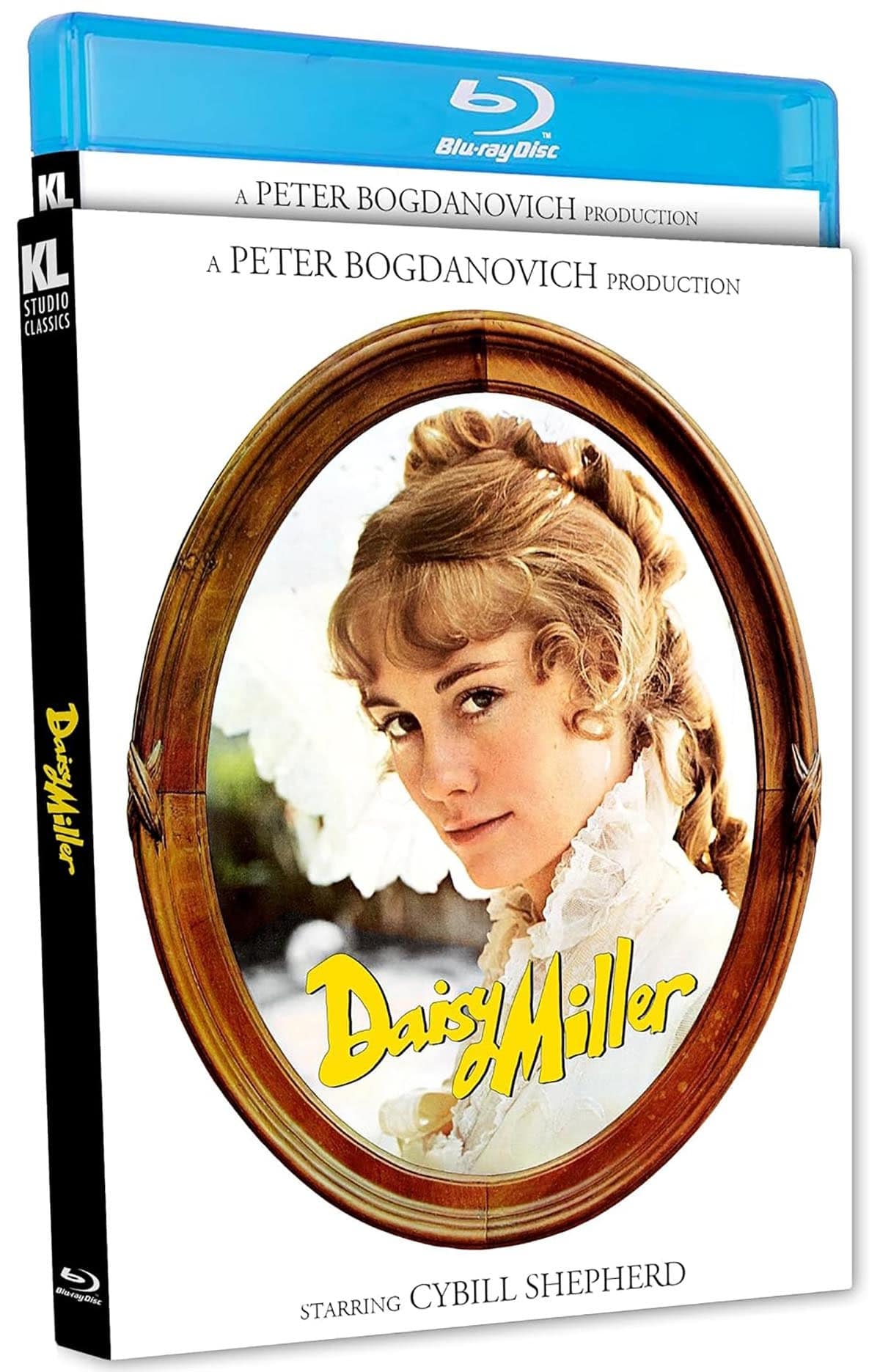
 Before Bertrand Bonello transformed The Beast in the Jungle into a time-hopping, existentialist sci-fi melodrama, the most radical cinematic treatment of the work of Henry James was Peter Bogdanovich’s 1974 film maudit Daisy Miller. The adaptation is certainly faithful, with dialogue lifted directly from the text and the core narrative and themes understood and preserved by Bogdanovich and writer Frederic Raphael. But the film also filters James’s tale of a scandalously flirtatious 19th-century American woman in Europe through a screwball prism.
Here, the novella’s cool-tempered Frederick Winterbourne (Barry Brown) is left completely befuddled by the rapid-fire, monopolizing chatter of Daisy Miller (Cybill Shepherd). It’s an oddly compelling approach, but it only intermittently succeeds. When the film premiered, critics and even many of Bogdanovich’s friends and colleagues derided the entire project as a vain folly devoted to the star, the director’s then-girlfriend. The blatant sexism of the reaction aside, it’s easy to find fault with Shepherd’s performance in the runaway gallop with which she delivers lines in her early scenes.
Screwball may be fast-paced, but it still has to obey basic comedy rules of timing and reaction, and too often Daisy is speaking past Frederick and others, preventing Frederick from establishing himself as a viable straight man. Not helping matters is that Daisy’s mother is played by Cloris Leachman, who offers a masterclass in steamrolling Frederick’s prim attempts to keep up with conversation while modulating her cadence to set up a series of detonating punchlines that slam against the poor man’s face like boxing combos.
It’s only when the film, which Bogdanovich made after Paper Moon, slows down that it begins to come into its own. The comedy finds an actual rhythm in scenes of Frederick and Daisy’s scenes of courtship as she lets him get a few words in edgewise while still relentlessly teasing his repressed huffiness. More importantly, the modulation in tempo allows the film to dig into the heart of James’s story, that of “proper” society’s swift censure of Daisy’s free-spiritedness.
Shepherd may struggle with the staccato of the dialogue, but she excels at silently communicating Daisy’s bafflement as various members of Frederick’s high-class social circle, including Frederick himself, caution her about her behavior as if her loose tongue could trigger a diplomatic incident. Daisy Miller is otherwise a blend of comedy and drawing-room drama, but in the suffocating close-ups of judgmental matrons hissing vague but unmistakable threats toward the young woman, it begins to resemble the era’s paranoid thrillers.
Daisy Miller marked the first time that Bogdanovich’s knack for juggling Old Hollywood classicism with New Hollywood modernism came up short, and the financial failure and critical hostility that greeted the film marked a downturn in the filmmaker’s fortunes that never fully reversed. But if Daisy Miller isn’t an outright success, it’s also not a failure. Alluringly shot by Alberto Spagnoli, it anticipates the lush period dramas of Merchant-Ivory’s golden period, and the attempt to turn the words of one of literature’s most understated, psychologically piercing authors into the stuff of punchy, Hawksian wit comes perilously close to working.
Image/Sound
Kino Lorber’s Blu-ray ably captures the warm, sunlit tones and gossamer sheen of Alberto Spagnoli’s cinematography, presenting fine textures on costumes and faces even in the most washed-out exterior shots. Small details like the flecks of yellow in Daisy’s parasol or the fine stitching in furniture come through clearly, and the darker hues of Frederick’s clothing or the oaken walls of old-money homes show off a deeper range of black levels than on previous, standard-def releases. The soundtrack likewise captures the understated audio of soft-spoken dialogue amid the sparkling romanticism of Angelo Francesco Lavagnino’s score.
Extras
Kino’s disc includes an archival commentary by Peter Bogdanovich, who thoroughly dissects his literary and cinematic inspirations, Daisy Miller’s production, and the somewhat harrowing fallout of the film’s release. Equally informative is a new commentary with film historian Peter Tonguette, who places the film in the context of Bogdanovich’s career and calls attention to the director’s unique status as a family-friendly auteur in the midst of New Hollywood’s turn toward graphic violence and sexual content. In a new interview, Cybill Shepherd shares memories of the project and her affections for Henry James’s novella. Also included is an old introduction of the film by Bogdanovich, who briefly elaborates on its themes and his aesthetic approach.
Overall
Buoyed by a gorgeous new transfer and two incisive commentaries, Peter Bogdanovich’s misguided but compelling Henry James adaptation receives its best-ever video release.
Since 2001, we've brought you uncompromising, candid takes on the world of film, music, television, video games, theater, and more. Independently owned and operated publications like Slant have been hit hard in recent years, but we’re committed to keeping our content free and accessible—meaning no paywalls or fees.
If you like what we do, please consider subscribing to our Patreon or making a donation.