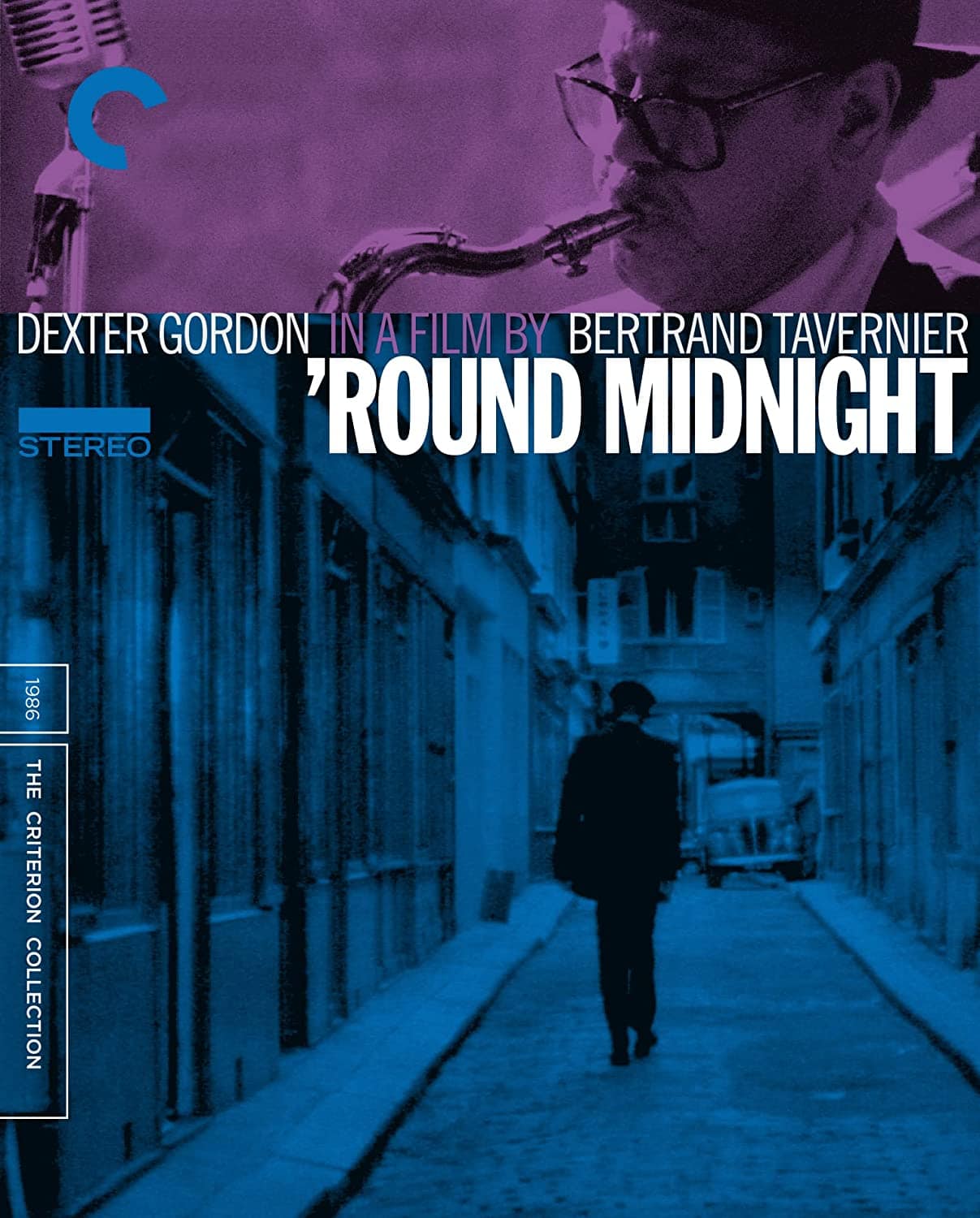
 Jazz music is a state of mind in Bertrand Tavernier’s 1986 film ’Round Midnight. At least that’s how Dale Turner (Dexter Gordon) sees it. The sixtysomething saxophonist, an alcoholic and drug user, plays his music wherever he goes and with little regard for who may be listening. But he has to make ends meet, so he often finds himself inside the jazz clubs of Paris and New York, mostly at the behest of those around him, like Francis Borler (François Cluzet), a French graphic designer who becomes Dale’s confidant and savior.
Mostly set around the Blue Note jazz club in Paris in 1959, ’Round Midnight automatically invokes the burgeoning New Wave movement because of the time in which it’s set, and in many respects the film is as much an homage to the work of Louis Malle and François Truffaut as it is to jazz musicians Bud Powell and Lester Young, the latter of whom receive dedications during the end credits. In Francis’s daughter, Berangere (Gabrielle Haker), we can see a corollary to the protagonist of Malle’s Zazie Dans le Métro, made obvious in one sequence where the girl waits for a train while standing inside a colorful tunnel. And in Francis, Tavernier recognizes a whimsical, unbridled passion for the arts, something that Truffaut’s characters, most notably in the dream sequences from Day for Night, often went to great lengths to express.
’Round Midnight, though, wants for the rambunctious, experimental formal tactics that animated many a New Wave film, especially across the scenes focused on the ins and outs of Francis’s private life. In a scene set inside a café, Francis and his ex-wife, Sylvie (Christine Pascal), discuss his lack of money and her dissatisfaction with their past relationship before he storms out in frustration. Shot as if to conform to the standards of American studio work of the time, the scene is so prosaic that, at least when set against moments that more elusively portray its characters’ desires, feels as if it’s been beamed in from an entirely different work.
One memorable passage from the film features Martin Scorsese in a bit part as Goodley, a jazz promoter who escorts Dale and Francis from the airport to a gig in the city. As the trio rides across the Brooklyn Bridge, Goodley pontificates about why the music scene in Paris doesn’t hold a candle to the one in New York, citing tougher people and tougher mindsets as evidence. As Dale and Francis look at the man, saying nothing in response, Tavernier cuts to a brief, canted shot of the bridge almost as if he were responding on the pair’s behalf.
This sort of welcome detail, so curious about the fabric of place and mind, invigorates ’Round Midnight. It’s sly, too, as the hubris of Scorsese’s character can easily be seen as a tongue-in-cheek acknowledgement, and a brave one on Tavernier’s part, that New York filmmakers were making more interesting art in the ’80s than the French. The significance of this moment works in the film’s favor by demonstrating how art forms become beholden to narratives and lore over time, and it’s often those least qualified to make the assessment who wind up creating it over the silence of those, like Dale, who actually create the art.
The beacon of ’Round Midnight is Gordon’s performance, for the way that Dale moves with the low-key energy of a sage who, though he talks at times, very much allows his lips, when pressed upon the mouthpiece of his saxophone, to speak louder than words. The film’s soundtrack was recorded live during production, which reinforces how much power can emanate from specific moments and particular sounds captured or heard in a given time and place. Dale is fond of telling people that he’s tired of everything—except the music. And when he’s performing, or really on screen at all, ’Round Midnight does justice to that sentiment.
Image/Sound
Criterion’s new Blu-ray boasts a 4K digital restoration scan that looks every bit as luminous and detailed as one could hope for, and given the variety of indoor and outdoor settings, the stability and balance of the transfer is all the more remarkable. The 2.0 surround DTS-HD Master Audio track packs a wallop, especially when Dexter Gordon lets loose on the saxophone. Dialogue, yes, is a bit muted at times, but that appears to be intentional on Bertrand Tavernier’s part. There’s also an alternate 5.1 DTS-HD Master Audio track that remasters the film’s soundtrack for a more contemporary, surround-sound experience.
Extras
In a new interview, jazz critic Gary Giddens details how Tavernier reached out to him after the publication of his negative review of the film in The Village Voice and subsequently became friends. Giddens still has his reservations about certain clichés in ’Round Midnight, especially those pertaining to Black jazz musicians, but as he tells it, he’s come to appreciate the film over the years, and he offers a heartfelt adieu to Tavernier, who died last year.
A conversation between music producer Michael Cuscuna and author Maxine Gordon, Dexter Gordon’s widow, sheds light on ’Round Midnight’s contexts, in particular how her husband approached his participation in the film. Other extras include Before Midnight, a 1986 behind-the-scenes documentary by Jean Achache, a 2014 panel discussion featuring Tavernier and Maxine Gordon, among others, and a performance from 1969 of “Fried Bananas” by Dexter Gordon, directed by Teit Jørgensen. Finally, an essay by scholar Mark Anthony Neal contextualizes the relationship between French and American cultures and jazz music.
Overall
Bertrand Tavernier’s ode to jazz music and late-night Parisian culture gets a melodious 4K restoration from the Criterion Collection.
Since 2001, we've brought you uncompromising, candid takes on the world of film, music, television, video games, theater, and more. Independently owned and operated publications like Slant have been hit hard in recent years, but we’re committed to keeping our content free and accessible—meaning no paywalls or fees.
If you like what we do, please consider subscribing to our Patreon or making a donation.