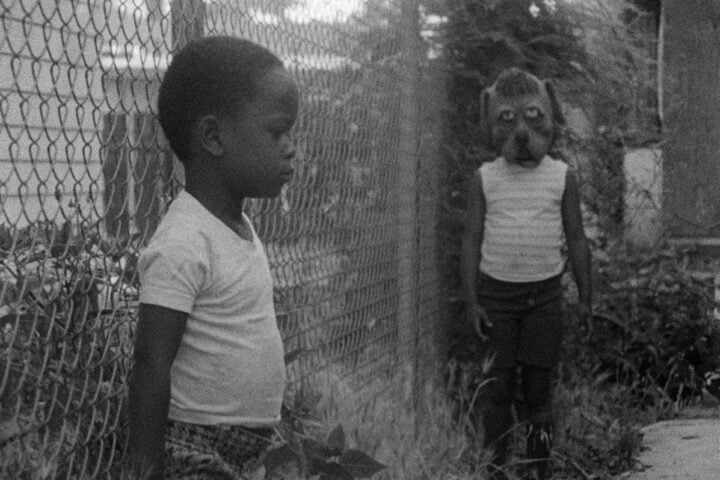
Early in Billy Woodberry’s Bless Their Little Hearts, Charlie (Nate Hardman) declares to a group of drinking buddies that there’s a time in every man’s life when he must “make a decision between the spiritual and the material.” Until now, Charlie has always chosen the material, and his pronouncement suggests a deliberate mental shift, perhaps as a form of self-preservation to stave off despair. After all, he pounds the pavement day after day, begging for work and filling out employment applications, yet all he ever has to show for it is the occasional temporary landscaping gig or a few bucks from selling catfish he caught by the side of the road.
Where Charlie’s confidence in the spiritual is short-lived—his faith is only ever rewarded by dashed hopes—it remains the central focus of Woodberry’s touching and melancholic feature-length debut. Written with piercing clarity by Charles Burnett, the script details Charlie’s spiritual disintegration from his sustained joblessness and the tensions of his marriage to Andais (Kaycee Moore), who, stuck home in Watts caring for three young children, is weighed down by her husband’s failures, particularly once he starts cheating on her.
The extended argument between Charlie and Andais an hour into Bless Their Little Hearts is especially insightful for its look at how underlying resentments in a marriage reach a boiling point. But it’s the film’s languorous sense of time that most pointedly evokes the limbo state that the couple exist in as they wait for something, anything, to happen that will improve their lives.
Woodberry lingers in dead time, with numerous scenes of Charlies’ mundane activities—shaving, walking through an abandoned trainyard, filling out job applications—playing out in real time. As professor Samantha N. Sheppard mentions in her booklet essay, the film invites comparison to Jeanne Dielman in such moments. But where Chantal Akerman uses duration as a means of conveying the oppressiveness of domestic routine, Woodberry uses it to capture the spiritually draining nature of time unmoored from meaning and self-worth.
Indeed, where Andais is “tired, tired, tired,” from working herself to the bone around the house, Charlie is worn down by the stasis of poverty and his inability to fulfill the breadwinner role. Theirs is a deep-seated emotional brokenness that’s seemingly without a fix. Even when Andais nods off on a bus or tries to nap while her kids prep dinner, her rest is fleeting. When Charlie comes home before that meal, he asks Andais if she’s asleep, to which she replies, “I wish I was.” More than most other films about poverty, Bless Their Little Hearts understands how it can feel like a waking nightmare from which there is no reprieve.
Image/Sound
Sourced from a restoration by UCLA Film & Television Archive from the original 16mm negative, Milestone’s transfer is virtually flawless. The myriad intricacies of the homespun set design are presented in vivid detail, while the fairly strong contrast makes for clear visibility in the nighttime scenes. The audio is clearly limited by budget constraints, so there’s a slight echo in numerous scenes, but the dialogue is always clear and audible.
Extras
Film scholar Ed Guerrero provides a well-researched audio commentary that covers the works of many of the L.A. Rebellion filmmakers. He’s prone to long pauses, and his delivery can be a bit stilted, but he offers plenty of strong scene analysis and is especially engaging when discussing the similarities and differences between the L.A. Rebellion and blaxploitation films produced at the same time. In a separate interview, Guerrero discusses how he first saw Bless Their Little Hearts, his favorite scenes, and what the film owes to Italian neorealism.
Also included here is an interview with Billy Woodberry, who, in conversation with restorationist Ross Lipman, reflects on his friendship and working partnership with this mentor, Charles Burnett. Elsewhere, a 30-minute workshop recorded at the Indiana University Black Film Center in 1990 sees Woodberry reminiscing about his time at UCLA and the camaraderie he developed with all the L.A. Rebellion filmmakers. The disc is rounded out with Woodberry’s 1980 short film “Pocketbook,” behind-the-scenes photos, a re-release trailer, and essays by professor Samantha N. Sheppard and filmmaker Alison Anders.
Overall
Billy Woodberry’s classic of the L.A. Rebellion gets a gorgeous transfer and several indispensable extras courtesy of Milestone Films.
Since 2001, we've brought you uncompromising, candid takes on the world of film, music, television, video games, theater, and more. Independently owned and operated publications like Slant have been hit hard in recent years, but we’re committed to keeping our content free and accessible—meaning no paywalls or fees.
If you like what we do, please consider subscribing to our Patreon or making a donation.