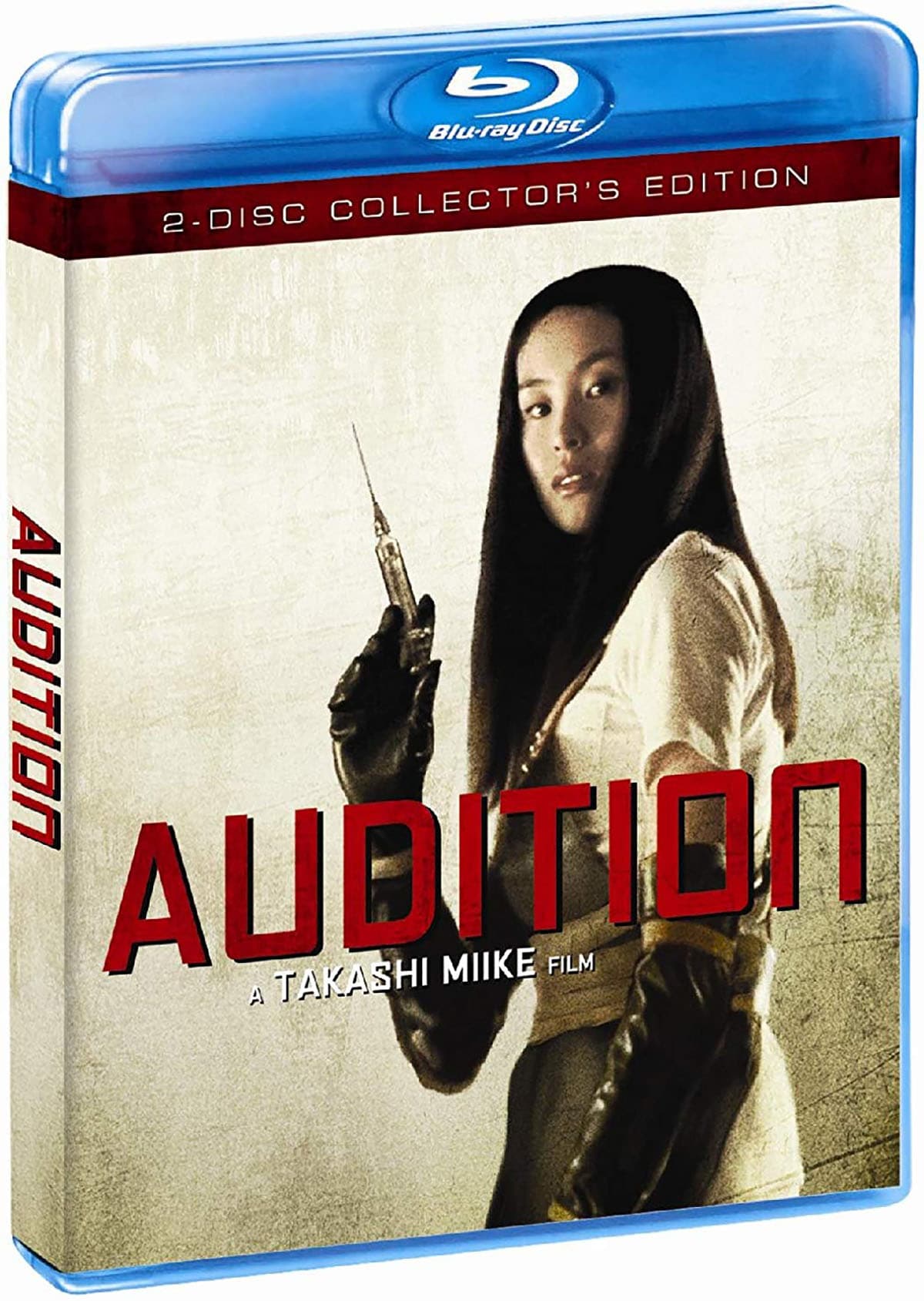
 Takashi Miike’s neo-Darwinian exercise in terror, Audition plays out like a comfy companion piece to Shall We Dance? before evolving into a torturous freakshow not unlike Baise-moi. Miike devilishly sets up a discordant relationship between commerce and affection when a filmmaker, Aoyama (Ryo Ishibashi), uses an audition as a way of finding love. His cohort, Yasuhisa (Jun Kunimura), is concerned with the slump in the motion picture industry and advises Aoyama that only the fittest will survive: His deceased wife’s replacement should be good but not necessarily talented. (For him, only good girls can be good wives while only talented girls can shoot a movie.) The audition is then seen as a bridge between fantasy and reality—a successful experiment (or so it seems), for Asami (Eihi Shiina) appears to embody Aoyama’s every ideal. Asami makes Yashuhisa uneasy: She’s gentle and graceful, but the package is “too easy.” Miike’s static long shots and symbolic use of color subversively recall Ozu, and the audition itself becomes, intentional or not, a studied take on stately naïvete. Audition’s stylistic trapdoor, though, isn’t as abrupt as many seem to suggest, because a shaking body bag and a troubled Asami (sitting by her phone waiting for Aoyama’s delayed call) terrifyingly portend the chaos yet to come. Miike’s torture mechanism is very much based on the premise that performance is crucial to the freeing of the soul, and just as Asami’s rage is as much a product of Freudian psychosexual repression, so too does it express a need to negate her passivity. Audition’s twists and turns fascinatingly blur the film’s already hallucinogenic temporal rhythms. Though she isn’t cast as the lead in Yashuhisa’s now defunct film, Asami yearns to be an actress in real life. Hence the piano wire. The problem, of course, is that what is real is now a matter of opinion.
Image/Sound
Audition deserves a video transfer as sharp as Asami’s razor wire, but alas, what we get here is simply unacceptable. Colors are washed out and dull, image clarity is dismal (characters frequently seem to blend into the background), and any solid surface is swarmed with distracting flurries of visual noise. There’s nothing to distinguish this transfer as high-definition; frankly, many current non-HD releases look better. Audio, on the other hand, is fine. It’s nothing amazing, but dialogue is clear, and sound effects are loud enough to have the proper jolting impact.
Extras
Similarly underwhelming. Spread out over an unnecessary two discs, the extras include a intermittently interesting commentary track between Takashi Miike and screenwriter Daisuke Tengan, a few bland cast interviews, and a solid booklet essay by Tom Mes, author of Agitator: The Cinema of Takashi Miike. The disc also includes international trailers for the film, if you care about that sort of thing.
Overall
Miike makes so many movies that his only truly essential one should get a deserving HD release. No such luck, sadly.
Since 2001, we've brought you uncompromising, candid takes on the world of film, music, television, video games, theater, and more. Independently owned and operated publications like Slant have been hit hard in recent years, but we’re committed to keeping our content free and accessible—meaning no paywalls or fees.
If you like what we do, please consider subscribing to our Patreon or making a donation.