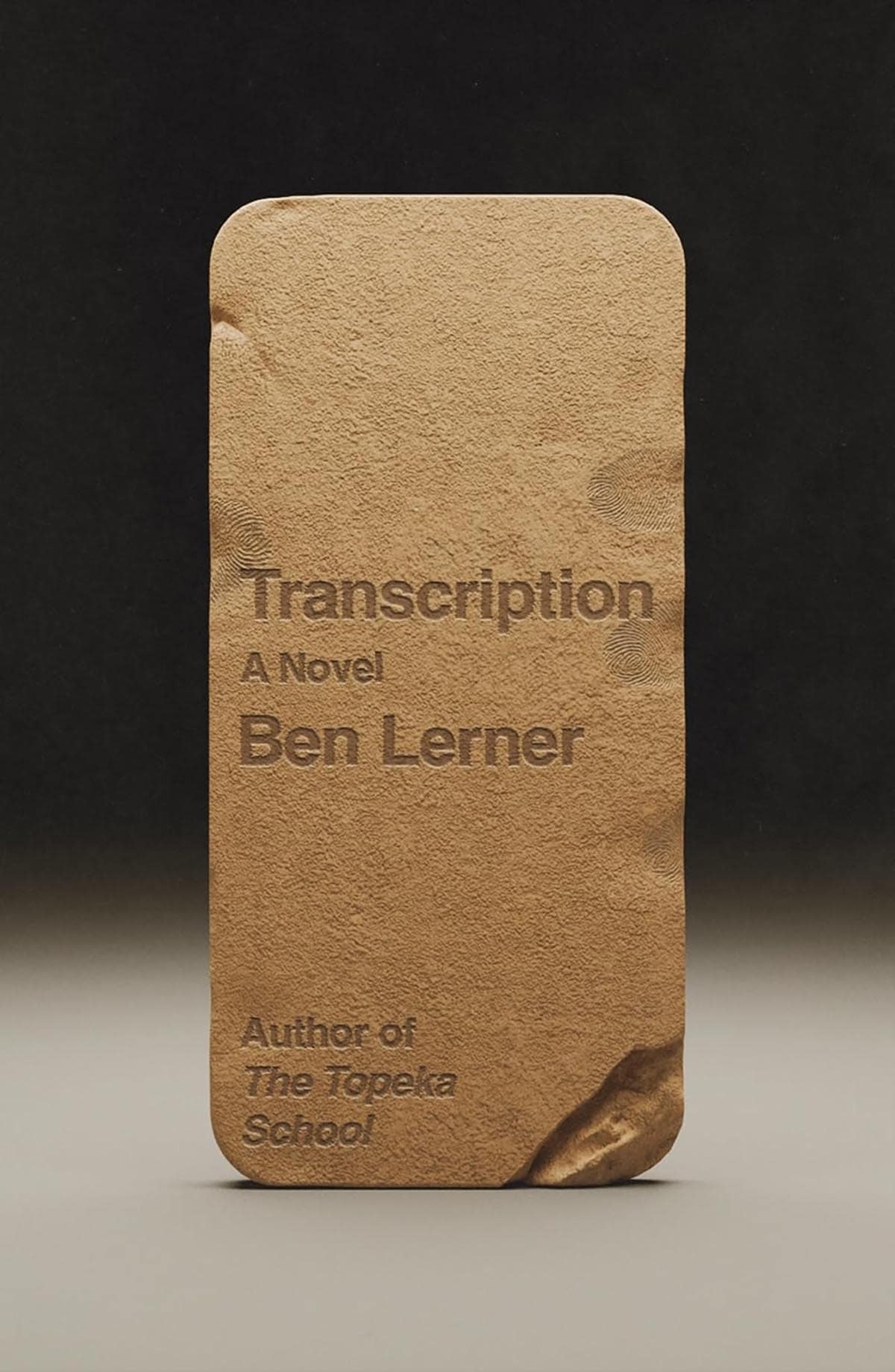
 The young narrator of Ben Lerner’s deceptively slim new novel, Transcription, attends an exhibition of strikingly accurate anatomical glass models of flowers in bloom, and he’s forever changed. He marvels at how the handblown specimens present as “organic one instant and as artificial the next, a kind of duck-rabbit effect, not between the things the object might represent, but between nature and culture, the given and the constructed.”
Transcription’s unnamed narrator is astonished in this retrospective scene by the sensation of a slippage between the real and the unreal, based only on the knowledge that “these delicate things were the result of a thousand rapid choices and adjustments.” And he carries this acquired way of seeing into other contexts as well, such as in a newfound appreciation of phenomena that he’d previously been unmoved by—mountain views, the colors of a spectacular sunset—but which now represent “a history of small decisions,” his mind toggling between understanding the sight as either natural or somehow “applied.”
The illusion of deliberate creation now confers its own sense of wonder. And Transcription ultimately argues that this is also the pact we must make when we read fiction, indulging in the fantasy that the world being depicted is real even as we know that the images conjured by the words on the page have been intentionally summoned by some other consciousness.
The plot of the novel, Lerner’s follow-up to 2019’s The Topeka School, is centered on an interview the narrator conducts in middle age with his famous literary mentor, Thomas, at the much older man’s home in Providence, where the narrator had once been an undergraduate at Brown. The engine of this situation is the fact that he had planned to record the interview on his phone, but when the device is ruined by water damage at his hotel just before the scheduled meeting, he continues with the official conversation despite this limitation, which he surprises himself by concealing from Thomas. The nonexistent transcript is later published as Thomas’s final interview before his death, which the narrator only reveals—at a subsequent memorial event—that he’d largely reconstituted from memory.
The inadvertent confession that the transcript cannot be corroborated as a legitimate historical document—“in all of the interviews in that magazine, the editors move stuff around, make composites,” he claims in self-defense—is met with reactions ranging from disbelief to rage. “What would have happened—he might have been annoyed?” asks a friend and professional peer regarding why the narrator withheld from Thomas that there would be no record of the conversation. “Were you that afraid of his disapproval, like a little boy? Or was it some defense against the reality of losing him—a way to turn it into fiction?”
Lerner’s narrator is confounded by this reframing of his contribution to his mentor’s memory, which he believes he’d carefully curated with Thomas’s legacy in mind. He doesn’t accept the suspicion that’s now emerged about the interview simply because the “transcription” of the conversation that was ultimately published is only a reconstruction of reality rather than its direct representation. But the document has now been reframed by those in the know as a mere fiction grubbed up from the ingredients of life, which we can psychoanalytically contextualize as curated memory, or maybe as considered recollection—memory buttressed by narrative structure, experience given retrospective meaning. And this is also what we now understand, at least in contemporary publishing terms, to be the genre not of fiction but of memoir.
A piece of fiction is built piece by piece from a blank page, the creative mind aggregating the results of all those small decisions into a story that can be shared with an audience. But a memoir’s construction is an act of culling rather than of accretion, a coherent and purposeful narrative emerging only after so much else of lived experience has been stripped away. The memoirist travels back into a messy and heretofore unexamined past and gathers only what will serve. And Transcription’s narrator assumes that his audience trusts him when he says that he accurately represented the spirit of the conversation, perhaps even deftly scrubbing out any evidence of Thomas’s cognitive decline in the process. Yet the revelation here isn’t necessarily his indiscretion, but rather the refusal of his audience to believe his claim to the truth.
In the conversation as reported to the reader (we never see the published version), Thomas riffs on a dream the narrator shares from when he’d dozed off earlier on the train. He’s in Paris waiting to pick up his daughter from school when a woman stops him and makes him understand that he’s cut to the front of a long line of other parents. Later, when Thomas conjures the memory of his late wife’s eyes, the narrator wonders aloud whether the woman in his dream might have resembled her. Thomas then seems to claim the dream as his own, inserting his family into the scene instead of the narrator’s. “We extend the dream when we share it,” he insists. “You call it fiction, but it is more. Like the eyes, all dreams are brown until they are shared.”
The weaving of personal histories on Thomas’s part—or the recounting of his own personal history based on moving stuff around, making a composite—is subtle but ultimately telling. Before this moment, there have already been other instances of slippages between the real and the unreal as Thomas begins to confuse the narrator for his own son, Max, who’s around the same age (the two are also close friends from college). Eventually the transposition between the two younger men has been total in Thomas’s mind as he speaks over and interrupts the narrator in his insistence on his own version of the story—in this case, his memories of a trip to Switzerland from decades ago that proves pivotal to the novel’s final extended sequence—as the narrator seemingly finds himself erased from the scene.
The novel’s conclusion is a transcription of a conversation between the narrator and Max following Thomas’s death, and the mostly one-sided exchange complicates and deepens the novel’s primary concerns with the reliability of memory and our fraught relationship to connectivity—human, technological, and the unavoidable combination of the two—as Max offers his own account. When Thomas contracts Covid in the first wave of infection, Max recalls being invited by hospital staff to visit his father virtually on Zoom in what he refers to as an “exit interview,” the nurses promising to “make [Thomas] as comfortable as possible” during what Max assumes are his final hours. The monologue he delivers as a goodbye to his father is cathartic and deeply moving, a lifetime of complicated relations consolidated into one long comma-spliced sentence. But despite the nurses assuring Max that Thomas has understood him, the man claims to remember nothing of the exchange upon his miraculous recovery when the two reunite following the ordeal. The catharsis is Max’s to reflect upon alone.
This is a novel full of callbacks and recursion, and the final scene shows Max recording a conversation between himself and his father in what becomes a mirror of the opening in the same house that takes place a few years later with the narrator, when Thomas thinks he’s being recorded by the narrator but isn’t, except now he is but without his knowledge. Max does this “not because I wanted to preserve his voice for [my daughter, with whom Thomas is close], you understand, but because I wanted to preserve my connection to reality. To know that there would be a transcript, even if I never consulted it, to know that I would, for once, in regard to my father, have something objective to test my experience against.”
We return to Thomas’s memories of the trip to Switzerland as he once again appears to conflate his son and the narrator, collapsing them into a single character in the story of his life. But his memory isn’t the only one that’s now proven fallible. The narrator’s authority dissolves in one heartbreaking instant that serves as a testament to the power of fiction to arrange our human deficiencies in such a way that they become beautiful rather than tragic. And we also return to the handblown glass flowers at the exhibition, that notion of a hinge between art and life.
Memoir represents a space between fact and the imagination where it becomes possible to reconfigure the past into the stuff of narrative meaning, and Transcription grapples thrillingly with generic semantics like this in real time. Much is made in the novel (less so in this review) of our reliance and dependence on the internet and the devices we use to access it, and the curated nature of the algorithm itself becomes analogous to how we frame our lived experience, both to ourselves and for others as well. We block the things we don’t want to see again. We heart the things that give us joy. We favorite the things that reflect the versions of ourselves that we want or perhaps already believe ourselves to be. And in an anti-intellectual publishing landscape where the novel of deeply explored yet ultimately unresolved questions has largely been sidestepped, I’m heartened, at least, that everyone on my feed has been talking about this book.
Transcription is now available from Farrar, Straus and Giroux.
Since 2001, we've brought you uncompromising, candid takes on the world of film, music, television, video games, theater, and more. Independently owned and operated publications like Slant have been hit hard in recent years, but we’re committed to keeping our content free and accessible—meaning no paywalls or fees.
If you like what we do, please consider subscribing to our Patreon or making a donation.