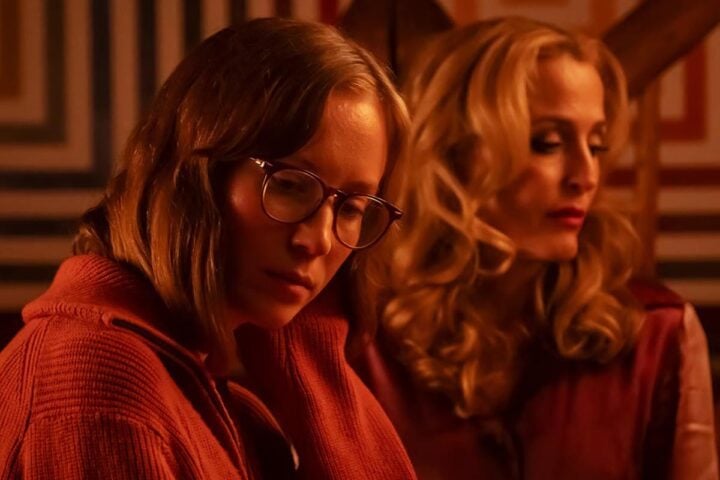
In Terence Davies’s The House of Mirth, Lily Bart (Gillian Anderson) is repeatedly tested with a series of marriage proposals, but it’s clear that her heart lies with the handsome Lawrence Selden (Eric Stoltz), whose poverty more or less proves difficult for the avaricious woman to ignore. When she loses a considerable amount of money at cards, she turns to Gus Trenor (Dan Aykroyd) for help. Even though Lily refuses to have an affair with him in order to erase her debt, Gus nonetheless lends her the money but only on the condition that she will pay him back. Now penniless, she returns to Sim Rosedale (Anthony LaPaglia), whose marriage proposal she once rejected (or put off, as she begs to differ). In one devastating swoop, Lily’s dignity is completely ravaged and she becomes painfully aware of the consequences of her indiscretions.
Besides his remarkable ability to render a profound sense of past in all his films, Davies can uncannily map out the emotions of his characters via his mise-en-scène. Born to a working class family in Liverpool, Davies is clearly worshipful of his heroine, a woman whose ravenous desire to fit into her money-hungry New York milieu is at once pathetic and devastating. Not unlike Chopin’s heroine from The Awakening, Lily is uncomfortably lost in time. What with its prophetic and languorous tone, The House of Mirth most resembles Davies’s Distant Voices, Still Lives. A lesser director may have romanticized the woman’s tragic downfall; instead, Davies holds her as equally responsible for her fall as the parasites she considers her friends. Davies’s dour direction befits Edith Wharton’s cynical subject matter, which feels as fresh and relevant today as it did when it was written in 1905.
One particularly ravishing pan in the film moves from a clock on a mantle and across a room full of furniture recently covered in white sheets. From there the camera glides across lush outdoor greenery and over a small brook. From the bright circles emanating from the sun-drenched water, the gentle swell of the camera gorgeously evokes Lily’s psychical and emotional trajectory from her New York home to the European retreat that triggers her downfall. Anderson, picked for the role because she reminded Davies of a Singer Sargent heroine, recalls Rossetti’s figure from the painting Beata Beatrix, while her actual attitude brings to mind William Holman Hunt’s The Awakening Conscience. Hunt was very much obsessed with social mores and, like Davies, his use of light and composition played an integral role in his aesthetic universe. Both Hunt’s painting and Davies’s film are hauntingly hung up on heroines possessed and suffocated not only by the people around them but the actual physical space they inhabit.
Since 2001, we've brought you uncompromising, candid takes on the world of film, music, television, video games, theater, and more. Independently owned and operated publications like Slant have been hit hard in recent years, but we’re committed to keeping our content free and accessible—meaning no paywalls or fees.
If you like what we do, please consider subscribing to our Patreon or making a donation.