Growing up as a sickly boy in an unforgiving working-class neighborhood of London’s South Bank during the 1890s (a part of London still so dangerous that the concierge at my hotel recommended I not venture there to pay tribute), young Charlie Chaplin, confined to his bed, only felt like he could take part in life by observing the people who passed in front of his window. On one such occasion, he saw coming out of the pub his uncle owned across the street an aged retainer, knees-bent, feet-splayed, and carrying a crooked little cane. From the memory of this one individual, the most famous character the cinema has ever conjured was born. Chaplin claimed that the rest of his little Tramp’s signature style—his short mustache, crooked bowler hat, baggy pants, and threadbare vest—were assembled on the spur of the moment from costumes lying around Mack Sennett’s Keystone Studios when Chaplin was making his third short film, Kid Auto Races at Venice.
The 1914 film is a mockumentary, in which Chaplin’s Tramp—making his first ever screen appearance—hijacks the attention of a camera crew filming kiddy races by always stepping into the foreground of their field of vision. It’s a telling moment. For one, it signifies his interest and ability in having his personality—and physical presence—become the subject of the film. In essence, he wanted to be a movie star. But it also points out what will become a criticism of his entire cinema: that his visual style is predicated entirely on nothing more than pointing the camera at himself. In reality, the idea that Chaplin’s films are “uncinematic” is one of the great lies perpetrated on cinephiles by modern film criticism, apparently a new school of resentment that writes off all emotion as mere “sentiment” and equates visual efficiency with simplemindedness.
Chaplin grew up in a theatrical family. His father and mother were London music hall actors, but his father abandoned them when he was seven years old. With their father gone, Charlie and his brother Sydney were parted from their devoted but mentally unstable mother and sent by the government for a time to one of London’s notorious workhouses. When he came to America in 1912 at the age of 23, he had already made a name for himself in England in his family’s business—that of performing at music halls, where he made his debut at the age of five, after his mother suffered a nervous breakdown. A fan of Max Linder’s short comedies, Chaplin joined up with comedy pioneer Sennett’s Keystone Studios for $150 per week. From the period of 1914 to 1917, Chaplin would make 62 films, which Roger Ebert has declared to be “the most influential in film history.” With these films, Chaplin would become the world’s first movie star, succeeding in getting his audience to recognize him and his performances from film to film—and honing his comic and visual techniques as well. In Tillie’s Punctured Romance, the cinema’s first feature-length comedy, headlined by theater star Marie Dressler, Chaplin not only acted, but again did what he did best: he observed. Specifically, he observed the way Sennett could build comic gags and prolong their duration through editing.
Tired of Sennett’s crude slapstick approach to film comedy, Chaplin abandoned Keystone shortly afterward for Broncho Billy Anderson’s Essanay Film Manufacturing Company in Chicago earning $1,250 a week. At Essanay, he would poke fun of the smash-and-bash vulgarity of Sennett in his meta film His New Job, which portrays a troglodyte director wringing comedy from scenarios clichéd in even 1915. Directing his own films for the first time, he would experiment with fantasy sequences, location photography, and clever inversions of the functions of props—like turning a palm frond into a toothbrush. These short films bear none of the visual fluency of his later features starting with The Kid in 1921, and it’s in this period that Chaplin falls short most significantly in comparison to the other pantheon silent clown, Buster Keaton.
The favorite game of cinephiles is a binary one: Kurosawa vs. Mizoguchi, Wyler vs. Ford, British Hitchcock vs. American Hitchcock, Star Trek vs. Star Wars, and the biggest one of all, Chaplin vs. Keaton. It’s a ludicrous form of discourse. As David Bordwell says, “The forced duality ignored other important figures—Harold Lloyd, most notably—and it asked for an unnatural rectitude of taste. Surely, a sensible soul would say, one can admire both, or all.”
Keaton’s films keep a cool detachment as he juggles whatever the inhospitable universe throws at him: hurricanes, roaring rapids, collapsing buildings, runaway trains, speeding cars without brakes, Civil War battles, legions of policemen, angry island natives. Throughout it all, he keeps his cool, showing little emotion on his great stone face. Just his ability to survive in any of his films was a great existentialist triumph of human will, so it’s easy to see how his films underwent a great critical resurgence during the celebration of willpower that was the ’60s.
Chaplin, by comparison, came to be seen as old-fashioned, theatrical, sentimental, and artificially manipulating our emotions to fall in love with him. Chaplin’s films were stagy and mannered (he was never properly integrated into his environment the way Keaton was). Of course, these new Chaplin haters had forgotten something Chaplin kept dear to him his whole career: “Life is a tragedy when seen in close-up, but a comedy in long-shot.” There are countless examples of Chaplin interacting with his mise-en-scène in ways every bit as inventive as Keaton: running over the rooftops in The Kid, or against the wind in The Gold Rush; falling backward into a barrel in The Circus, or into the bowels of a machine in Modern Times.
In fact, the only period of his career when, film for film, Chaplin can’t in any way hold his own with Keaton is that of the short films he made before 1921. Chaplin never once told a pithy black comedy with the poetic three-act efficiency of, say, Keaton’s Cops or The Haunted House. Chaplin’s films of this period are more episodes than narratives, built around two or three gags stretched to fill one or two reels.
That’s not to say that there’s nothing of value in this period of his career. When he moved to Mutual and began earning $10,000 a week, he began adding more physical comedy to his aesthetic. One A.M. is an 18-minute short built entirely around the idea of a guy trying desperately to get into his bedroom but thwarted by every conceivable obstacle, however ridiculous, including the pendulum of a particularly foreboding clock. There’s a nascent surrealism to this short, and in its depiction of frustrated impulses it prefigures Buñuel’s The Exterminating Angel and The Discreet Charm of the Bourgeoisie. The Rink introduces his graceful proficiency with roller skates. In The Immigrant, he pushes clearly beyond mere theatricality, by adding a whole new level of special effects shots, including lurching effects for the ship on which he, the titular immigrant, and his companions are traveling. In 1917, it was a bit daring, considering the anti-immigration climate of the day, to take on the emigration of poor Eastern Europeans to the United States, and some audiences balked, indeed declaring even then their preference for Chaplin’s earlier, funnier movies, as they would with Woody Allen 60 years later. In Easy Street he plays a reformed convict who ultimately becomes a policeman.
The transition of his character into the Establishment in Easy Street identifies a critical component of his characterization of the Tramp. Though he is always unemployed, often in trouble with the law, and without a roof over his head, the Tramp almost always maintains a highly refined demeanor. His nobility comes from his impeccable manners, which, for Chaplin, like Lubitsch, are of the utmost importance. Of course, this also means there is an element of irony about his character, since he is something of a phony. In one short, the Tramp actually drills holes into a solid block of cheese to entice restaurant patrons with the idea that it’s really Swiss cheese. The idea of “making it” was as big a theme for Chaplin as it was for the Tramp and every bit as important, if not more so, as artistic expression. When he sent his brother Sydney to negotiate a new contract with the First National studio in 1917 he said, “Tell them I’m an artist. I want $1 million.”
It was at this point, at the age of 28, that Chaplin broke ground on his own studio, which would be his personal artistic testing ground—the site where he would begin experimenting with dozens of takes for each shot rather than just a handful and earn his reputation as the most taxing of perfectionists. His films with First National would be more ambitious still, even taking on the trench warfare of WWI in Shoulder Arms, but with a Chaplin twist. When, like Sergeant York, he captures a whole platoon of Germans by himself, he spanks an aristocratic officer, instantly endearing him to all the working-class German infantrymen. It’s a moment like this that demonstrates Chaplin’s view of man as defined by class more than nationality, an “internationalist” point of view that would vex the powers-that-be some decades later. He also begins giving the Tramp a tad more dimension. No longer a mere saint in a tattered suit, the Tramp pulls a gun on a card sharp and considers tossing his foundling baby down a storm drain in The Kid.
During the period of his short films, Chaplin also began expressing his undeniably misogynistic view of women. A prolific womanizer, he cast his lover Edna Purviance in 35 of his short films of the late ’10s. His presentation of her was one of unadulterated adulation. Chaplin’s dual views of womanhood are of a race of pure, uncorrupted beings (and the younger, the purer) or of shrill, insufferable control-freak harpies. His second wife, Lita Grey, insisted that Chaplin had a “fetish for virgins.” In his personal life he was always known to have affairs with girls in their teens, including his first wife, Mildred Harris, who he was forced to marry when she claimed that, at the age of 16, she was carrying his child. When she sued him for divorce in 1920, she threatened to take away his working negatives of The Kid. Chaplin fled to Salt Lake City where he finished editing the film, a process that had taken 18 months.
That said, our perspective on Chaplin’s view of women is complicated by the way he incorporates feminine—perhaps effeminate—characteristics into his persona as the Tramp. In the fantasy sequence of The Kid, when captivated by the dancing angels who’ve surrounded him, he prances about, shoulders hunched, hands clenched, toes-turned-in for once, as if incorporating his own unique idea of feminine gestures and behavior into his expressions of romantic love for, and attempted seductions of, women. In his Monsieur Verdoux, he has a similar moment played to comic effect, when, out on a rowboat with Martha Raye, she turns suddenly and almost catches a glimpse of him trying to put a rope around her to drown her. Chaplin’s Verdoux immediately sits down, crosses his legs, folds his arms, and plasters a coy smile on his face—easily a more feminine gesture than anything that Raye displays in the course of the movie!
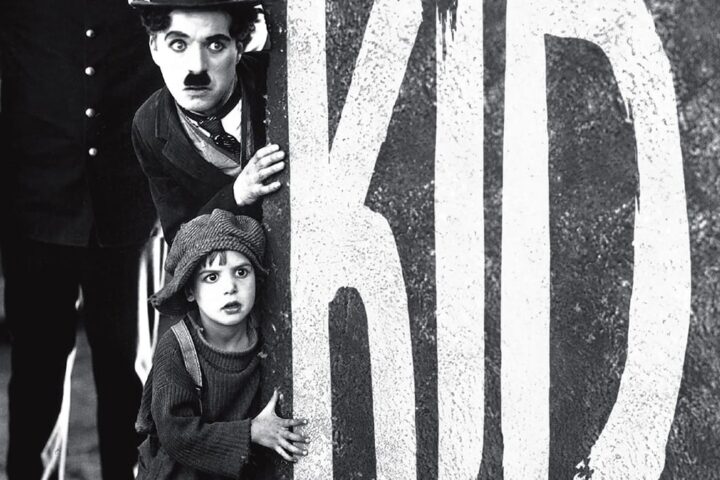
The Kid, released in 1921, is not only Chaplin’s most personal film, drawing as it does from his experiences of slum life and the forced separation from his mother by callous social workers, but it is the film that announces Chaplin as one of the cinema’s foremost poets. His observation of human nature, begun when a sickly boy looking out his bedroom window at the city-dwellers strolling past, reaches its apotheosis. When the Tramp is preparing his adopted son (the incomparable Jackie Coogan) for bed, Coogan not only kisses his stuffed animal, but demands that his “father” kiss it as well—something every parent can relate to. It’s also one of his most heavily symbolic films, with a lyrical dissolve near the beginning cutting between Coogan’s overwhelmed mother and an image of Christ carrying the Cross. And above all, it’s one of Chaplin’s most physical performances, especially at the end when he scrambles over crooked rooftops trying to get to little Jackie Coogan as he’s being driven away to the workhouse, as if nothing in the physical realm can stop him.
Continuing his practice of robbing the cradle, Chaplin became smitten with 12-year-old Lita Grey, who plays a coquette angel in The Kid’s great fantasy sequence—and is instructed by a demon to try to seduce the Tramp with the line “Vamp him”—and married her in 1924. After the success of The Kid, Chaplin returned to Europe for the first time since he left England in 1912. He toured Paris and Berlin and became fascinated with the decadent lives of the filthy rich, and determined to make a film about the glamour and callousness of their experiences. His film would become A Woman of Paris, a dramatic feature, where he only appears in a brief cameo as a rail porter carrying a trunk. In its emotionally resonant depiction of simple symbolic forms, characters, and situations, it prefigures Murnau’s Sunrise made four years later. Jean, a provincial painter, follows Marie to the big city, where she immediately strikes up an affair with the wealthy Pierre (Adolphe Menjou, playing cool sophistication as only he could).
There’s a strong sense of eroticism in A Woman of Paris. In one scene, a woman, wrapped in sheets of lace, stands on a turntable as a man slowly unwraps layer after layer of sheet, until she stands naked—off-screen, of course. Another woman at the party slowly adjusts the placement of a monocle to get a better eyeful. Chaplin demonstrates great proficiency in the blocking of his characters in this film, especially at the moment when Marie sees her old love, Jean, again, with her back facing the camera for the duration of one very lengthy shot. Unfortunately, though A Woman of Paris received among the best critical notices of his career, audiences left the theater disappointed they hadn’t seen their beloved Tramp.
During this period of the early ’20s, Chaplin became the focal point of the cinema’s first multimedia merchandising campaign. There were animated cartoons based on the little Tramp, comic strips, Chaplin toys, games, and figurines. The studio he formed with D.W. Griffith, Douglas Fairbanks, and Mary Pickford, United Artists, needed the money after the failure of A Woman of Paris. But they really needed Chaplin to deliver a hit. And did he ever with The Gold Rush in 1925.
The cinema of Charlie Chaplin is made up of meetings and partings, with little interest in the development of relationships in between these most pivotal of moments. In The Gold Rush, his budding romance with “dancehall girl” Georgia (Georgia Hale) transpires over merely four scenes: their initial meeting when Georgia expresses interest in the little fellow just to make a hulking brute jealous, a second when Georgia and her friends meet the Tramp at his cabin and make plans for New Year’s Eve, a third when the Tramp intends to confront Georgia about why she didn’t attend the New Year’s festivities they had planned, and a fourth when the Tramp is now a millionaire and Georgia is stuck in steerage on a ship headed out from the Klondike. Again, the Tramp’s emotional capacity is expressed as being far greater than the relatively insensitive Georgia, and there is something self-congratulatory about his eventual reunion with her once he’s a millionaire.
But his shortcomings in terms of characterization are minor compared to the astounding achievement of his epic special effects work. The Gold Rush is the film that most soundly refutes the idea that Keaton understands landscape better than Chaplin. Six hundred extras were hired for the staggering long shot of desperate miners climbing up the face of a Yukon mountain, and Chaplin—shooting the scene in Truckee, California—amazingly got all the footage he needed in just one day. The Gold Rush does show up Chaplin’s very different response to the forces of nature than Keaton, however. When cartoonishly strong gale-force winds blow through Black Larsen’s cabin, where the Tramp has sought refuge to the scoundrel Larsen’s dismay, Chaplin runs against the wind as if on a treadmill, getting nowhere. Whereas Keaton balances whatever nature or man should throw at him, Chaplin is either oblivious to any danger, such as when a bear follows him along a narrow cliff, or is tossed about by it. The Gold Rush may be Chaplin’s most ambitious film and certainly the one that’s hardest to define in terms of his “theatricality”—or even the terms that he had set for himself. The famous “Dance of the Rolls” sequence is shot almost entirely in medium close-up with Chaplin’s facial expressions contributing greatly to the scene, confounding his own idea that comedy occurs only in a “long shot.” The Gold Rush also represents a new level of control for Chaplin. He supervised every aspect of the production, including even donning a chicken costume, when another actor couldn’t get it right.
And for the 1942 re-release (the superior version of the film in existence), Chaplin recorded a new voiceover narration, in which he plays all the parts, literally putting his own voice into each character’s mouth. The dialectic between the narration of the soundtrack and the diegesis of the images is in effect a Brechtian distancing device, but more entertaining in the way it offers prismatic perspective on the characters. He also composed and recorded an original score for the film, as he would do later for his subsequent films and The Kid. If he hasn’t been recognized as much for his role as a music producer on his films, it’s only because there’s so much else to mention. His scores, however, always have a lilting beauty in perfect harmony with the images, and he demonstrated an ability to compose one or two memorable themes and find new variations in replaying them throughout the course of the films.
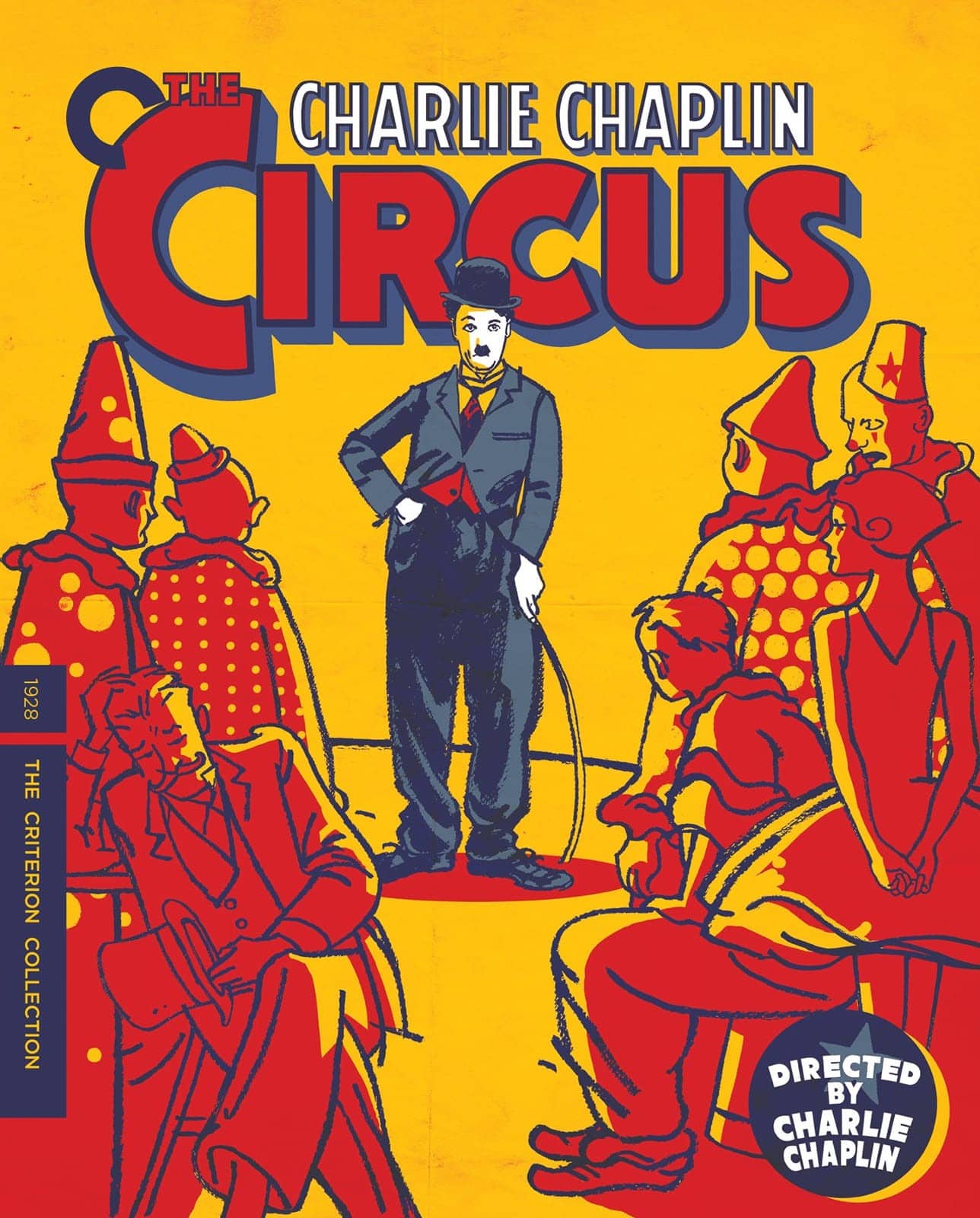
The Circus represents Chaplin’s reversion to his days in the music hall. With a great gag of the Tramp trapped in a lion’s cage and a bravura tightrope walking sequence involving wild monkeys, Chaplin never shows off better his ability to build on a gag until it snowballs into utterly surreal hilarity. The Tramp accidentally appears in the ring of a traveling circus during a performance, wows the crowd, and is hired to be funny again. The film becomes an interrogation of comedy itself, because when the Tramp tries to be funny, he’s not, and when he’s not trying, he is. It also expresses Chaplin’s fear of his audience, summed up when, as the Tramp faces mortal peril walking the tightrope, one guy in the crowd frantically stuffs popcorn in his mouth, almost yearning for Chaplin to fall to his death. The fame and recognition the Tramp experiences in The Circus is ephemeral, however, and when he’s left behind in what’s left of the ring where the big top had once stood (the most enigmatic of his open-road endings), it could have been a metaphor for the precarious place of Chaplin’s career. The Circus had wrapped production three days after The Jazz Singer opened. Would the Tramp be funny if he had to talk?
Of course, Chaplin, uncompromising as any movie producer who’s ever lived, decided to buck the trend of talking films and make another silent one, City Lights, which, along with Modern Times, is his great exploration of urban alienation and the possibility, or lack thereof, of genuine human connection. From the very first scene, Chaplin pokes fun at the sound revolution by having the society bigwigs at the unveiling of a new statue speak entirely in gibberish, a la the adults in the Charlie Brown cartoon series. Watching them dedicate the statue you get a sense exactly of what they’re saying, it’s just so obviously mindless that they might just as well be saying nothing. City Lights relies more on the blocking of characters within the frame than editing or expressive camera movements, as shown in the scene of Chaplin facing a boxer in the ring but keeping the referee between himself and the other pugilist at all times. There is nonetheless a narrative elegance to City Lights. When the Tramp’s beloved flower girl sells him a rose, she thinks he’s a millionaire when she then hears the sound of a car door slamming and the vehicle speeding away, proving that sound can play a major role in even silent cinema.
Something of a piece with City Lights, Modern Times relies on the former film’s sentiment while adding even that much heavier a level of symbolism. The opening shot of Modern Times is of a herd of sheep, with one black one right in the middle, racing toward who knows what, dissolving into a shot of men climbing out of a subway entrance on their herd-like march to work in the factories. He integrates himself into the mise-en-scène in the most clever capacity since The Gold Rush, when he dives into and becomes a part of the machine at the factory where he works, and when he is encased in the eating machine his factory intends to buy to maximize productivity. Chaplin’s factory worker (not the Tramp) also internalizes the rhythms of his moronically repetitive job tweaking bolts with a wrench, to the point where he pursues a woman with blouse buttons over her breasts that temptingly remind him of the bolts he has to adjust for work. The actual jokes in Modern Times make better use of the cinema’s capacity to open up new spaces in surprisingly abrupt ways than City Lights, such as when the factory worker picks up a red flag that’s fallen off a truck and almost immediately a communist parade forms up behind him, as if he were their leader.
Modern Times also introduces the next great muse of Chaplin’s career, Paulette Goddard. Watching her play “The Gamin,” the street-rat equivalent to Chaplin’s eventually unemployed factory worker, it’s not hard to see that Chaplin’s fallen deeply in love with her. His close-ups of her face reflect such affection on his part. One may criticize Chaplin for the importance of muses in his artistic development, but why, then, does Jean-Luc Godard get a free pass for his loving-bordering-on-fetishistic shots of Anna Karina? Is not Made in U.S.A, almost made entirely of close-ups of Karina’s face, every bit as much an indulgent expression of a director’s real-life romantic longing?
Chaplin cast Paulette Goddard for The Great Dictator as well. In the film, Chaplin takes the incomprehensible speech of his nonsense song from the end of Modern Times and makes it the speaking voice of feared dictator Adenoid Hynkel at his Nuremberg-esque rallies. Interestingly, his fake German was entirely improvised on set, while the balletic movements involved with Hynkel’s dance with the globe were entirely preplanned. One of his richest films, and unfairly labeled as uncinematic, The Great Dictator works on multiple levels. First, it acknowledges the physical similarity between Chaplin and Adolf Hitler. In fact, Hitler may have adopted Chaplin’s trademark mustache just to be instantly recognizable. Secondly, The Great Dictator expresses the difference between Chaplin’s universally recognized Tramp persona and his more ordinary appearance in his personal life, which had already been acknowledged in King Vidor’s Show People when a celebrity-besotted twit fails to recognize Chaplin as he normally looks. Finally, The Great Dictator is an acknowledgement of Chaplin’s own dictatorial proclivities. As Andrew Sarris has put it, “The genius of the film is that Chaplin realizes there is a lot of Hitler in him. That there’s a lot of Hitler in anyone who dominates audiences and rouses the rabble.” But when Chaplin’s Jewish barber character delivers an almost five-minute long speech at the end calling for peace and human kindness, it’s not the barber speaking, it’s Chaplin himself. Audiences who had waited years to hear Chaplin himself speak, finally got their wish, and it’s about as genuine and earnest a call for a new humanity as has ever been expressed. The Great Dictator turned out to be Chaplin’s largest grossing feature ever, and he turned the film’s box-office success into an opportunity to raise money for our Russian allies at a Carnegie Hall fundraising event.
Unfortunately, from here on, Chaplin’s career proceeds downhill. First, J. Edgar Hoover brought up charges against him for allegedly violating the Mann Act, a law prohibiting the transport of women across state lines for “lewd purposes.” Chaplin was acquitted but suffered a serious dent to his reputation. Then, disturbed young actress Joan Barry brought up paternity charges against him, and even though blood tests proved that he was not the father, Chaplin continued to support the child for many years. Finally, America ended its love affair with the former Tramp once and for all, when he debuted Monsieur Verdoux in 1947.
Monsieur Verdoux, easily Chaplin’s most underrated film, shows how far he had come in embracing sound design. When the titular gentleman, a bluebeard who marries women for their money then kills them, is plotting the death of Martha Raye while canoodling with her on a rowboat in the middle of a lake, another boater, a yodeler, passes by and foils Verdoux’s murderous plans. We don’t ever see the yodeler, we just hear him.
In Monsieur Verdoux, good manners are the most important trait a person can possess, a la Lubitsch. We identify with him, while the women he knocks off are never more than shrill, vulgar, and cruel. The film makes fun of bourgeois values in a way that hit far too close to home for postwar American audiences— especially returning GIs, who objected to Verdoux’s critique of the accepted idea that killing on the battlefield is legitimate, while any other form of killing is a heinous crime. “For 35 years I used [my brains] honestly,” Verdoux says. “After that, nobody wanted them, so I was forced to go into business for myself. As for being a mass killer, does not the world encourage it? Is it not building weapons of destruction for the sole purpose of mass killing? Has it not blown unsuspecting women and children to pieces, and done it very scientifically? As a mass killer, I’m an amateur by comparison.” When Verdoux heads for the guillotine at the end, it’s hard not to see the existential similarity to the fate of Albert Camus’ absurdist hero in The Stranger.
His next film would have presumably been a return to form for his sentiment-hungry audience. Coming out in 1952, Limelight is Chaplin’s weakest feature film, his most self-indulgent, and most sentimental. It is his pity party for having lost his American audience. As has-been comic Calvero, Chaplin sums up his condescending view of his audience: “I love them, but I don’t admire them. As individuals, yes there’s greatness in everyone, but as a crowd they are like a monster without a head that never knows which way it’s going to turn.” The film is a tribute to his absent father, who had also been abandoned by his audience (before himself abandoning his family), but the film’s major set piece, a painfully extended flea-circus scene shows that Chaplin’s objective with Limelight is not in any way comedy, but sentimentality. His duet with Buster Keaton, who, unemployed and long since unbankable, needed the work, is one of the few moments of true inspiration in Limelight. But at last with this film, Chaplin reaches his greatest indulgence—imagining his own death.
Limelight is very much in harmony, though, with his own life experiences at the time. After having traveled to London in 1952 with wife Oona O’Neill, Chaplin was denied a permit to re-enter the United States due to his leftist political leanings. He ultimately ended up settling in Switzerland, but he wasn’t done with America just yet. In his 1957 A King in New York, Chaplin satirizes, somewhat obviously but with great bite, the vulgarities and excesses of contemporary American culture. All of it. Red-baiting, consumerism, tacky advertising, shallow pop music, plastic surgery, and even CinemaScope. Made in only a few weeks, it’s a sloppy film and something of an eyesore. His aesthetic had at last become a theme without a style. When he directed A Countess from Hong Kong in 1967, starring Marlon Brando and Sophia Loren, nobody even took any notice. Retiring at last to his home in Switzerland, Chaplin enjoyed the critical resurgence afforded him in the last years of life, including winning an Oscar for his score to Limelight in 1972, 20 years after the film’s initial release.
When at last death came to him in 1977, it wasn’t dramatic like Calvero’s in Limelight, but a simple passing away into the realm of legend he had created for himself. The first artist to successfully translate his personality across multiple films (in fact, his entire cinematic career), Chaplin was thus also the first to find immortality within the confines of celluloid. Far from being uncinematic, Chaplin’s films reveal him to be the original auteur of moving pictures, in charge of not only his own performance, but the direction and blocking of actors, composition of the frame, editing, and even musical score, building on the previous achievements of Méliès, Edwin Porter, Max Linder, and D.W. Griffith. For Chaplin, life was always tenuous and unstable, so how fitting that he would ultimately find his immortality in that most ephemeral medium of projected light and shadow.
The Chaplin festival will run for three weeks, from July 16 to August 5, at New York City’s Film Forum. For details, including ticketing information, click here.
Since 2001, we've brought you uncompromising, candid takes on the world of film, music, television, video games, theater, and more. Independently owned and operated publications like Slant have been hit hard in recent years, but we’re committed to keeping our content free and accessible—meaning no paywalls or fees.
If you like what we do, please consider subscribing to our Patreon or making a donation.