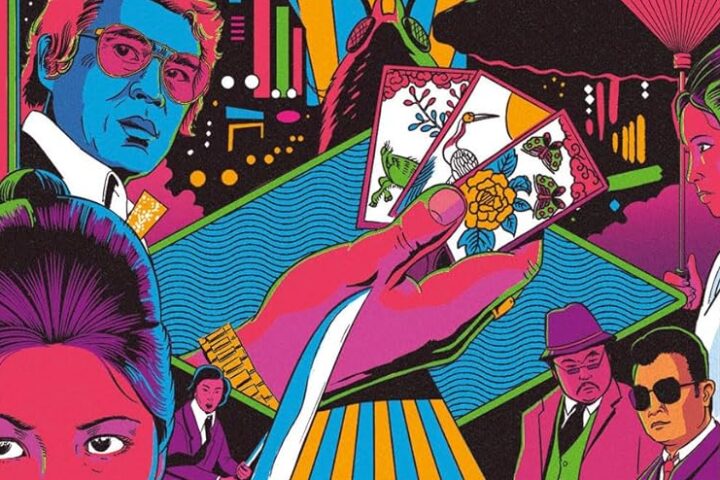
Akira Kurosawa’s first color film, Dodes’ka-den, is a loosely-structured collection of vignettes about destitute Tokyo down-and-outers eking out something like an existence in even more loosely-structured hovels. Most of the world at large may still be a sizable distance from hitting rock bottom and can probably still live within a rational, realistic frame of reference, but the characters inhabiting Kurosawa’s garbage heap don’t have that luxury.
The movie begins and ends with an enlightened fool figure who believes himself a train conductor. While his exasperated mother nam-myoh-renge-kyo’s her maternal disappointments into submission, her son spends his working hours shuffling through the rusted, soiled canyons of their shantytown, incanting “dodes’ka-den, dodes’ka-den” as if to will the fantasy of mass transit to life. (Kurosawa’s unrushed depiction of the boy’s imagined morning facilities check—complete with non-diegetic sound effects—is a regal bit of pantomime that calls to mind Jacques Tati.)
A patchwork a la later works by Robert Altman or Spike Lee (the vibrant, oversaturated faux-sunsets call to mind the throbbing oranges and reds of Do the Right Thing), Dodes’ka-den’s forgotten souls enact their tribulations only in brief, impressionistic strokes, as apt to lapse into candy-coated reverie as they are to stare down the demons of fiscal and moral poverty. A hollowed-out shell of a man lives in a stripped car with his street-urchin son, who is dying of starvation and exposure while the elder paints the image of a perfect hillside domicile inside his head. Two grimy married couples bicker away their hangovers and swap spouses almost out of indifference, while another couple floats like a pair of ghosts through their nondescriptly desecrated ex-romance. Meanwhile, a kindly doctor absorbs everyone’s misery to the point that he allows himself to be burglarized because it would be for the greater good.
Kurosawa’s Oscar-nominated movie hasn’t endured as a major critical or popular touchstone within his body of work. (When people spoke of the recovery of Kurosawa’s career in the 1980s, this was basically the movie he was recovering from. He did, after all, attempt suicide in its aftermath.) Indeed, it lacks many of the qualities cinephiles have come to associate with Kurosawa: the insistent brusqueness of Rashomon, the raucous machismo of Seven Samurai, the ribald comedy of Yojimbo. But if his use of color to code and define human experience verges on kitsch, if not condescension to brightening up the unbearable drabness of being, the film’s short cuts rarely stray into the realm of parable, nor do you ever get the sense that the characters feel the need to somehow transcend their lot in life.
Since 2001, we've brought you uncompromising, candid takes on the world of film, music, television, video games, theater, and more. Independently owned and operated publications like Slant have been hit hard in recent years, but we’re committed to keeping our content free and accessible—meaning no paywalls or fees.
If you like what we do, please consider subscribing to our Patreon or making a donation.