“Sooner or later you need insurance” was an ominous slogan used by Swedish insurance company Trygg-Hansa, the first firm to bring Roy Andersson into its employ as a director of its TV ads in the late 1970s. For three decades, commercial work was the arena in which Andersson developed the inimitable style he’s come to be known for: punctiliously art-directed tableaux, exactingly framed in single-take long shots, that depict everyday Swedish life with deadpan, bleak humor. And the philosophy implied in the Trygg-Hansa slogan—a weary, sardonic resignation to life’s stumbling blocks—more or less mirrored his governing worldview. Despite being ultimately regarded with sympathetic identification, the people who populate Andersson’s commercials and films have long been subjected to methodical punchlines about the cruel hand of fate, their sense of agency tamped down by the expectation of an all but inevitable scene-capping gag at their expense.
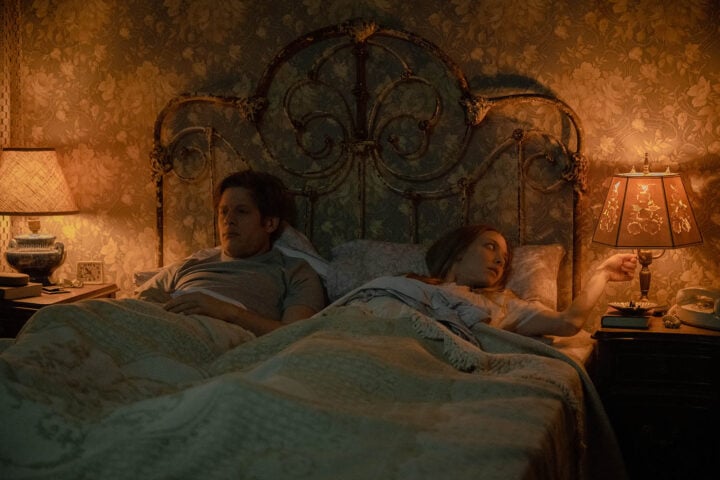
About Endlessness, Andersson’s sixth feature and fourth since embarking on the style developed in the Trygg-Hansa spots, bears the Swedish filmmaker’s unmistakable aesthetic markings, but the setup-punchline formula that he mastered in his commercials and regularly employed in his features is downplayed here, complicated or bypassed altogether. Many of the discontinuous vignettes that comprise this concise feature—most of which occur in an unnamed Swedish city without clear temporal markers, Andersson’s version of Jacques Tati’s Tativille—have no overriding comic conception to speak of, or the joke is so understated that it elicits little more than a faint chuckle. A young man passes a florist on the street and turns back as she walks into her store. A woman stands in an empty meeting room admiring the cityscape outside the window. A man checks the money stash in his mattress before retiring for the evening. Calling these prosaic moments of life “scenes” feels imprecise; Andersson is simply staging mundane situations that float free of the need for punctuation marks.
The audacious simplicity of About Endlessness is contextualized by the framing device of a plainspoken female narrator who often notes that she’s witnessed the events that have just transpired, placing emphasis less on what’s happening than the fact that it’s being observed. This is the first instance of such an omniscient commentator in Andersson’s films, though if one were to look for precedent, the brand slogans dropped at the end of his commercials come closest. “I saw a woman unable to feel shame,” the allusive phrase that caps off the aforementioned shot of the office employee, and “sooner or later you need insurance” both function as the marks of an overseeing consciousness. The difference is that the former passes no judgment and offers no easy remedy, a statement one might also make of God.
If the disjointedness of Andersson’s prior film, 2015’s A Pigeon Sat on a Branch Reflecting on Existence, was justified by the non-human perspective implied by its title, what appears to be a similar lack of cohesion here is explained by a roving god’s-eye view, effectively raising the perch of the film’s gaze from a tree to the heavens. That the only recurring image in the film (a pair of embracing lovers floating serenely over a bombed-out city) and one of its only recurring characters (a priest, played by Martin Serner, suffering a crisis of faith) both exude different dimensions of spirituality—one consummated, one unfulfilled—would seem to confirm the celestial nature of the film’s framing, as would the Gregorian chants quietly reverberating in the soundtrack. But subjecting the progression of situations to the logic of a higher being doesn’t imply the driving home of any kind of “point.” The God overseeing the film’s human figures is observant and often times perceptive, as in the attribution of deeper emotions like shame and love onto Her subjects, but never so interventionist as to create a cause-and-effect relationship between the visions She spectates upon.
As such, the film drifts freely from the wry to the bittersweet, the uplifting to the tragic, and from passages defined by inertia to those possessing a faint glimmer of narrative progression. Andersson characteristically accounts for the many gradations of disappointment and despair, ranging from one man’s thwarted date at a bar to a much grimmer vision of the anguished aftermath of a father’s honor killing of his daughter. But such darkness is no more integral to the film’s magpie sampling of humanity as moments of buoying lightness. In one breezy vignette, a trio of young women carrying a boombox spontaneously erupt in dance to the mild delight and scattered applause of patrons at an outdoor café—the kind of youthful vigor often missing from Andersson’s work. Indeed, the film’s constant toggling between fleeting glimpses of different people we barely come to know might be seen as Andersson’s bemused response to the TikTok generation, with the obvious and profound wrinkle being that the film’s deep-focus compositions, and its all-seeing perspective, offer a degree of aesthetic beauty and observational freedom rarely present in your average user-generation social media video.
By introducing an overtly divine perspective, Andersson is offering a sustained autocritique of his own authorial control—a particularly poignant gesture coming from a filmmaker who owns his own soundstage in which he constructs worlds from the ground up, painting every surface in precise shade of beige and gray and strictly modulating the movements of his performers. The utter banality of many of the moments captured in About Endlessness doesn’t imply a scaling back of its filmmaker’s expressive powers, however, as Andersson brings the same level of detail and optical trickery to a shot of a woman disembarking a train and waiting for her tardy boyfriend that he brought to, say, You, The Living’s finale involving a moving house, which called upon hundreds of extras and featured a use of forced perspective so stunning that a single viewing was hardly sufficient to really grasp what was happening. In About Endlessness, rather than eliciting surprise and wonder, Andersson is channeling his full stylistic arsenal in search of something far more delicate: a recognition of the sublime in the prosaic, and of a kind of holy present tense that requires no petitions for insurance.
Since 2001, we've brought you uncompromising, candid takes on the world of film, music, television, video games, theater, and more. Independently owned and operated publications like Slant have been hit hard in recent years, but we’re committed to keeping our content free and accessible—meaning no paywalls or fees.
If you like what we do, please consider subscribing to our Patreon or making a donation.