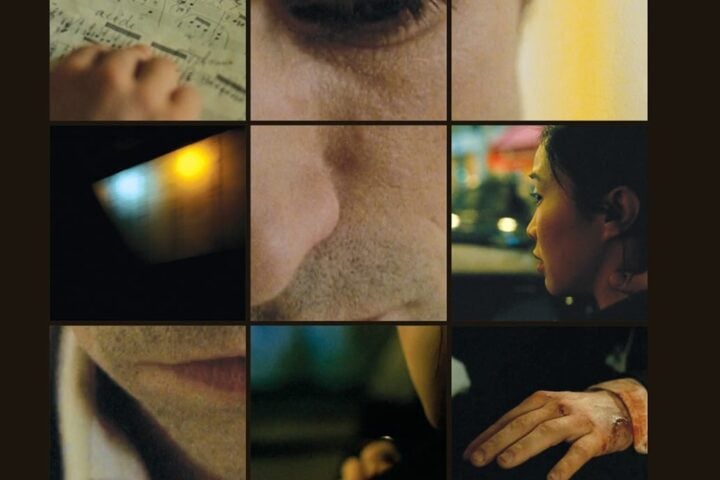
Jacques Audiard’s Paris, 13th District illustrates French cinema’s gravitational pull toward ambiguity and stories about instability, namely in matters of love. Specifically, love’s tendency to slip away from monogamy. More times than not, a person’s inability to stick to one lover forces them to confront the existential questions of life rather than indulge the hyperbolic feelings of betrayal that are often at the center of similarly themed American films.
In Paris, 13th District, then, the comings and goings of desire are dictated by pleasures in the present, not fantasies of a future of marriage and emotional exclusivity. Here, sexual-emotional connection springs from nowhere and quickly morphs into something unwieldy, and without all-or-nothing traumatic repercussions. Lovers try to learn from love’s failures instead of disavowing it for its inability to operate seamlessly. At least for a little while.
Émilie (Lucie Zhang) posts an advert looking for a female roommate. So when Camille (Makita Samba) shows up to look at the apartment, she tries to send him away because he’s a man. It doesn’t take long for Camille to change Émilie’s mind, as they bond over their shared quirks and erudition. He’s a teacher who reads Rousseau’s Confessions late at night for fun whenever he isn’t preparing his PhD thesis, while Émilie is a graduate of the internationally acclaimed Sciences Po, though she seems to do nothing these days but pig out on junk food, wrap plastic wrap around her stomach to lose weight, and mail raw meat to guys who annoy her.
What starts out as a refusal turns into a memorable night of boozing and great sex. Camille is allowed to move in, and while Émilie wants to keep the affair going, Camille just wants his own space. You can almost see him thinking, “Wasn’t she just looking for a roommate?”
These are people who take MDMA with the same gusto, and the same ease, as they read Enlightenment thinkers, and there’s much pleasure to be had from watching their communion of the cerebral and the sensuous, in them so unabashedly performing their commitment to joie de vivre. But Paris, 13th District isn’t interested in being just that kind of film.

Adapted by Audiard, Léa Mysius, and Céline Sciamma from a series of stories by American cartoonist Adrian Tomine, the film also features a parallel, and eventually intersecting, storyline of 33-year-old Nora (Noémie Merlant), whose plans for going back to school to study law get derailed when her classmates confuse her with popular camgirl Amber Sweet (Jehnny Beth). Although the Nora character is supposed to create the third element for a love triangle to emerge, the makings of that entanglement are established from the very beginning of the film by Camille’s lack of investment in Émilie beyond an occasional sexual partner.
In short, Nora’s plotline feels almost completely extraneous. Paris, 13th District is stronger when it’s in the realm of lovers rejecting puritanism and mastering the art of calibrating carnal enjoyment with intellectual curiosity in one fell swoop. But once the film digresses from that focus, you begin to sense a desperation in almost every aspect of the frame.
For one, the black-and-white cinematography starts to feel like it’s trying to impart the gravitas that the film initially resists. Also, split-screen sequences punctuate Paris, 13th District in cumbersome ways. This visual trick tends to appear when Émilie’s sister (Geneviève Doang) rings or texts her, pleading for her to call their dying grandmother. All of which amounts to a botched, and mawkish, strategy to retrofit emotional baggage onto the character.
Masters of the depiction of heterosexuality, French-style, such as Eric Rohmer or Philippe Garrel, are known to focus on the lovers themselves, chronicling them as archetypes of a domesticity bound to fail, but having its last orgasmic hurrahs in the meantime, unworried about what comes after the orgy, or the umpteenth glass of wine. These sorts of chronicles are often sustained by a mixture of exquisite dialogue, bordering on pretentiousness, and the barebones simplicity of everyday situations, both of which are absent in Paris, 13th District. Instead of such riches, the filmmakers favor the sorts of narrative shenanigans that may have worked in the graphic novel format but only work to neuter the power of their film.
The camgirl scenario specifically reads like a boomer’s idea of how young lovers deal with feelings and technology these days, or a misguided attempt to appeal to a younger demographic. There’s no reason to believe that the film isn’t set in the present, but when Émilie’s co-workers tell her about this thing called a dating app, it’s as if she’s a stranger to technology. Camille also finds it depressing that someone would resort to such a shortcut for finding sex and love. Indeed, with Paris at their feet, the idea of an algorithmic facilitator of encounters is nothing short of an indecent proposition, cinematic or otherwise.
Since 2001, we've brought you uncompromising, candid takes on the world of film, music, television, video games, theater, and more. Independently owned and operated publications like Slant have been hit hard in recent years, but we’re committed to keeping our content free and accessible—meaning no paywalls or fees.
If you like what we do, please consider subscribing to our Patreon or making a donation.