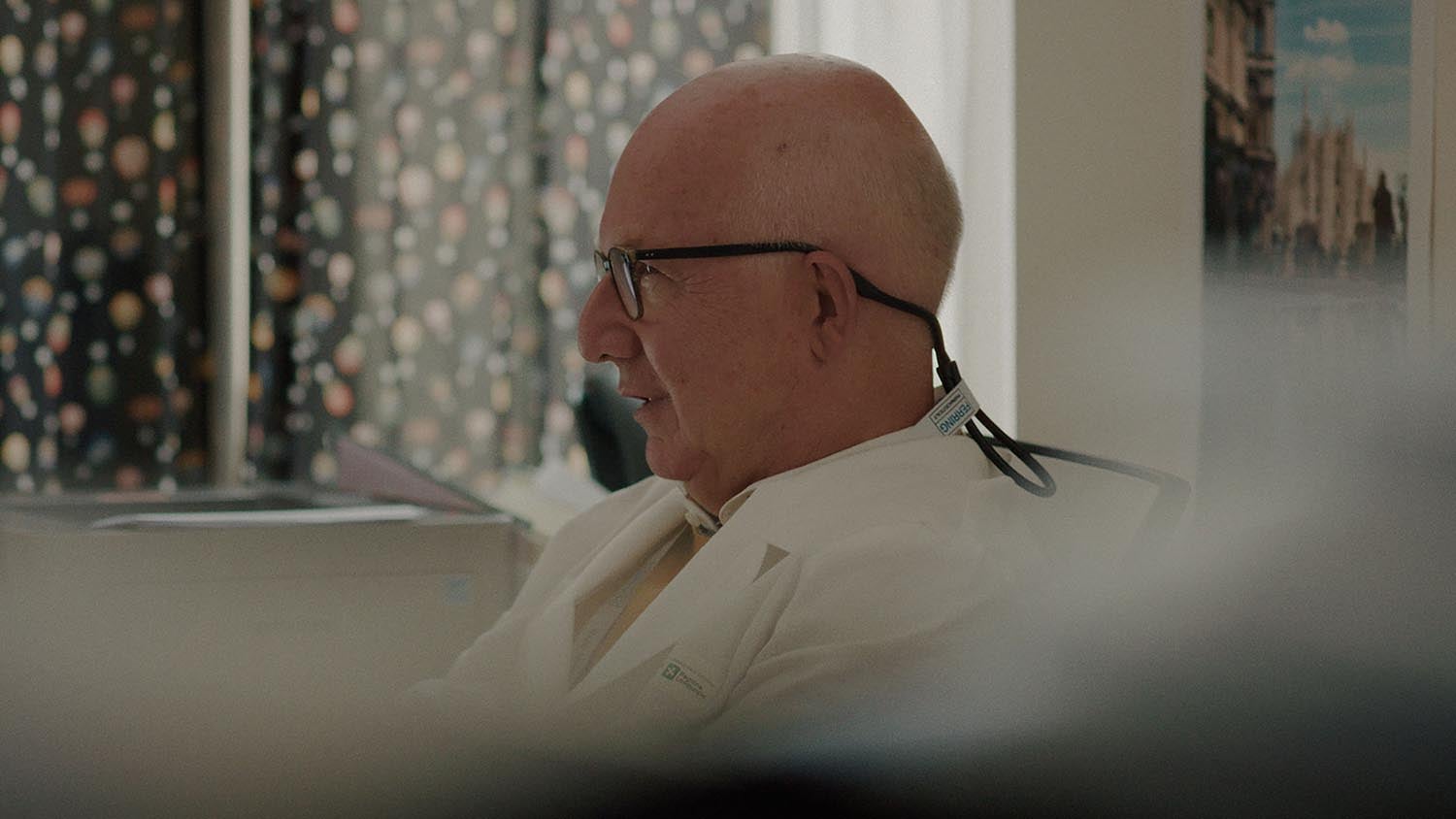
From a respectable and intimate distance, Gianluca Matarrese’s GEN_ grants us access to a diverse group of patients, many of them transgender, at Niguarda Hospital in Milan under the care of Dr. Maurizio Bini. As a population that lives on the outskirts of heteronormativity, trans people are constantly negotiating the thin line between visibility and invisibility. As if to mirror this balancing act, Matarrese’s camera never gawks or prods, positioning us as curious observers to the conversations between Dr. Bini and his patients.
Among those patients are aspiring parents undergoing in vitro fertilization and individuals seeking gender-affirming care, and at a time in Italy when anti-trans legislation and rhetoric is ever-intensifying. Dr. Bini doles out the kind of care that goes beyond the call of straightforward medical practice. “You are a more beautiful person than you think,” he tenderly tells a non-binary patient who’s dealing with crippling self-doubt and a fear of familial rejection. For many of these patients, it’s clear that they’ve never been told by an authority figure that they’re normal and deserving of the same dignified care as their cisgendered peers.
GEN_ is movingly premised on the responsibility of witness, and through Dr. Bini’s consultations with his patients, the film seeks to demystify gender care. Its title is derived from the Greek and Latin root for gender, which can mean “produced,” or “birth” or “born.” Perhaps more importantly, “gen” is a combining form, employed for compound words. With the title of the film alone, then, Matarrese announces his intent to present transness as natural, yet elusive in definition—an identity existing beyond the realm of what we previously thought possible.
GEN_ profiles Dr. Bini, an amiable and funny middle-aged man with sparse white hair and round frames, as he goes about his work, occasionally offering glimpses of him devoting time to his hobby of mushroom foraging, which he compares to the complexity of human reproduction. In a way that recalls Frederic Wiseman’s fly-on-the-wall approach to documentation, Matarrese humanizes his subjects by simply letting us see the day-to-day operations of a clinic with progressive ideals. Within Bini’s office, patients don’t experience judgment or scrutiny, as Dr. Bini is a fount of honest intentions, even when he’s indulging a little dishonesty.
In an early exchange, Dr. Bini delicately speaks to a trans man about his pregnancy options—a compassionate conversation that reveals the doctor’s implicit understanding of queer gender dynamics. In other visits, he consults with trans femmes interested in bottom surgery while also recommending legal help, sometimes even offering to take the heat for deliberately ignoring Italian law surrounding age limits on certain medications. As if these dialogues weren’t enough to reveal the breadth of Dr. Bini’s knowledge and compassion, he’s also seen speaking Mandarin to a Chinese couple and Arabic to an Egyptian trans masc prisoner.
Elsewhere, we hear him explaining to a colleague over the phone why he’s writing an op-ed lambasting the Italian government for its hypocrisy in providing sanctuary for Ukrainian embryos but not those from Gaza. Through all these interactions, as he affirms his patients’ gender identities, Dr. Bini comes across as a miracle of love. His frequently teasing humor elicits the kind of joy that, given how tinged it is with sadness, his patients clearly rarely experience. With another patient, a trans man interested in surgery, he helps to lay the groundwork toward mutual understanding between the patient and his adopted parents.
Though Italy’s laws around gender-affirming care are more or less fair by comparison to those of other western countries, public anti-trans rhetoric is, as in America, at a fever pitch. In between several glimpses into the good doctor’s consultations, Matarrese clues us into this frightening context. The film begins with imbricated voices across the ideological spectrum debating queer rights over images of space and the moon, perhaps suggesting that discovery of the unknown, in all its forms, will always elicit regressive opinions borne out of fear.
When, later, Dr. Bini is seen driving to his clinic, he listens on the radio to an Italian politician raving mad about the so-called dangers of transness. What’s there to do in the face of virulent hate? As Matarrese shows us through Dr. Bini, it may be that all we can do is to show up for our neighbors and offer the care they need. “I’m the black sheep of the family,” says one trans woman interested in bottom surgery. “No,” Dr. Bini replies, “you’re a black swan.”
Since 2001, we've brought you uncompromising, candid takes on the world of film, music, television, video games, theater, and more. Independently owned and operated publications like Slant have been hit hard in recent years, but we’re committed to keeping our content free and accessible—meaning no paywalls or fees.
If you like what we do, please consider subscribing to our Patreon or making a donation.