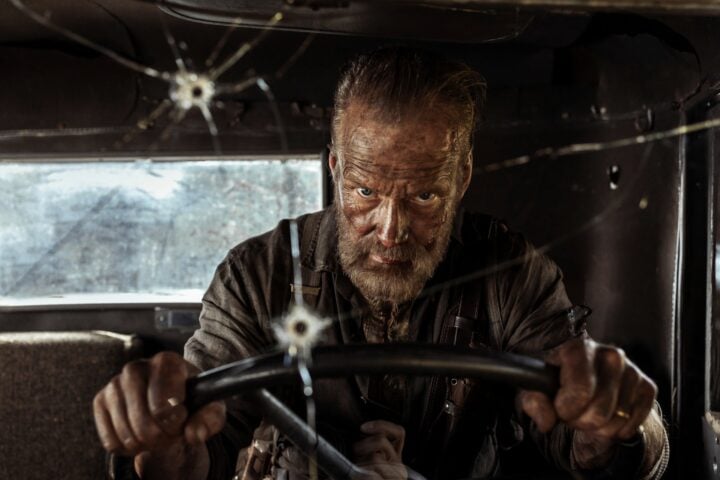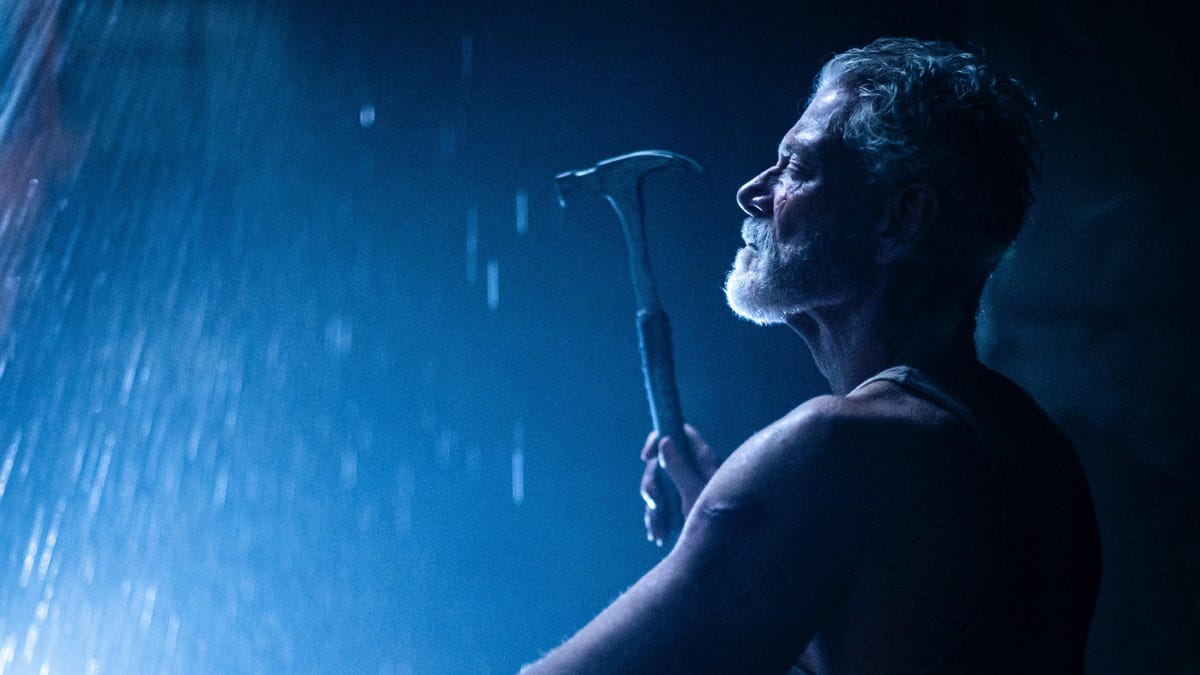
Rodo Sayagues’s Don’t Breathe 2 opens with a seemingly imperiled young girl (Madelyn Grace) frantically running through a forest. She eventually hops a fence to narrowly avoid the clutches of a vicious dog before grabbing a pistol out of the front seat of a nearby truck, only to be grasped from behind by Norman (Stephen Lang), the blind antagonist of Fede Alvarez’s Don’t Breathe. Is she another kidnapping victim of the deranged veteran, or perhaps the result of a forced impregnation in the intervening years since the end of the first film? Sayagues answers these questions in due time, but for now, we simply know the girl as Phoenix—the supposedly widowed man’s daughter (or so she thinks) who spends most of her days in survival training, and made forever fearful of the outside world.
When a gang of goons tread upon the pair’s rundown Detroit home, it appears as if we’re going to get a simple retread of Don’t Breathe, wherein intruders are once again ground into mincemeat by the impossibly proficient Norman, only now with a young sidekick in tow. And for a while, the film delivers similarly choreographed set pieces, including one involving some particularly creative uses of a variety of garden tools, if slightly lacking in the claustrophobic tension that Alvarez so consistently and effectively whipped up in the first film.
That Norman is initially presented as both warranted in his paranoia and an effective guardian of Phoenix is certain to irk many viewers, given the loathsome acts he perpetrated in the prior film. But as Don’t Breathe 2 unfolds, revealing the identity and goals of the gang’s leader, Raylan (Brendan Sexton III), both he and Norman are alternately presented in equally damning lights, with Phoenix essentially a pawn in the endgame of two equally damaged men.
In the film’s second half, where it opens up to the world outside Norman’s booby-trapped home base, Sayagues takes things in some rather surprising directions, most notably veering from pure white-knuckle tension toward a more distinctive dark humor that’s suitable given the preposterous turns that the story takes. In the stretches where Norman is, perhaps misguidedly, allowed to rise to the status of hero, the film undercuts this notion by amplifying the campier aspects of the blind vigilante, stretching believability past the breaking point as if to suggest that he’s so inhuman as to be beyond any redemption except, perhaps, God’s.
Don’t Breathe 2’s gore, from hacked limbs to gouged eyes, is presented with an increasing sense of playfulness, just as likely to invoke fear as to serve as a killer punchline to one of Sayagues’s set pieces. A disloyal dog and a well-timed blown kiss even further upend the disturbing nature of some of the film’s narrative twists, inviting laughter more than disgust once the story, as in Don’t Breathe, enters the morally dubious realm of exploitation horror. In the end, this sequel may not be as relentlessly pulse-pounding as its predecessor, but it’s some kind of mercy that Sayagues doesn’t settle for blindly following in Alvarez’s footsteps.
Since 2001, we've brought you uncompromising, candid takes on the world of film, music, television, video games, theater, and more. Independently owned and operated publications like Slant have been hit hard in recent years, but we’re committed to keeping our content free and accessible—meaning no paywalls or fees.
If you like what we do, please consider subscribing to our Patreon or making a donation.