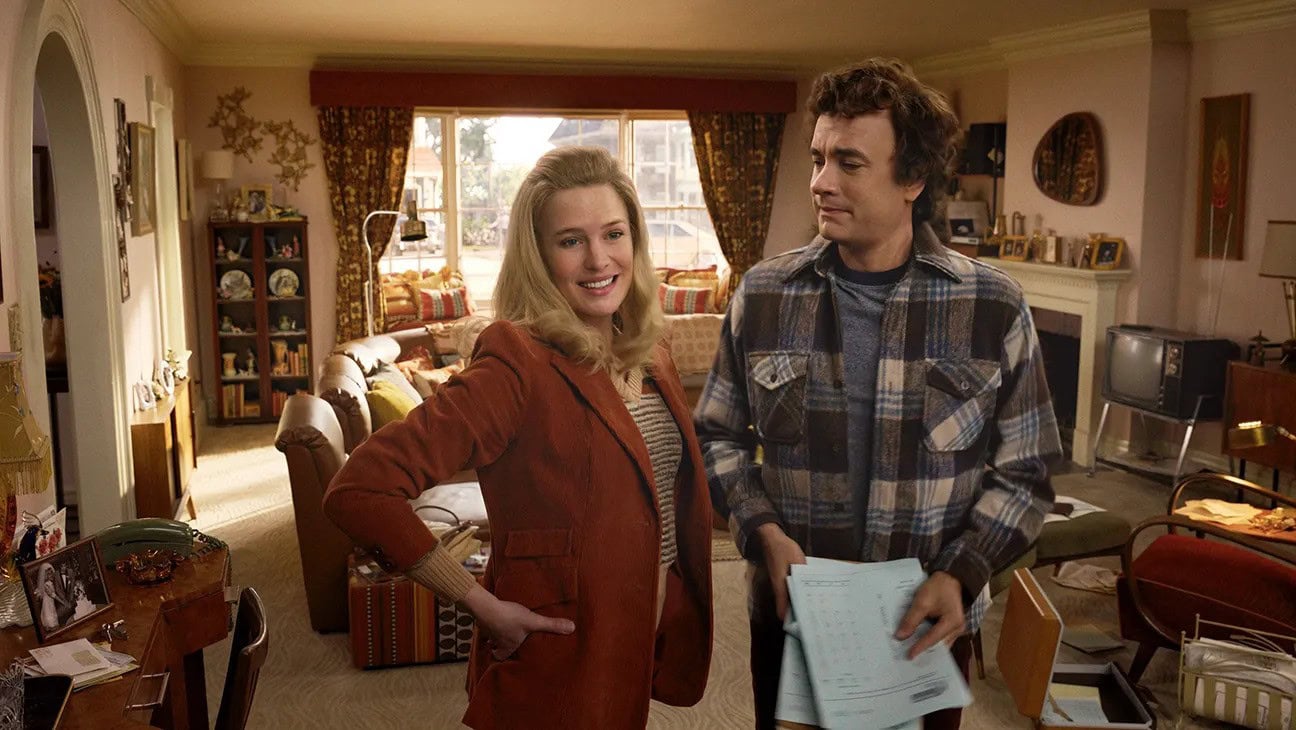
As Forrest Gump marks its 30th anniversary, Here finds director Robert Zemeckis reteaming with that film’s screenwriter, Eric Roth, and two stars, Tom Hanks and Robin Wright, for an adaptation of Richard McGuire’s 2014 graphic novel of the same name. This film turns out to be a fitting companion piece to Zemeckis’s divisive 1994 best picture winner, as it sees him once again applying boomer nostalgia to a unique, albeit woefully misguided, VFX-aided odyssey through mid-20th-century America.
With their script, Zemeckis and Roth seek to lend an air of cosmic grandeur to their tale of suburban triumphs and woes. The action stretches back to the age of the dinosaurs, and it catches up to contemporary times, but for all of the film’s bobbing and weaving through various time periods, it doesn’t take long to figure out that the only era that the filmmakers actually care about is the one focusing on Hanks’s Richard, primarily in the 1950s, ’60s, and ’70s.
Adopting the compositional conventions of the graphic novel, Zemeckis’s film is composed—apart from one exception at the end—of static shots of the same patch of land in what eventually becomes a small town in New England. From this single, unmoving perspective, we witness everything from the extinction of the dinosaurs, to Benjamin Franklin’s illegitimate son, William (Daniel Betts), whining about his father, to the horny creator (David Fynn) of the La-Z-Boy futzing about the living room with his even hornier wife (Ophelia Lovibond).
Throughout Here, Zemeckis employs an array of visual tricks as it bounces between time periods, most significantly a small rectangular frame that appears on screen and reveals a different time period within it before the entire film frame dissolves into that era. It’s a clever means of tracing the centuries of history—the loves won and lost, the technological developments, the changing fashion trends, and more—that have unfolded here.
There’s plenty of aesthetic and conceptual juice to be squeezed from such a premise, but Here is undone by its own ambition, particularly by its editing, which, in hopping around time, flattens out all the drama and makes the film about as exciting as watching home videos of families you barely know. Much of Here takes place when the central home is owned by Al (Paul Bettany) and Rose (Kelly Reilly), whose son, Richard (played by three different actors as a child before a creepy, A.I.-de-aged, then aged, Hanks plays him from a teenager to a senior), eventually inherits the house with his eventual wife, Margaret. Yet, even these lengthier stretches of the film are bereft of any specificity or genuine emotional or psychological complexity.
We see glimpses of Al’s alcoholism getting worse and Richard’s early artistic ambitions dwindling as his economic worries over his growing family intensify. There are weddings and birthdays, fights and celebrations, but they rarely carry any substantial weight due to the scattershot nature of their presentation. Here is all moments, some small and many big, but it’s lacking in gravitas, concerned as it is with tugging at our heartstrings by serving up little more than signifiers that we can project their own memories or personal baggage into.
The film also annoyingly includes obvious historical time markers in numerous scenes, including the radio announcement of the bombing of Pearl Harbor, the Beatles’s appearance on The Ed Sullivan Show, and a discussion of the suffragette movement. In a scene that’s particularly pandering and self-important—a combination which sums up much of Here—a Black father (Nicholas Pinnock) sits down to tell his son (Cache Vanderpuye) about the proper way to act whenever he gets pulled over by the police. That we never even learn the characters’ names or anything about them makes their use as props that much more egregious.
Here’s collagistic presentation is all in service of the idea that “time flies,” as Margaret says at one point. Indeed, years frequently pass in the blink of an eye. But the film itself is plodding and lifeless, its aspiration to make grand statements on the nature of existence and American life in the 20th century effectively undercut every step of the way by its fragmented and maudlin, broad-stroke presentation. It’s so desperate to be understood as universally relatable that it ultimately feels as fake and over-manicured as the A.I. tech used on its actors.
Since 2001, we've brought you uncompromising, candid takes on the world of film, music, television, video games, theater, and more. Independently owned and operated publications like Slant have been hit hard in recent years, but we’re committed to keeping our content free and accessible—meaning no paywalls or fees.
If you like what we do, please consider subscribing to our Patreon or making a donation.